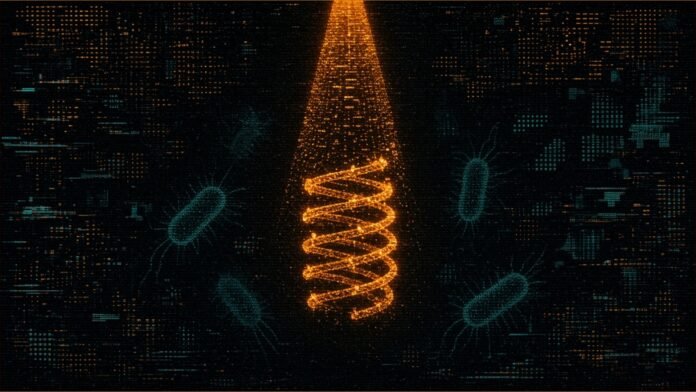
Google DeepMind says researchers using its Antigravity platform, working with an AI agent, have found a previously uncharacterised protein that could act as a new antibiotic-like molecule. The result is a computational lead only. No laboratory results have been published, and DeepMind says the candidate “still requires wet lab validation.”
The work is described in a Google DeepMind blog post published on 15 October 2026 by Pengfei Tian, Maxwell L. Bileschi, Zoi Tsangalidou, Sukhdeep Singh and Lucy J. Colwell.
What was found
The candidate is a bacteriocin, a small protein that bacteria make to kill competing bacteria. DeepMind identifies it by its UniProt ID, A0A0U0D591, and says it has “a length of 97 amino acids from the Lactococcin 972 family.” It comes from the bacterium Streptococcus pseudopneumoniae.
DeepMind says the candidate “has predicted activity against the pathogens involved in respiratory tract infections.” That activity is a prediction, not a measurement. “The lead identified here is now undergoing wet-lab validation,” the post says, along with several other candidates found through the same process.
Why antimicrobial peptides
DeepMind points to rising antimicrobial resistance, when bacteria evolve to survive the drugs used against them. It says resistance could result in “an estimated 10 million annual deaths globally by 2050”; the post does not name the source of that estimate.
Antimicrobial peptides, and bacteriocins in particular, are seen as a promising alternative to traditional antibiotics because they “have naturally evolved to target fundamental vulnerabilities in competing bacteria,” which makes it hard for pathogens to develop resistance, according to DeepMind.
Many such proteins are hidden in what DeepMind calls the unannotated “dark matter” of protein databases. UniProt, the leading public database of protein sequences, holds millions of entries whose function is unknown because they do not resemble known proteins.
How the agent worked
Google describes Antigravity as its agentic development platform. DeepMind says it “provides an agentic science workbench” that lets biologists find and rank promising targets in a single session. The search relies on ProtNLM, “a model that predicts biological function from amino acid sequences,” which Google built to label millions of unnamed UniProt entries.
According to the post, the researcher set the goal and steered the strategy, while the agent did the database work. The steps were:
- Filtering. The agent narrowed millions of entries to a handful of candidates.
- Checking novelty. It compared the candidate against curated proteins in Swiss-Prot using the EMBL-EBI BLAST service and found “no meaningful sequence homolog” among manually reviewed proteins.
- Looking at structure. It pulled a predicted 3D model from the AlphaFold Protein Structure Database. DeepMind says the fold closely matches an experimentally determined bacteriocin, supporting ProtNLM’s prediction.
- Reading the genome around it. The gene sits just ahead of genes for a transporter system and another bacteriocin, which DeepMind calls “strong contextual evidence” that it belongs to a working bacteriocin system.
- Proposing a mechanism. From the scientific literature, the agent suggested the molecule may target bacterial cell division and could act against several drug-resistant pathogens.
- Writing a lab plan. Finally, it drafted an experimental protocol covering protein expression, susceptibility testing and toxicity tests.
The mechanism and the range of pathogens are hypotheses the agent drew from existing research. They have not been tested.
DeepMind is also introducing a Biomolecular Structure Viewer inside Antigravity, a 3D tool that the researcher and agent share. A researcher can mark a region of a protein and ask the agent about it directly.
Why it matters
DeepMind’s main claim is about speed and convenience: turning “days of fragmented database triage into a single collaborative session.” Because lab work is expensive, narrowing the search to the strongest leads before testing matters, the post argues.
What’s still unknown
Whether the peptide actually kills bacteria, how potent it is, and whether it is safe for human cells are all unanswered until lab results come back. DeepMind has not said when it will publish them or how many other candidates are being tested.
What to watch
Watch for the wet-lab results, and for whether other research groups use Antigravity to search for candidates against other priority pathogens.
What this means
- A lead, not a drug. The candidate is computational and still needs lab validation.
- Agent plus scientist. The researcher steered; the agent did the cross-database work.
- Results pending. Several candidates are now in wet-lab testing, DeepMind says.
Sources
Related stories
- Google’s Antigravity Launch: The End of Coding As We Know It
- Google Research Makes Deep Review Public, an AI Agent That Checks Technical Documents
Follow @tsnmediahub on X for breaking AI news as it happens.
Follow on X