“Pathology has historically told us what a tumor looks like,” said Tanishq Mathew Abraham, chief executive of Sophont. “Holon-S1 goes beyond this and tells us what the tumor is doing and where it may be vulnerable.”
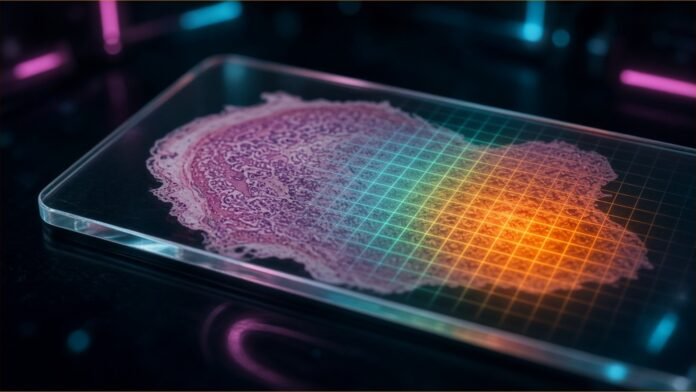
The start-up’s new model, announced on Tuesday, works from the most ordinary material in cancer care: tissue slides stained with haematoxylin and eosin, the routine pink-and-purple preparations pathologists examine every day. From those images it predicts which genes and biological pathways are active, and where in the tissue. Measuring that directly takes specialised molecular testing, so a reliable estimate from existing slides would let researchers look at far more samples. For now that is a research proposition: Holon-S1 is available for research use only, and its results so far come from Sophont’s own retrospective work.
The company’s case rests on old data
Sophont’s technical report describes tests across 16 organ types and more than 15 slide scanners, on both formalin-fixed and fresh-frozen tissue. The company says Holon-S1 outperformed two other state-of-the-art models released this year; the report names its comparators as Path2Space and DeepSpot-M.
Two examples carry the pitch. In one, the model was run on 14 publicly shared slides from a patient with osteosarcoma, a bone cancer, and Sophont says it “recovered several insights originally obtained through months of extensive molecular testing”, including activity of the protein FAP. “The model had not been trained on osteosarcoma,” the company noted. In the other, a biomarker built from Holon-S1’s predictions of the gene EREG in triple-negative breast cancer “was associated with response to chemotherapy before surgery in discovery and separate held-out cohorts”, according to Sophont.
Diagnosis is not on offer yet
The company is explicit about the limits. “Holon-S1 is currently available for research use only. Sophont is designing further retrospective and prospective studies to evaluate potential diagnostic use,” the release says, and its product page describes the cases as “potential research uses, not validated clinical decisions”. An association with chemotherapy response in past cohorts is also a long way from a test that should change a patient’s treatment, which would need prospective trials and regulatory approval.
Sophont, founded in February 2025 by Abraham and Paul Scotti, has raised $9.22 million to date and has previously released open medical models including OpenMidnight. Investor interest in AI pathology is real: Agilent agreed this month to buy Proscia, an AI digital pathology company, for $240 million plus up to $30 million in milestones.
Whether Holon-S1’s numbers survive outside testing is the question even a supportive voice in Sophont’s own announcement left open. Jorge Reis-Filho of Foresite Labs said: “I look forward to seeing rigorous, independent evaluations of Holon-S1 against other leading foundation models on biologically and clinically relevant benchmarks.”
Related stories
Sources
- Sophont via PR Newswire: Sophont launches Holon-S1 to reveal tumor biology from routine pathology slides, 20 October 2026
- Sophont: Holon-S1 technical report
- Sophont: Holon-S1 product page
Follow @tsnmediahub on X for breaking AI news as it happens.
Follow on X