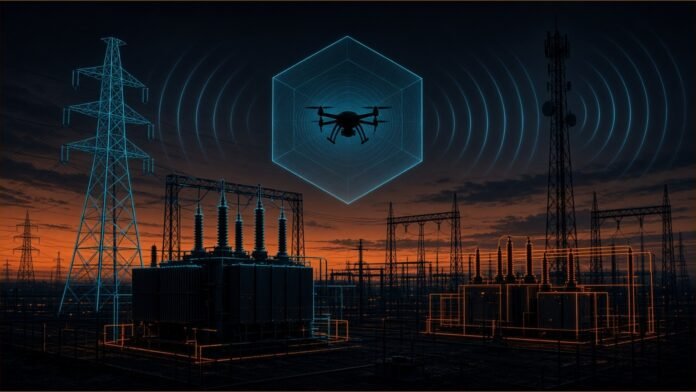
At a former flight-test base at Brétigny-sur-Orge, south of Paris, French evaluators have spent the summer putting drone jammers and interceptor drones through their paces. The buyers they have in mind are not only armies and police forces but power companies and railways.
Across Europe, governments are starting to hand operators of critical infrastructure powers that used to belong to the military, according to a Reuters investigation republished by The Straits Times. The concern is that a cheap drone, or a wider campaign of hybrid attacks, could knock out power to millions of people. Reuters, which spoke to more than 30 executives, officials and drone experts, found that the technology to detect and down drones “is maturing faster than the rules on who may use it”.
“It is a theoretical, and increasingly a practical, possibility that there could be heating outages this winter due to hybrid attacks,” Kristian Ruby, secretary general of the European electricity industry body Eurelectric, told the agency.
France has gone furthest on paper
France’s parliament passed a law in August that lets approved operators of critical infrastructure, and their contractors, detect, jam and shoot down drones near designated facilities. It followed a run of incursions over sensitive sites, including the Ile Longue nuclear submarine base near Brest in December 2025. A senior French official told Reuters that France wants a newly expanded list of vital sites equipped by 2027. “We were defenceless in the face of the (drone) threat,” the official said.
The plan is to give operators such as the state-owned utility EDF and the railway company SNCF a catalogue of approved kit, from electronic jammers to interceptor drones, to suit different sites. Systematic Paris-Region, which runs the government’s test programme at Brétigny, said its evaluations had so far catalogued three systems integrators and 17 counter-drone systems, and that work was under way to speed up buying from among them. EDF and SNCF declined to comment.
Other countries are at different stages:
| Country | Position, as Reuters reports it |
|---|---|
| France | August law lets approved operators detect, jam and shoot down drones near designated sites |
| Germany | Counter-drone work stays with police; interior ministry reviewing how operators could be involved |
| Austria | September plan to give similar powers to operators, including large energy firms |
| Poland | Designated operator security units may destroy, disable or take control of drones in restricted zones |
| Finland | Grid operator Fingrid wants the job left to authorities and the armed forces |
Who pays when a drone comes down is unclear
The hardest question is not technical. Bringing down a drone can injure people or damage property on the ground, and Reuters found legal uncertainty over who may even order a response. Two sources at energy transmission companies on NATO’s eastern flank told Reuters that effective intervention still needs more assurances, and perhaps a court precedent, on liability for collateral damage. Without that, they said, operators may hold back from acting at all.
It would be a cultural shift as well as a legal one. Utilities have spent years hardening networks and planning how to restore service rather than how to stop attacks. E.ON chief executive Leonhard Birnbaum said in September that operators must assume some attacks will succeed; his company runs about 2,720 substations in Germany. Some utilities would rather not take on the role. Fingrid’s chief executive, Asta Sihvonen-Punkka, said handing such powers to grid operators would be “a very, very big change” needing careful legal thought, and Fortum’s security chief, Jari Stenius, said he was content to leave security to police and the military.
That legal grey area is also slowing the technology. Counter-drone systems combine sensors, command software and countermeasures into a chain meant to respond within seconds, and several companies told Reuters that uncertainty over who may authorise a response has held back investment in the last steps of that chain. France is trying to automate as much as possible, the French official said, so that a utility’s security staff could eventually launch a response at the press of a button rather than station trained specialists at every site. State buyers are not waiting for that debate: the US Department of Homeland Security has ordered a counter-drone system from OpenWorks, and Germany’s military procurement office has signed for interceptor drones that capture targets in nets.
Rheinmetall told Reuters that the biggest hurdle for civilian operators is often the gap between spotting a drone and deciding whether to act, because legal responsibilities remain fragmented. It is already running site surveys for infrastructure operators and expects what it called a “very fast-growing” market, which will probably grow only as fast as Europe’s lawmakers settle who presses the button.
Related stories
- OpenWorks Wins DHS Order for Its Vision Pace Counter-Drone System
- Germany Signs Net-Firing Interceptor Drone Deal; Report Puts It Above €1.1bn
Sources
Follow @tsnmediahub on X for breaking AI news as it happens.
Follow on X