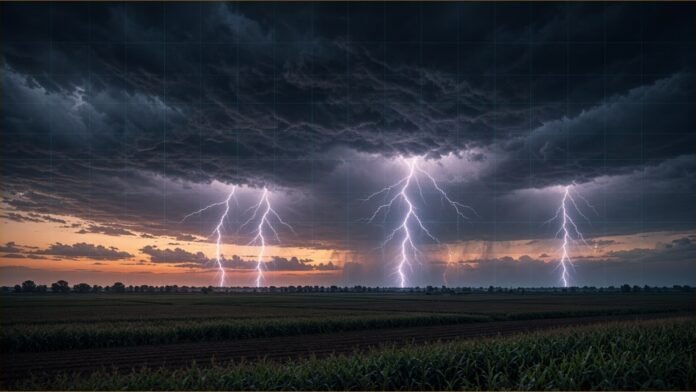
Vaisala Xweather says it will use NVIDIA’s AI weather models to extend lightning forecasts from one hour of lead time to three, in a collaboration it announced on 21 October during NVIDIA’s GTC Berlin conference.
The first use case pairs NVIDIA’s StormScope model with Vaisala Xweather’s own lightning detection data. Vaisala has not published accuracy figures for the longer forecasts, nor a launch date or the regions where they will be offered.
“High-impact weather doesn’t wait, and every extra minute of warning matters,” said Samuli Hänninen, Executive Vice President of Vaisala Xweather. “By combining NVIDIA Earth-2 models and AI tools with Vaisala Xweather’s observations and domain expertise, we can turn advanced models into earlier, more actionable warnings.”
Vaisala Says Two Extra Hours Would Help Airports, Ports and Wind Farms
Vaisala calls lightning “one of the fastest forming and most disruptive weather hazards”. The company lists national weather services, government agencies, aviation, energy, maritime, transport and insurance among the sectors that would benefit.
“Two additional hours of warning can be the difference between reacting and preparing,” the release says. Vaisala gives examples: moving crews to safety, controlling operations at airports, securing ports and wind farms, and managing crowds at outdoor venues.
The company says the collaboration brings NVIDIA’s Earth-2 platform and accelerated computing into Vaisala Xweather’s observation networks, lightning data and forecasting products. It says lightning alerts are “the first step”, and that it plans to extend AI-powered warnings to other severe weather and to offer more precise high-resolution forecasts.
“AI weather models become far more powerful when grounded in real-world observations,” said Tim Carroll, Global Weather & Climate Business Manager at NVIDIA. “By building on StormScope with lightning data and a global sensor network, Vaisala Xweather can see severe weather coming hours earlier.”
NVIDIA Says Its Nowcasting Model Covers Zero to Six Hours
StormScope is part of NVIDIA’s Earth-2 weather and climate platform. On its Earth-2 page, NVIDIA says Earth-2 Nowcasting uses generative AI to predict satellite and radar imagery and “delivers high-fidelity, zero- to six-hour hazardous weather forecasts in minutes”. NVIDIA also calls it “the first AI model to outperform traditional physics-based systems in simulating storm dynamics”. That is NVIDIA’s own claim.
NVIDIA’s Earth2Studio documentation lists StormScope variants that forecast US radar data at 3km resolution in 10-minute steps, and at 6km in one-hour steps. By default they use imagery from the GOES-East weather satellite as an input.
A preprint describing Stormscope, posted to arXiv in January and not peer-reviewed, says the models were trained on satellite and radar observations over the continental United States. It reports forecasts at 10-minute and 6km resolution that are “competitive with state-of-the-art mesoscale NWP models for lead times up to 6 hours”. It says simpler extrapolation methods “degrade rapidly beyond 1-2 hours”.
Satellite-Based Models Could Reach Places Without Radar, but the Lightning Claim Is Untested in Public
The strongest case for this kind of system is reach. The preprint argues that because Stormscope relies on “globally available satellite observations”, with radar where available, it “offers a pathway to extend skillful mesoscale forecasting to oceanic regions and countries without strong operational mesoscale modeling programs”. Vaisala’s pitch is that adding its lightning network to such a model turns that reach into earlier warnings for customers “worldwide”. If the forecasts hold up, two extra hours is the kind of time the company says crews, airports and venue operators need to act.
What has been published does not yet test Vaisala’s headline claim. The preprint’s results cover clouds and precipitation, not lightning, and only over the continental US. Vaisala’s three-hour figure is a lead time, not a measure of accuracy: the release gives no hit rates, false-alarm rates or comparison with current lightning forecasts. Its description of offering “the weather industry’s most advanced lead time” is a marketing claim with no supporting data in the release. NVIDIA’s statement that its nowcasting outperforms physics-based systems is also made on a product page. Independent checks of how often a three-hour lightning warning is right will decide how much operators can rely on it.
Other AI forecasting work has published its evidence in journals, such as the MIT and Microsoft method for forecasts two to six weeks out in Nature. Google has taken an agent approach with its Earth AI geospatial reasoning system, which draws on its weather and flood models.
Vaisala Has Named No Launch Date or Accuracy Data
The release does not say when the three-hour forecasts will reach customers, which countries they will cover, or what they will cost. Last week NVIDIA also joined the European Commission’s AI in Science Enablers initiative, pledging tools and compute access to researchers. For Vaisala, the test is the first published verification of a three-hour lightning forecast.
Sources
- Vaisala, “Vaisala Xweather Collaborates with NVIDIA to Deliver AI-Powered Early Warning for High-Impact Weather”, 21 October 2026, 14:02 BST: https://www.vaisala.com/en/press-releases/2026-10/vaisala-xweather-collaborates-nvidia-deliver-ai-powered-early-warning-high-impact-weather
- NVIDIA, Earth-2 platform page: https://www.nvidia.com/en-us/high-performance-computing/earth-2/
- NVIDIA Earth2Studio documentation, StormScopeMRMS: https://nvidia.github.io/earth2studio/main/modules/generated/models/px/StormScopeMRMS/
- Pathak, J. et al., “Learning Accurate Storm-Scale Evolution from Observations”, arXiv 2601.17268, submitted 24 January 2026 (preprint): https://arxiv.org/abs/2601.17268
Related stories
- MIT and Microsoft Researchers Use Machine Learning to Improve Weather Forecasts Two to Six Weeks Out
- NVIDIA Joins the European Commission’s AI in Science Enablers Initiative
- Google Cloud Sets Next-Month Launch for Vera Rubin A5X, Scalable to 960,000 GPUs
Follow @tsnmediahub on X for breaking AI news as it happens.
Follow on X