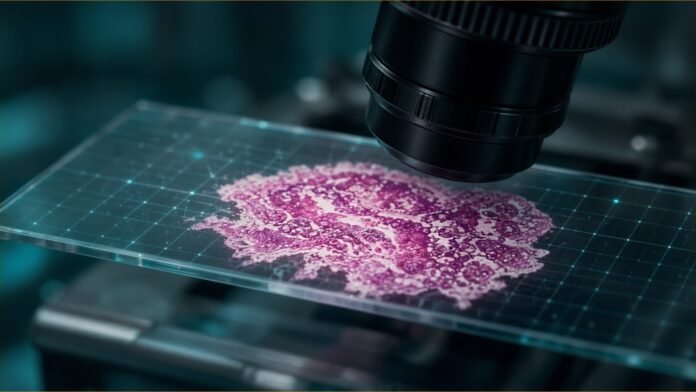
An artificial intelligence model led by researchers at King’s College London can flag a DNA-repair defect in ovarian cancer from the routine tissue slides that hospitals already make, according to a paper published in Nature Communications on 21 October.
The model, called HRDPath, predicts homologous recombination deficiency, or HRD, from images of slides stained with haematoxylin and eosin (H&E). The authors say it achieved an AUC of 0.846, a measure of how well it separates positive from negative cases, and that it needs “no additional molecular testing”. The researchers are clear that it is not yet ready for clinical use.
“We are unlocking information hidden in microscopic images of cancer tissue that could transform how we match patients to treatments,” said Dr Heba Sailem, Reader in Computational Pathology at King’s College London, in a university release. “By using AI to reveal defects in DNA repair, we could make precision cancer medicine faster, more affordable and accessible to more women with ovarian cancer, not just in the UK but around the world.”
HRD Status Helps Decide Who Gets PARP Inhibitors
According to King’s College London, HRD can arise from mutations in the BRCA1 and BRCA2 genes and makes cancers more vulnerable to platinum chemotherapy and to drugs called PARP inhibitors. The paper says PARP inhibitors significantly extend progression-free survival in patients with HRD-positive ovarian cancer.
Existing HRD tests are genomic. The paper names myChoice and FoundationOne, and says genomics-based tests are “variable, expensive, and time-consuming”. It adds that they “may be less accessible in regions of the world with limited resources”. By contrast, the authors write, H&E staining is “routinely used in clinical practice worldwide”.
The Paper Reports 0.846 AUC on One Slide and Higher Scores With Six or More
The team trained HRDPath on archived slides from patients whose HRD status was already known from genomic analysis. Its main in-house cohort, which the paper calls UWOV, covered 152 patients and 720 slides. The authors used 117 patients for training and held back 29 for testing. The model works at patient level, combining each patient’s slides into a single input. They then checked the model on two public datasets: TCGAOV, with 81 patients, and PTRC, with 93.
On the held-out test set, the paper reports up to 0.846 AUC, with 0.692 sensitivity and 0.938 specificity. In plain terms, at that setting it caught about seven in ten HRD-positive cases and correctly cleared about 94% of HRD-negative ones.
Accuracy rose when the model saw several slides from the same patient. “When six or more slides were used, accuracy exceeded 0.950 with 0.910 sensitivity and 1.000 specificity,” the authors write. That is the basis of King’s statement that the model identified “approximately 91%” of HRD-positive cases. In the abstract, the authors say that combining several slides with targeted optimisation brought both sensitivity and specificity to 0.90.
The researchers also looked at what the model was picking up. King’s College London says HRD-positive cancers had rounder nuclei and more densely packed cancer cells. The authors say the 0.846 figure is “significantly outperforming previously reported results” in high-grade serous ovarian cancer, the type that made up 145 of the 152 patients in the main cohort.
Elsewhere in pathology AI, Sophont has said its Holon-S1 model predicts tumour gene activity from routine slides, and Agilent has agreed to buy the digital pathology company Proscia.
Cheap Slides Could Widen Access, but the Evidence Is Still Small
The benefit the researchers are pointing to is practical. Most hospitals that treat ovarian cancer already produce H&E slides, and the paper’s case is that a model reading those slides could give an HRD signal where genomic testing is costly, slow or unavailable. Ovarian cancer patients often have several slides taken from different sites, and the paper shows that using more of them improves the result. That fits how pathology already works rather than asking clinics to add a new step.
The limits are just as clear in the paper itself. The held-out test set was 29 patients. The PTRC validation set included only five HRD-negative patients, which the authors flag. The labels used to train the model in the main cohort came from HRDetect, a genomic signature that the authors say “is not FDA-approved”. The single-slide sensitivity of 0.692 means about three in ten HRD-positive cases would be missed if only one slide were available. The paper also reports that HRDPath predictions “were not significantly associated” with overall survival in the main cohort, though it found differences when cohorts were combined.
The authors write that “broader validation across more diverse patient populations and balanced datasets will be necessary”, and that validation against “multiple clinical HRD assays will be important to support clinical translation”. King’s College London says further research is needed in larger patient populations. Neither source describes a regulatory submission, a prospective trial or a date for clinical use. As with Microsoft’s diagnostic AI results in Science, these are strong numbers on past cases, not proof of benefit to patients.
The Model Is Not a Cleared Test
HRDPath is a research model described in a peer-reviewed paper. It has not been cleared as a diagnostic test in the UK or elsewhere, and neither the paper nor King’s College London says when it might be. The next step the authors name is testing on larger and more varied groups of patients, with more than one clinical HRD test as the benchmark.
Sources
- Banda, K. et al., “HRDPath: an explainable multi-model deep learning architecture for predicting homologous recombination deficiency from histopathology images”, Nature Communications 17, 10870, published 21 October 2026: https://www.nature.com/articles/s41467-026-78430-y
- King’s College London, “AI model detects signs of faulty DNA repair in ovarian cancer using tissue images”, 21 October 2026, 10:00 BST: https://www.kcl.ac.uk/news/ai-model-detects-signs-of-faulty-dna-repair-in-ovarian-cancer-using-tissue-images
Related stories
- Sophont’s Holon-S1 Aims to Predict Tumour Gene Activity From Routine Slides
- Microsoft Diagnostic AI Scored 83% on Past Cases, Science Paper Says
Follow @tsnmediahub on X for breaking AI news as it happens.
Follow on X