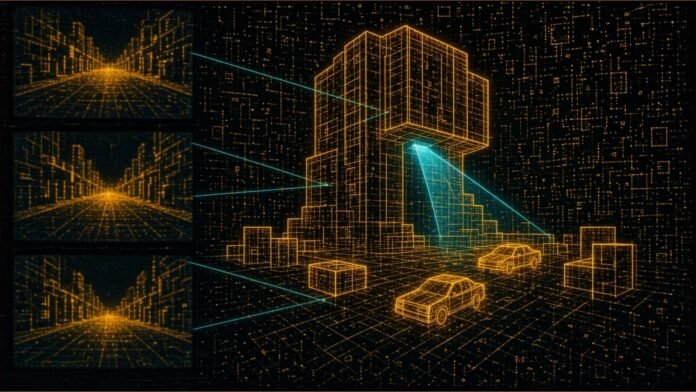
Rivian has bought Third Dimension AI, a two-year-old startup that turns real driving footage into 3D scenes that can be edited and replayed, to help train and test its self-driving software. Rivian announced the deal on 22 October and said “financial terms of the transaction are not being disclosed” (Rivian).
The deal has a British angle. Third Dimension’s 15-person team, “most of whom are based in the U.K.”, will be absorbed into Rivian’s autonomy and AI team led by James Philbin, and the purchase gives Rivian a chance to expand its AI hub in London, Philbin told TechCrunch in an exclusive interview.
In brief
- Rivian has acquired Third Dimension AI, whose software rebuilds real driving scenes in 3D so they can be varied and replayed. Terms were not disclosed.
- The 15 staff, mostly in the UK, join Rivian’s autonomy team, and Rivian may expand its London AI hub, TechCrunch reports.
- Rivian says the aim is to test rare, dangerous situations without waiting for them to happen on the road.
What Third Dimension’s software does
In Rivian’s words, Third Dimension’s platform “transforms real-world data into high-fidelity, controllable 3D environments and enables complex driving scenarios to be recreated and varied at scale”. Rivian says bringing the team in-house will let its autonomy models “simulate complex driving conditions without waiting for rare real-world edge cases to occur”. Rivian plans to use it for both its consumer driver-assistance features and its robotaxi work.
“Simulation is central to how we train and validate our autonomous driving systems,” said Philbin, Rivian’s SVP, Autonomy & AI, in the release. “This allows us to recreate challenging driving situations, vary the conditions, and improve how our systems respond.”
Philbin gave TechCrunch a more concrete picture. “For us, it’s about taking real scenarios, but making them simulatable,” he said. “These are not synthetic kind of video game styles, they’re real things that happen in the world, but now we get that extra dial of being able to move the cameras around, shift other agents, have maybe different lighting or weather conditions.” He said Rivian had “done a pretty extensive kind of evaluation of a lot of different providers” first. Kart told TechCrunch that a sim-to-real gap remains with simulators built on game engines.
The raw material comes from Rivian’s own vehicles. According to TechCrunch, the footage is drawn from tens of thousands of R1T and R1S vehicles, delivery vans and R2s whose owners have enabled external camera sharing, and is aggregated and anonymised. Philbin put the volume at “more than 400,000 sequences uploaded from its customer fleets per day”.
Who built it
Rivian names Tolga Kart and Piotr Sokolski as founders and says the company was founded in 2024. Its seed announcement in October 2024 listed a third co-founder, Özgun Pelvan. That release described a “$7M Seed financing led by Felicis, with participation from Abstract Ventures, MVP, Soma Capital, Solari Capital, and other investors” (PR Newswire). It also said the firm was “based in California” with locations in the UK and Turkey.
The founders come from both sides of the simulation business. Kart was previously VP of engineering at the synthetic data company Parallel Domain, worked on simulation for Tesla’s Autopilot and spent more than five years as a senior director on Call of Duty at Activision, the release says. Sokolski spent four years at Wayve, the London self-driving company, building “photorealistic neural simulators for self-driving cars”. In 2024 the company was pitching to customers ranging “from The U.S. Military to video game developers to autonomous vehicle companies”.
Kart told TechCrunch the team was glad to narrow its focus. “I think as a small company, having to serve many, many different masters is very hard,” he said, “and so we’re very excited to come work on a problem that has such an amount of scale, where our technology makes a true difference.”
Where it fits in Rivian’s plans
Rivian’s “Universal Hands-Free” system already works on highways, and the company plans a version that handles the whole drive on surface streets and highways, still under driver supervision, “by the end of the year”, TechCrunch reports. Rivian’s R2 robotaxis are due to appear on the Uber app in 2028. Uber is also working with Pony.ai on robotaxi trials in London and in Manchester.
The purchase adds to a run of AI moves at Rivian. Its chief executive has said AI agents from companies like Anthropic are coming to its cars, and its industrial robotics spinout Mind Robotics recently hired Doug Field as president.
Rivian is buying a way to sign off its software
The most revealing word in Rivian’s announcement is “validate”. Training data gets most of the attention in self-driving, but Philbin’s comments point to a different bottleneck: deciding when a system is safe to release. He told TechCrunch the question is “is the system good to ship?”, and that “you really want to have a good sense of this sim-to-real gap”. Kart’s statement makes the same pairing, citing both the data “needed to train autonomous systems and the validation needed to deploy them safely and reliably”.
That explains the emphasis on real footage over game-style worlds. A simulated scene is only useful for sign-off if the software behaves in it as it would on the road. Starting from recorded scenes and then changing the weather, camera angle or the movements of other road users keeps the scenario anchored to something that happened.
For the UK, the significance is in people rather than money. The deal brings a small, mostly UK-based team inside a US carmaker. Philbin’s remark about London points to more hiring, although Rivian has not said how many roles. The founders’ previous jobs, at Wayve and Parallel Domain, were in this same niche. The price is unknown, so there is no way to judge what Rivian paid for that expertise. The real test comes later, when Rivian’s supervised point-to-point system and its 2028 robotaxis show whether the simulation work has paid off.
Sources
- Rivian, “Rivian Acquires Third Dimension AI, Inc. to Accelerate Advanced Scene Simulation for Autonomous Driving Technology Development”, 22 October 2026 (also on Business Wire, 22:04 BST)
- Third Dimension AI, “Third Dimension Raises $7 Million to Build Worlds for Real Time Engines”, PR Newswire, 8 October 2024
- Kirsten Korosec, “Rivian buys world model startup to accelerate self-driving ambitions”, TechCrunch, 22 October 2026, 22:05 BST (exclusive interview; reported)
Related stories
- Rivian CEO RJ Scaringe Says AI Agents From Companies Like Anthropic Are Coming to Rivian Cars
- Rivian Spinout Mind Robotics Hires Former Ford, Apple and Tesla Engineering Chief Doug Field as President
- Pony.ai and Uber Plan Robotaxi Testing in London: What Is Planned, and What Is Not Known
Follow @tsnmediahub on X for breaking AI news as it happens.
Follow on X