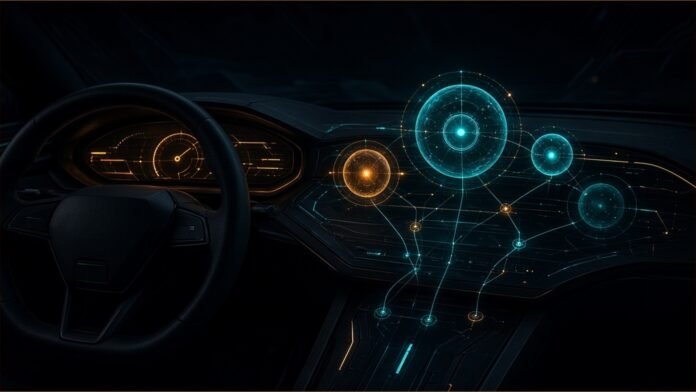
Rivian’s electric vehicles will in future be able to run AI agents built by other companies, such as Anthropic, the carmaker’s founder and chief executive RJ Scaringe said at TechCrunch Disrupt this week. “That’s where it becomes magical,” he said on stage, TechCrunch reported on 15 October 2026.
Scaringe did not say when this will happen. Rivian declined to give more details, TechCrunch reported, and pointed instead to the “AI & Autonomy Day” event it is holding in December.
What Rivian has today
Rivian recently rolled out an AI assistant that lets drivers and passengers control the car by talking to it, according to TechCrunch. The company builds its in-car software itself, rather than relying on Apple CarPlay or Android Auto, and has written many of its own apps, such as navigation.
Rivian says it has built an in-house “agentic framework” that works out what a person wants when they speak to the vehicle and sends the request to the right part of the car’s software. Most requests are everyday ones: lowering the temperature, turning on the seat heaters or summarising the news.
Scaringe described it as a router. “Think of it as like a traffic light. So if you ask the vehicle something, it decides what model it’s going to use. It can use a local model that’s running on the edge and the vehicle. If it’s a more complex question, it can go up to the cloud. And then even for that, we have different models that we use,” he said. A model “on the edge” runs on the car’s own computer rather than in a remote data centre.
Since May, the assistant has been able to use outside apps such as Google Calendar, TechCrunch reported. In its third-quarter results on 29 October, Rivian said its October over-the-air update added Gmail integration to Rivian Assistant, and that the assistant arrived on the R2 in October.
The next step: frontier AI labs
Scaringe said the next step would be to add products from the frontier AI companies, but that it will not be simple. “There’s a lot of plumbing behind the scenes we have to do to make sure that that works, and it’s not just within Rivian. That’s also a lot of coordination with the labs to make sure they enable that plumbing,” he said.
He gave an example of how it might feel to use. A driver could ask the car to turn on the ventilated seats “and then simultaneously say, ‘We were talking yesterday about this meal. I’m planning to have guests over on Friday. Can you help me think through what we’re going to make?'” The car could then draw on a conversation the driver had with an assistant on another device.
That would mean linking the car to the context that AI apps hold about their users, TechCrunch noted. Rivian has not said which AI companies it is working with beyond naming Anthropic as an example.
Agents won’t drive the car
Scaringe stressed that agents will be kept away from driving functions. Putting this kind of software near safety-critical systems means Rivian has to be extremely careful, he said. “You wouldn’t want an agent to determine, ‘hey, it’s time to apply the brakes, or time to steer the vehicle.’ So anything that’s vehicle-level controls are not being handed to an agent.”
A clear line on driving, and open questions on data
Rivian would not be the first US carmaker to do this. TechCrunch pointed out that earlier this year Tesla added a feature letting users talk to SpaceX’s Grok chatbot. What sets Scaringe’s remarks apart is the boundary he drew: agents can handle information and comfort, but not the brakes or steering. That split matters as cars become more software-driven. A chatbot that gets a recipe wrong is an annoyance; one that could act on the vehicle’s controls would be a safety risk. Keeping the two apart is the sensible design, and saying so publicly gives regulators and buyers something to hold Rivian to.
Rivian is well placed to try this because it owns its software stack. Its third-quarter shareholder letter says RivianOS 2 rebuilt the infotainment system “on an AI-defined platform” and ties features to “Rivian Unified Intelligence, our common AI foundation”. That control makes it easier to add outside agents than for a carmaker that leans on phone mirroring. It is also becoming a business: Rivian said it is licensing elements of its AI voice assistant technology to its joint venture with Volkswagen Group, without disclosing terms. Software and services revenue rose 45% to $605 million in the quarter, 59% of it tied to that joint venture.
The harder questions are about data. Pulling in “context” from a driver’s AI account means linking a car, which already knows where you go and when, to an assistant that may know your plans, contacts and conversations. Rivian has not said how users would link accounts, what would be shared with AI labs, or whether people could opt out. Those answers will decide whether the feature is a convenience or a privacy concern.
What’s still unknown
Rivian has not given a launch date, named any partner deals, or said whether the feature would cost extra or need a subscription.
Rivian’s results put its Autonomy and AI Day on 9 December. That is the next point where the company may give details on timing and which AI companies are involved. Rivian has also bought Third Dimension AI, a simulation startup, to help test its self-driving software, and covered the Volkswagen licensing in its third-quarter results. Separately, Mind Robotics, a Rivian spinout, has hired Doug Field as president. If December brings named labs and clear data rules, the agent plan becomes a product; if not, it stays a promise.
Update, 30 October 2026: This article has been updated with details from Rivian’s third-quarter results, published on 29 October, including the 9 December date for its Autonomy and AI Day and the addition of Gmail to Rivian Assistant.
Sources
- Sean O’Kane, “AI agents are coming to Rivian’s cars”, TechCrunch, 15 October 2026
- Rivian, “Rivian Releases Third Quarter 2026 Financial Results”, 29 October 2026
- Rivian, Q3 2026 shareholder letter (filed with the SEC), 29 October 2026
Get TSN’s biggest tech stories, explained.
News and insights across AI, tech, crypto and cybersecurity. Every source linked. Unsubscribe anytime.
Get the newsletterRelated stories
- Rivian Spinout Mind Robotics Hires Former Ford, Apple and Tesla Engineering Chief Doug Field as President
- Meta Launches Muse Wonder and Muse Wonder Full, Its “Most Capable Models to Date”, Built for AI Agents
Follow @tsnmediahub on X for breaking AI news as it happens.
Follow on X