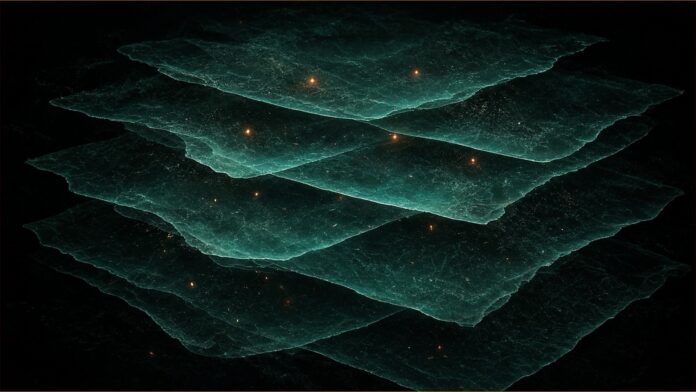
Researchers led by Linköping University in Sweden have used machine learning to find 33 MXenes, a family of 2D materials, hiding in plain sight in decades-old materials databases. The search then pointed them to new compositions, and they made 11 rare-earth MXenes that had never been produced, using a method that needs no sustained external heating.
In brief
- A Linköping-led team screened old materials databases with machine learning and found 33 reported compounds that had never been recognised as MXenes.
- Using a fast reaction that needs no sustained external heating, the team made 18 phases, 11 of them rare-earth MXenes never made before.
- The work, published in Science on 29 October, is lab-stage; the researchers say scaling up is the next hurdle.
The study, “Data-driven discovery and rapid, direct synthesis of MXenes”, was published in Science on 29 October. Its corresponding authors are Ali Saffar Shamshirgar and Johanna Rosén of Linköping’s Department of Physics, Chemistry and Biology. Coauthors work at Tallinn University of Technology in Estonia and Aalto University in Finland, and the AI side drew on Linköping computer scientists including Fredrik Heintz. Science received the paper on 28 March and accepted it on 7 September after peer review.
Finding MXenes that were already made
MXenes were first identified in 2011, according to Linköping University’s release. Basic MXenes combine a metal with carbon or nitrogen, and their key feature is structure: only a few atomic layers thick, they offer a very large surface area for their weight.
The team searched two large public databases, the Materials Project and the Open Quantum Materials Database, for compounds matching the MXene structural pattern. It combined a machine-learning classifier with a check of the scientific literature. The paper reports 56 experimentally reported materials that match multilayer MXenes, 33 of which had not been recognised as MXenes. Many were made before the term existed.
“We need to look both backwards and forwards to accelerate materials science. There’s so much information in the literature that we’re not aware of,” Rosén said in the university release. She said the researchers had informally called it the Treasure Chest Project. “The literature and databases are treasure troves – you just have to open the lid and see what’s there.”
A reaction that runs on its own heat
The second result concerns how MXenes are made. Their synthesis is challenging, as the journal’s editor’s summary notes. The team used self-propagating high-temperature synthesis: a brief ignition starts a reaction that releases its own heat, so no sustained external heating is needed. The paper says the reaction completes within minutes; the university release describes it as taking just a few seconds.
The university also says the new route needs significantly fewer hazardous chemicals and less water than earlier methods. Using it, the team made 18 phases in total. They include the known yttrium compounds Y2CF2 and Y2CCl2, a yttrium bromide version not previously recognised, and 11 rare-earth MXenes never made before, built with praseodymium, neodymium, samarium, gadolinium, terbium, holmium and thulium.
Magnetic and semiconducting on paper
The team also ran theoretical checks. According to the paper, 43 of 45 candidate compositions met its stability criteria, including all 18 that were synthesised. Most are predicted to be semiconductors with band gaps of roughly 1 to 2 electronvolts, and selected cerium and ytterbium phases are predicted to be half-metallic. Calculations point to both ferromagnetic and antiferromagnetic states, and holmium-based samples showed antiferromagnetic ordering in measurements.
The university release says rare-earth metals can make these MXenes magnetic, which broadens where they might be used. It lists water purification, energy storage, telecommunications and biomedicine as areas where MXene properties “may be suitable”. “MXenes can have a wide range of useful properties, many with potential applications in sustainability,” said Saffar Shamshirgar, the first author.
Rosén framed manufacturing as the next step. “I think it’s the scaling up that will push MXenes over the edge to actually being significantly more used in different applications,” she said. The paper itself reports laboratory synthesis and calculations only.
The work was funded mainly by the European Research Council, the Swedish Research Council, the Knut and Alice Wallenberg Foundation, the Wallenberg Initiative Materials Science for Sustainability and the Estonian Research Council, with computing time from Sweden’s national supercomputer infrastructure.
The rare-earth MXenes came from reading the record first
The most useful part of this study is its order of work. The team checked what chemists had already made before trying to make anything new, and that check changed the count of known MXenes by 33 without a single new experiment. The 11 new rare-earth MXenes then followed from patterns the search exposed, rather than from a blind trial of the periodic table.
That makes machine learning a sorting tool here, not an oracle. The classifier flagged candidates; literature review, theory and synthesis did the confirming. It is the same division of labour seen in AI-designed proteins and in physics models trained on collision data, where the software narrows the search and laboratory or detector evidence settles it. Japan’s new joint quantum and AI materials programme rests on a similar premise.
The synthesis claim deserves equal weight. A reaction that supplies its own heat, with fewer hazardous chemicals, removes two of the costs that make MXene production awkward. Like the 2nm carbon membrane reported this month, though, the evidence so far is from lab samples, and the two primaries even differ on whether the reaction takes seconds or minutes.
Sources
Primary:
– Science: Data-driven discovery and rapid, direct synthesis of MXenes, Saffar Shamshirgar et al. (29 October 2026), DOI 10.1126/science.aeh5957
– Linköping University: Hidden and forgotten 2D materials are discovered with AI (29 October 2026)
Press:
– Nanowerk: republication of the Linköping University release (29 October 2026)
Related stories
- Six Japanese Firms Start Joint Quantum and AI Materials R&D
- Carbon Membrane as Thin as 2nm Sieves CO2 Past Benchmarks in Lab Tests
- EveNet, a Physics Foundation Model, Learns From 500m Collisions
Follow @tsnmediahub on X for breaking AI news as it happens.
Follow on X