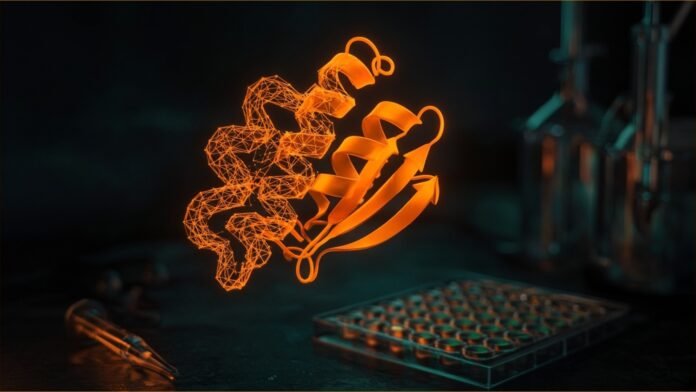
One researcher says he designed a pesticide-degrading enzyme in “just a few days” with a new AI model; his previous best had taken months. That model, RFD4-Proteina, was released on Wednesday by the University of Washington’s Institute for Protein Design (IPD) and NVIDIA. It is open source, under a BSD-3 licence, so any lab can use and build on it, according to UW Medicine’s announcement.
The headline numbers are the team’s own. “Across computational benchmarks,” UW says, the model achieves “fivefold to tenfold higher design success rates while generating protein candidates five to 10 times faster than previous models”. Those are in-silico tests, and the release cites no peer-reviewed paper; NVIDIA refers only to results in “the research draft”.
Two model families merged into one
The name gives away the lineage. RFD4-Proteina combines IPD’s RosettaFold Diffusion line with NVIDIA’s Proteina-Complexa. UW says it uses “biomolecular reasoning”: like language models that can “think” harder, it can spend more computation on difficult design problems, refining a protein’s sequence and structure together with the molecules it must interact with.
According to NVIDIA’s release, the model beat the baselines it was compared against on four benchmark suites: protein binding, small-molecule binding, enzyme scaffolding and DNA binding. UW adds that lab bench tests showed the designed proteins acted as expected, across tasks of different sizes and complexity. NVIDIA is careful to note that the model helps researchers choose candidates for the lab, “where experiments establish how a design performs”.
“RFD4-Proteina will open the door to new solutions in medicine, sustainability, materials and biotechnology,” said David Baker, IPD’s director and a 2024 Nobel laureate in chemistry, in UW’s release.
Early users report weeks turned into days
IPD scientists who have used the model say it is faster than the old tools. Besides Seth Woodbury’s enzyme, Meg Lunn-Halbert, a UW doctoral candidate, said her group could precisely control which sugars attach to proteins, something past models could not do, “in under just a week rather than months”. These are the researchers’ own accounts.
The model is already out through partners including Amazon Bio Discovery, Anthropic’s Claude Science, Benchling, Google Cloud, Hugging Face, OpenAI and Tamarind Bio, NVIDIA says. Genedata’s AI co-scientist will also use it in a protein-design workflow inside Danaher’s autonomous lab.
There is a British thread too. UW says the project was led by PhD students Nathaniel Corley, Maxwell Kazman and Rafi Brent, alongside Kieran Didi, a visiting student from the University of Oxford. Funders include the Howard Hughes Medical Institute and the Gates Foundation, and the Jen-Hsun and Lori Huang Foundation gave a computing grant.
It comes a week after TSN covered Baker’s lab using AI to design enzymes that cut specific proteins. With the weights open, outside groups can now test the five- to tenfold claims themselves.
Sources
- UW Medicine: Researchers achieve major advance in protein design, 21 October 2026
- NVIDIA: Healthcare and Life Sciences Leaders Build on NVIDIA to Advance Drug Discovery and Expand Patient Care, 21 October 2026
Related stories
- Baker Lab Uses AI to Design Enzymes That Cut Specific Proteins
- Anthropic Says Claude Designed Protein Binders Against Scorpion Neurotoxins
- OpenAI Says Its GPT-Rosalind Agents Mined a Mouse-Brain Atlas in 32 Minutes
Follow @tsnmediahub on X for breaking AI news as it happens.
Follow on X