
Our Next Energy, the Michigan battery maker also known as ONE, and Wen Acquisition Corp, a special purpose acquisition company listed on Nasdaq as WENN, have announced a definitive business combination that would take ONE public. The companies’ press release, filed with the US Securities and Exchange Commission on 16 November, and Wen’s accompanying Form 8-K, say the business combination agreement is dated 15 November. This is a signed deal, not a completed listing.
The companies put the combined group’s pro forma equity value at about $1 billion, made up of $600 million of pre-money equity plus up to $400 million of gross proceeds. That $400 million, they said, comprises $300 million of cash in trust, assuming no redemptions, and a $100 million private investment in public equity, or PIPE. Of the PIPE, they said $30 million “is committed to date” by two global strategic investors in steel and defence. A footnote to the release breaks that $30 million down: $20 million was funded in October 2026 through a Simple Agreement for Future Equity, and $10 million is pursuant to a non-binding letter of intent. The 8-K’s risk factors also warn that definitive agreements for the proposed PIPE may not be entered into, and that the PIPE may not be completed in the amount described, or at all.
Upon closing, the combined company is expected to trade on Nasdaq under the ticker ONEE. The 8-K says Wen, a Cayman Islands company, would first change its jurisdiction of incorporation to Delaware, and that after the merger the company would be named Our Next Energy Holdings, Inc., or another name the parties agree. Closing is expected in the first half of 2027, following approval by Wen’s shareholders and ONE’s stockholders and the satisfaction or waiver of other customary closing conditions, including an effective registration statement on Form S-4, expiry or termination of the waiting period under the Hart-Scott-Rodino Act, and a minimum-cash condition. The 8-K states that both boards unanimously approved the agreement. Cantor Fitzgerald is serving as exclusive capital markets advisor and sole placement agent.
What the companies claim about the business
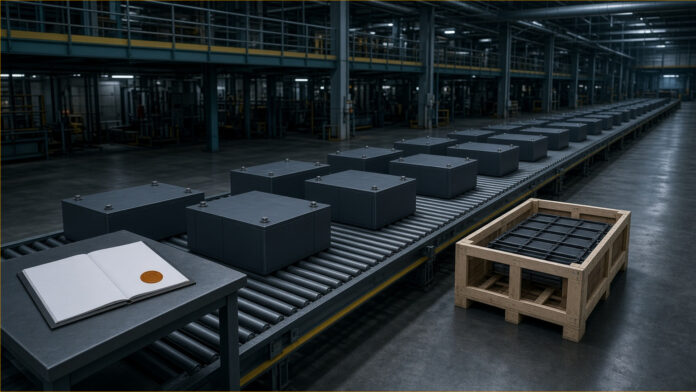
ONE describes itself as a US battery company serving defence, rail and grid customers from two Michigan factories. The release says the first, in Van Buren Township, is “America’s only source of large-format LFP cells built on domestic cell technology,” and that the second, in Novi, houses a pack line with 3 GWh of annual capacity. Those are the companies’ claims.
They also said ONE has $40 million of cumulative revenue and more than $200 million in binding multi-year contracts, including with locomotive original-equipment manufacturers serving four Class I railroads, among them Canadian National, and with five defence primes. The release adds that, as a 2026 winner of the US Army’s xTech|Disrupt Endurance competition, ONE “is eligible for follow-on government contracts without further competition.” That eligibility is stated by the companies; it is not an award of any named follow-on contract in the filing.
Mujeeb Ijaz, ONE’s founder and chief executive, said: “Over the last five years, LFP has grown from roughly 20% to 60% of the global battery market, yet China produces approximately 99% of the world’s LFP cells. We built ONE to close that gap with a secure American and allied supply chain.” The figures for China’s share of LFP cell production, and for LFP’s share of the global battery market, are his claims. He also said the combination with Wen would give the company “a public platform to scale ONE into this $40B addressable market.” The release characterises recent US measures, including the fiscal year 2026 National Defense Authorization Act and Executive Order 14421, as tightening restrictions on batteries and grid equipment tied to covered foreign entities. Those legal characterisations are the companies’ own.
TechCrunch, in a 16 November article by Tim De Chant, described an earlier near-collapse. According to that report, a Series C fundraising failed in late 2023, the company carried out layoffs, it vacated the lease for a planned $1.6 billion Michigan factory, and Ijaz was ousted as chief executive in December 2023 before returning in March 2025 after a new funding round that, TechCrunch said, his brother’s investment firm co-led. That history is TechCrunch’s account, not a finding in the SEC filing.
Other recent TSN pieces on US listing paths and battery manufacturing include Agility Robotics’ merger with Churchill Capital XI, Tesla’s $4.3 billion battery supply agreement, and Clarios’s agreement to buy Ecobat’s US battery-recycling plants. Those are neighbouring corporate stories, not this transaction.
A signed deal is not a completed listing
The filing records a board-approved agreement and a path to a Nasdaq ticker, not a completed public listing and not cash already in ONE’s account. The $1 billion pro forma equity value is the companies’ figure. Of the up to $400 million of gross proceeds used to build that figure, $300 million is cash in Wen’s trust only if there are no redemptions, and $100 million is a PIPE that is still being assembled. The $30 million described as committed to date includes a $10 million non-binding letter of intent. A letter of intent is not the same as funded capital, and the 8-K itself flags the risk that the PIPE may not close in the amount described, or at all.
The same caution applies to the operating claims. Cumulative revenue of $40 million, more than $200 million of binding contracts, the “only source” description of the Van Buren cell line, and the xTech eligibility to pursue follow-on government contracts without further competition are all stated by the companies. None of those figures is independently audited in the materials published with the announcement, and the release does not break the contract book down by customer, year or delivery date.
Closing is expected in the first half of 2027, and only if both sets of shareholders approve and the other customary conditions are met or waived. That timetable can slip, and redemptions can shrink the cash that actually arrives. Until the S-4 is effective, the votes are in, and the merger has closed, the documented event is the signing of a business combination agreement, not a completed listing of Our Next Energy on Nasdaq.
Sources
- Wen Acquisition Corp, Exhibit 99.1 to Form 8-K, “Our Next Energy to Go Public Through Business Combination with Wen Acquisition Corp”, 16 November 2026
- Wen Acquisition Corp, Form 8-K, filed 16 November 2026, agreement dated 15 November 2026
- Tim De Chant, “After dodging death, battery startup Our Next Energy is now going public,” TechCrunch, 16 November 2026
Get TSN’s biggest tech stories, explained.
News and insights across AI, tech, crypto and cybersecurity. Every source linked. Unsubscribe anytime.
Get the newsletterRelated stories
- Agility Robotics–Churchill Capital XI S-4 Declared Effective; Vote Set for 2 November is the closest recent TSN account of a US industrial company taking a SPAC path to Nasdaq, and the right next stop for that listing-mechanics file.
- Tesla’s 4.3 Billion Battery Bet: Why Elon Musk Is Buying American
- Clarios to Buy Ecobat’s US Plants Recycling 40m Batteries a Year
Follow @tsnmediahub on X for breaking AI news as it happens.
Follow on X


