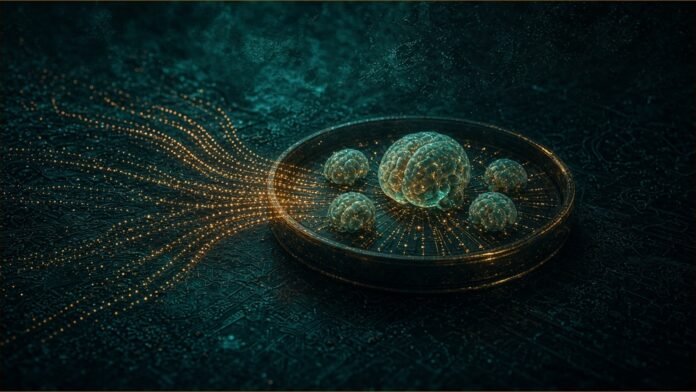
The University of Bristol announced on 16 October 2026 that researchers have shown lab-grown brain organoids can transmit signals corresponding to Braille letters — a step, the university says, toward more energy-efficient biohybrid computing. The peer-reviewed paper, Encoding tactile stimuli for Braille recognition with organoids (Liu, Philamore, Ward-Cherrier), appears the same day in Frontiers in Artificial Intelligence (open access).
What they did
The organoids are less than a millimetre across, with about 10,000 neurons plus supporting cells, placed on multielectrode arrays. Researchers applied a tactile sensor to the 26 Braille letters, converted the data into electrical stimulation patterns, and presented those patterns to the organoids. A support vector machine then classified the resulting neural activity patterns.
Results, per Bristol and the paper:
- A single organoid: letter correctly decoded about 61% of the time
- Three organoids combined: about 83%
- The three-organoid route was also more robust to added artificial noise than decoding the obscured signals directly without the organoids
Dr Benjamin Ward-Cherrier, senior author, said that after organoid processing the tactile data still contains enough information to classify Braille letters with good accuracy, and that combining several organoids improved performance.
The learning caveat — quote it plainly
First author Tianyi Liu stressed what the experiment does not show:
“We showed that tactile information could be encoded, processed through the organoids, and decoded, but we did not demonstrate learning or long-term changes in the organoids.”
The team tested one tactile task with a fixed encoding scheme and a relatively simple measure of neural activity. Next steps they flag include textures, edges, other kinds of touch, and eventually closed-loop tasks with feedback — where questions about adaptation through experience could actually be asked.
Why three beat one (still uncertain)
Liu said different organoids may have slightly different network connections, developmental states and ongoing activity, so combining responses may yield complementary information — while also making standardised, predictable systems harder. The researchers are unsure which explanation dominates.
Why it matters
This is an open-loop encode → organoid → decode demo, not a thinking mini-brain and not a trained living computer. Its value is the practical interface: take real tactile sensor data, drive a living neural network, recover letter identity with a simple classifier, and show noise robustness. For earlier “biological computing curiosity” coverage on TSN, see Brain Cells Just Played DOOM — a different setup and claim; do not conflate the two.
Energy-efficient biohybrid computing is the stated longer-term hope. Getting there still requires learning, closed loops and standardisation that today’s Braille classification does not provide.
What’s still unknown
- Whether organoids can adapt with feedback (explicitly not shown)
- How far accuracy scales beyond 26 Braille letters and fixed encodings
- Reproducibility across organoid batches and MEA platforms
What this means
- Peer-reviewed Bristol demo: organoids pass Braille tactile signals a decoder can read (~61% one / ~83% three).
- More robust to noise than direct decoding (Bristol / paper).
- Did not demonstrate learning or long-term organoid changes (Liu).
Sources
- University of Bristol, “Mini brain organoids ‘reading’ Braille marks key step towards biohybrid computing”, 16 October 2026
- Liu, Philamore, Ward-Cherrier, “Encoding tactile stimuli for Braille recognition with organoids”, Frontiers in Artificial Intelligence, 16 October 2026
Related stories
Follow @tsnmediahub on X for breaking AI news as it happens.
Follow on X