Helion, the Washington-based fusion energy company, has signed a letter of intent with the US Department of Commerce for up to $175m of research funding to develop high-voltage semiconductors in the US. The money would come through the CHIPS Research and Development Office and would be matched by $50m of private investment, Helion said on Thursday.
This is not yet a final award. Helion describes it as an “expected federal award”, and both sides still need to sign a definitive agreement. When they do, the government would also take a stake in the company: Helion says Commerce “would receive a $175 million non-voting interest in Helion based on its most recent Series G preferred stock valuation”.
Fusion needs chips that Helion says no US firm makes
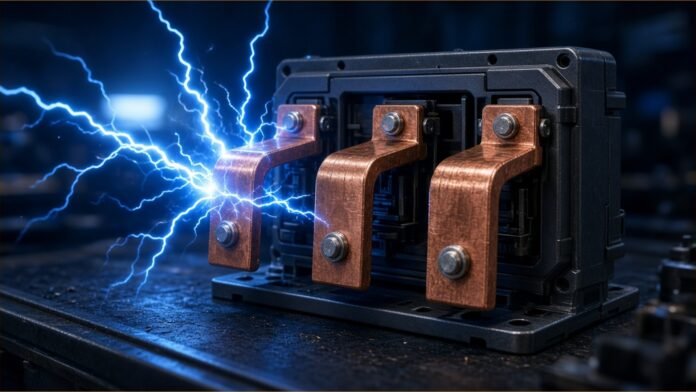
Helion’s machines rely on pulsed electrical systems that must switch and recover large amounts of energy over and over again. Semiconductors that perform at the level it needs “are currently only available from overseas manufacturers”, the company says. The funding is meant to support US development and manufacturing of its own high-voltage chips, designed for higher efficiency, longer life and better cooling.
The Commerce Department’s announcement describes the work as building “high-voltage power semiconductors and advanced energy power modules designed for high-peak-current pulsed-power applications”. These would “power, control, and harvest energy from the magnets driving Helion’s fusion generators”.
That last point is central to Helion’s design. It aims to recover electricity directly from the fusion reaction rather than boiling water to drive a turbine. Chief executive David Kirtley told TechCrunch that today’s devices lose about 5% to 10% of the electricity passing through them. “If we can cut that loss in half, that’s actually twice the power output of the fusion system,” he said. That is Kirtley’s claim about a future gain, not a measured result.
Most of the money would go to Washington state and Vermont
Helion says more than $100m would fund semiconductor and advanced packaging R&D in Everett, Washington, bringing over 100 jobs and power-module manufacturing capacity. About $80m would pay for tooling, design and process development with an unnamed “industry partner in Burlington, Vermont”. Kirtley told TechCrunch that partner is GlobalFoundries, which has a plant there, as we noted when it was picked to run two new fabs in New York. The rest would go on packaging improvements and manufacturing automation.
TechCrunch reported that the award would run for three years and that Helion did not name the private investor. Kirtley also said the work would not reach Orion, Helion’s first plant, in time for its launch. Orion is due to supply Microsoft with electricity in 2028, according to TechCrunch.
Helion was one of four companies in Thursday’s batch, which together have letters of intent for up to $389m. Commonwealth Fusion Systems could receive up to $85m, Vertical Semiconductor up to $73m for gallium nitride power chips, and Sibelco up to $56m for ultra-high-purity quartz, Commerce said. “These investments expand domestic research, secure critical supply chains, and create high-paying American jobs,” Commerce Secretary Howard Lutnick said.
Washington is buying equity along with research
The most unusual term in Thursday’s announcements is the equity. Commerce says it will take “a minority, non-controlling and non-voting equity stake” in each of the four companies “as a condition for making the awards”. For Helion, that stake is worth $175m at its latest private valuation, the same as the maximum funding. The CHIPS research money now comes with an ownership share for the government, as in a separate agreement with GlobalFoundries this month, under which Commerce is to receive about 4% of the chipmaker.
That gives taxpayers some exposure to the upside if Helion succeeds. It also ties the government more closely to a private fusion company with no commercial plant running yet. The stake is non-voting, so it brings no say over how Helion is run. Neither release says how Helion’s stake was sized relative to the funding, beyond tying it to the Series G valuation.
The research itself is aimed at a narrow but growing market. Power semiconductors already matter well beyond fusion, from electric vehicles to grid equipment, and supply deals such as Infineon and Wolfspeed’s silicon carbide agreement show how hard chipmakers are working to secure materials. Fusion is still early: rival developers such as Type One Energy have already pushed back construction dates. Big buyers of power are meanwhile signing conventional deals, such as Microsoft’s 20-year Indiana supply agreement with NiSource.
Helion says this has been a year of milestones, including a $500m Series G round and what it calls the first deuterium-tritium fusion by a private company. The next step is a definitive award agreement with Commerce. Only then does the funding, and the government’s stake, become final.
Sources
- Helion: Helion Signs Letter of Intent For $175 Million CHIPS Award to Advance U.S. High Voltage Semiconductor R&D To Support Fusion Energy, 22 October 2026
- US Department of Commerce (NIST): Department of Commerce Announces Letters of Intent With 4 Companies for $389 Million of R&D Awards, 22 October 2026
- TechCrunch: Fusion startup Helion is developing new semiconductors that could double output of its power plants, 22 October 2026
Related stories
- Type One Energy Raises $200 Million for Stellarator Fusion, but Groundbreaking Slips to 2027
- GlobalFoundries Selected to Operate Two New Chip Fabs at Malta, NY, Under a US–Japan Plan of Up to $21 Billion
- NiSource Signs 20-Year Microsoft Deal for ~1,100 MW in Northwest Indiana
Follow @tsnmediahub on X for breaking AI news as it happens.
Follow on X