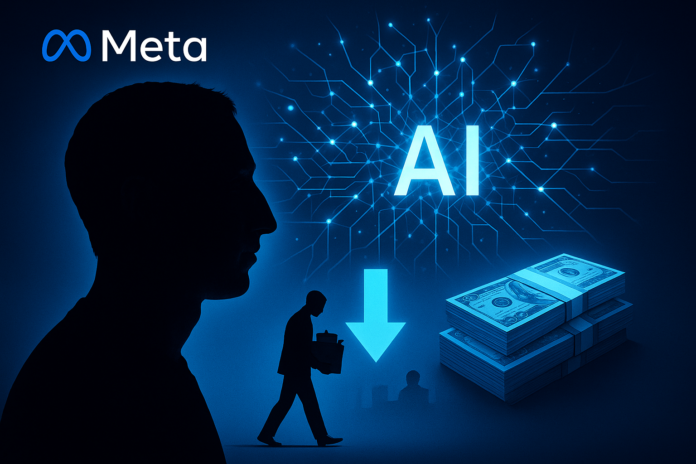
Meta’s $130 Billion AI Gamble: 8,000 Layoffs and a Bet on the Future
Meta is cutting about 10% of its workforce while spending $130 billion on AI. The $27 billion Nebius deal shows Mark Zuckerberg is willing to bet the entire company on artificial intelligence. Here’s what this means for tech workers, investors, and the future of Big Tech.
The Numbers Don’t Make Sense—Until They Do
$130 billion.
That’s how much Meta plans to spend on artificial intelligence in 2026. Up from $72 billion in 2025. An 80% increase.
20%.
That’s how much of its workforce Meta was reported in March to be planning to lay off. In the end, Meta cut about 8,000 jobs (roughly 10%) in May and moved about 7,000 more staff into AI roles.
$27 billion.
That’s the value of Meta’s new cloud computing deal with Nebius. One of the largest infrastructure contracts in history.
On the surface, these numbers contradict each other. How can a company spend record amounts on AI while cutting thousands of jobs?
The answer: Zuckerberg believes AI will replace human workers faster than anyone expects.
The Nebius Deal: Betting the Company
What Is Nebius?
Nebius is a cloud computing company founded by Russian entrepreneurs, now operating internationally. It specializes in AI infrastructure—exactly what Meta needs.
The deal: $27 billion over multiple years for cloud computing capacity.
The purpose: Power Meta’s AI ambitions, including its “Superintelligence” project.
The risk: Nebius is relatively unproven at this scale. If they fail, Meta’s AI strategy fails.
Why This Matters
Meta isn’t building its own data centers for this. It’s outsourcing to Nebius. This is a departure from Meta’s traditional approach of owning its infrastructure.
The message: Speed matters more than control. Meta needs AI capacity now, not in five years.
The implication: Meta is prioritizing AI development over everything else—including its own infrastructure.
The Layoffs: AI Replacing Humans
The Job Cuts
Reuters reported in March that Meta was planning layoffs that could affect 20% or more of its workforce; Meta called the report speculative. In May it cut about 8,000 jobs, roughly 10%. This isn’t performance-based pruning. This is structural reduction.
Who’s affected:
- Engineers (AI can write code)
- Content moderators (AI can review posts)
- Sales and marketing (AI can optimize campaigns)
- Operations (AI can manage systems)
The justification: AI productivity gains will offset the lost headcount.
The Market Reaction
Meta’s stock jumped 3% on the layoff news.
Investors love cost cuts. They also love AI spending—if it promises future growth. Meta is giving them both.
The bet: Short-term pain (layoffs) for long-term gain (AI dominance).
The $130 Billion Math
Where the Money Goes
AI infrastructure: $60-70 billion
- Data centers
- GPUs (NVIDIA, custom chips)
- Networking equipment
- Power and cooling
AI research: $20-30 billion
- Scientist salaries
- Compute for training
- Open source projects (Llama)
AI products: $30-40 billion
- Integration into Facebook, Instagram, WhatsApp
- New AI features
- Reality Labs (VR/AR AI)
The Comparison
Meta’s $130B vs. Big Tech AI spending:
- Microsoft: $80B estimated
- Google: $75B estimated
- Amazon: $100B+ estimated
- Apple: Minimal (partnership strategy)
Meta is outspending everyone except possibly Amazon. And Amazon’s number includes all AWS infrastructure, not just AI.
The Strategy: All-In on AI
Zuckerberg’s Vision
Mark Zuckerberg has made his bet: AI is the future of Meta. Everything else—social media, VR, even the metaverse—is secondary.
The plan:
- Build the best AI models (Llama, Superintelligence)
- Integrate AI into every product
- Replace human workers with AI
- Dominate the next computing platform
The risk: If AI doesn’t deliver, Meta has cut about 8,000 jobs for nothing.
The Superintelligence Project
Meta is explicitly aiming for “Superintelligence”—AI that exceeds human capability across most domains.
The timeline: Unclear, but likely 2027-2028 based on spending trajectory.
The competition: OpenAI, Google DeepMind, Anthropic, xAI all racing for the same goal.
Meta’s advantage: Open source approach (Llama) builds ecosystem and talent pipeline.
What This Means for Tech Workers
The New Reality
If Meta—a company that minted money for two decades—is cutting about 10% of staff to fund AI, what does that mean for everyone else?
The pattern:
- 2023: Tech layoffs (overhiring correction)
- 2024: AI hiring (building teams)
- 2025: AI replacement (productivity gains)
- 2026: Structural reduction (AI does the work)
The implication: Knowledge work is being automated faster than expected.
Who’s Safe?
Short-term: AI researchers, infrastructure engineers, product managers
Medium-term: Creative roles, strategy, human relationships
Long-term: Anyone whose job involves judgment, creativity, or emotional intelligence
The uncomfortable truth: If your job can be described in a prompt, AI can probably do it.
What This Means for Investors
The Bull Case
- Meta becomes the dominant AI platform
- AI productivity gains exceed expectations
- Llama ecosystem captures developer mindshare
- Superintelligence creates new product categories
Price target: $600+ (vs. $500 today)
The Bear Case
- AI spending doesn’t deliver ROI
- Layoffs damage morale and product quality
- Competition (OpenAI, Google) wins AI race
- Regulatory intervention limits AI deployment
Price target: $300-350 (correction)
The Base Case
- Mixed results on AI investments
- Gradual workforce reduction continues
- Meta maintains position but doesn’t dominate
- Stock trades sideways for 2-3 years
Price target: $450-550 (range-bound)
The Bigger Picture
Big Tech’s AI Arms Race
Meta’s $130B isn’t happening in isolation. Every major tech company is spending billions on AI:
Total Big Tech AI spend 2026: Estimated $400-500 billion
This is larger than:
- The Apollo program (inflation-adjusted)
- The Manhattan Project (inflation-adjusted)
- Global R&D spending on cancer research
The question: Will this investment create value, or is it the biggest bubble in history?
The Productivity Paradox
Economists have long observed the “productivity paradox”—technology investments don’t always translate to productivity gains.
AI may be different. Or it may not.
Meta’s layoffs suggest Zuckerberg believes AI will deliver. If he’s wrong, Meta has destroyed value. If he’s right, he’s created the template for every other company.
Key Takeaways
- Meta is betting $130B on AI — Largest corporate AI investment ever
- Meta’s layoffs show AI replacing humans — Not theory, happening now
- $27B Nebius deal outsources infrastructure — Speed over control
- Stock up on layoff news — Investors believe AI justifies cuts
- Superintelligence is the goal — Meta aims for AI exceeding human capability
Correction, 12 October 2026: this article treated a March report that Meta planned to cut 20% or more of staff as fact. Meta cut about 8,000 jobs, roughly 10%, in May 2026.
Related Reading
- NVIDIA GTC 2026 — The infrastructure powering AI
- Morgan Stanley AI Warning — $139B agentic AI market
- Digital Optimus — AI agents replacing workers
- OpenClaw Use Cases — AI automation in practice
Sources
- Reuters: Meta Layoffs — about 10% workforce reduction (roughly 8,000 jobs)
- CNBC: Meta AI Costs — $115-135B AI spending
- FinancialContent: Nebius Deal — $27B cloud contract
- Yahoo Finance: Meta Stock — Market reaction
- Asymco: Apple Strategy — Big Tech AI spending comparison
*This analysis was published March 17, 2026. Meta’s AI spending and layoff plans are subject to change based on market conditions and strategic priorities.*
Follow @tsnmediahub on X for breaking AI news as it happens.
Follow on X