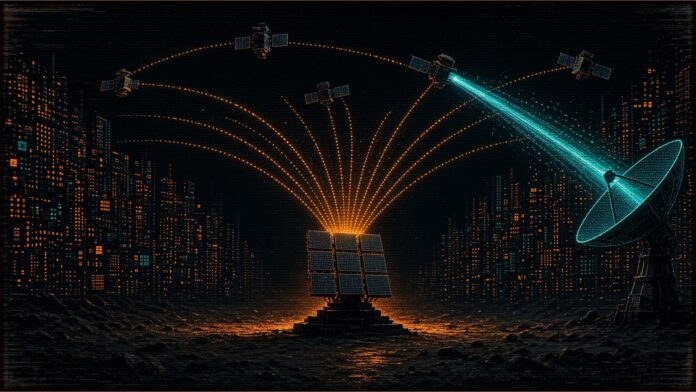
Northwood Space has closed a $375m Series C round to expand its shared network of ground stations, the antennas on Earth that satellites use to send data down and take commands. Andreessen Horowitz (a16z) and DFJ Growth co-led the round, the Torrance, California, company said on 2 November. TechCrunch reported that the deal values Northwood at $2bn, a figure the company did not give.
Alpine Space Ventures, Washington Harbour Partners, Stepstone Activate and In-Q-Tel also took part, along with unnamed others. Northwood also has a separate multi-year credit facility from HSBC Innovation Banking. The company says the money will go on delivering existing contracts, hiring, and building out its network for commercial, US government and allied customers.
In brief
- Northwood Space raised $375m less than nine months after a $100m Series B; TechCrunch reports a $2bn valuation.
- The company builds its own phased array antennas and dishes and rents capacity on a shared network, so satellite operators can skip building their own sites.
- It says it now has six sites on two continents, more than 140 staff and plans for 400 more jobs over three years.
Why Northwood Space thinks the ground is the bottleneck
Northwood’s case is simple. Satellites are multiplying, but the ground stations they talk to were built for a different era. The company says active satellites grew from about 3,000 in 2020 to more than 14,000 by the end of 2025, and that ground capacity has not kept up.
Its answer is standard, modular hardware. Northwood makes two antenna types at its Torrance factory: Portal, a flat phased array for command and control, and Prism, a dish for high-volume data. The systems ship by ordinary freight and need only flat ground, power and fibre. The company says a new site takes three months rather than years, and a new antenna can go from truck to live link in three to four hours. In one test it combined 10 Portals to match the receive performance of a 20-foot dish.
Operators then book time on the shared network through software, rather than building their own stations. Northwood also sells its antennas directly to some customers.
What the Series C follows
According to the company’s blog, since its $100m Series B in February Northwood has:
- set up six sites that can work with satellites in several orbits, on two continents;
- shown it can command a satellite in geostationary orbit from a commercial phased array, in a prototype for the US Space Force;
- launched Prism, which it says will give sites in busy regions more than 100 Gbps of capacity by the end of 2027;
- opened a 185,000 sq ft headquarters and factory in Torrance in September, growing its manufacturing space more than fivefold.
TechCrunch has previously reported that Northwood won a contract worth nearly $50m from the US Space Force to upgrade its satellite control network.
“This funding lets us scale that network and build the infrastructure the next generation of space missions will depend on,” said Bridgit Mendler, Northwood’s co-founder and chief executive. Katherine Boyle, a general partner at a16z and a Northwood board director, said the firm had “backed Northwood in every round since seed because we believe ground infrastructure is essential to making space infrastructure more abundant”.
Ground stations are becoming shared infrastructure
The bet behind the round is that ground stations should work more like cloud computing than like private property. For decades, many satellite operators built or leased dedicated stations, which is slow and costly. A shared network that can be booked by the pass lowers the cost of entry for small operators, and it means a new constellation does not have to wait years for its own antennas.
That fits a wider shift TSN has followed. Regulators are clearing new systems such as Globalstar’s C-3 direct-to-phone constellation, and governments want links they control, as with the ICEYE and Nokia plan for Ukraine’s own satellite links. Google is even testing computing in orbit: its Project Suncatcher has already sent its first AI reply from space. All of that traffic has to come down somewhere.
There are limits to what the announcement shows. Northwood does not name its new customers or the value of its contracts, the 2027 throughput target is a plan, and the 400 jobs are a three-year intention rather than hires already made. The valuation comes from press reports, not the company. Northwood says it will announce several site and network expansions in the first half of 2027, which will be the first real test of how fast the network can grow.
Sources
- Northwood (PR Newswire): “Northwood raises $375 million to build the network connecting satellites to Earth”, 2 November 2026
- Northwood blog: “Northwood raises $375 million to build the network connecting satellites to Earth”, 2 November 2026
- TechCrunch (Dominic-Madori Davis): “Northwood Space raises $375M Series C at a $2B valuation from a16z and DFJ Growth”, 2 November 2026
Related stories
- FCC Clears Globalstar’s C-3 Satellite System for Direct-to-Phone Service
- ICEYE and Nokia Sign Letter of Intent on Ukraine’s Own Satellite Links
- Google’s Project Suncatcher Satellite Sends First AI Reply From Orbit
Follow @tsnmediahub on X for breaking AI news as it happens.
Follow on X