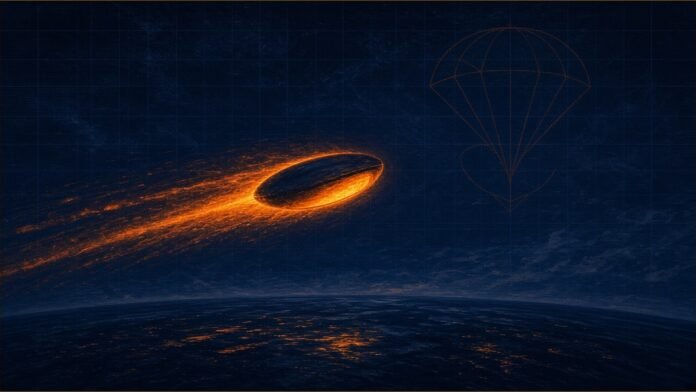
SpaceX launched its Bandwagon-5 rideshare mission from Florida on 20 October 2026, carrying what SpaceNews and NASASpaceflight both describe as the company’s second Starfall reentry capsule. Falcon 9 lifted off from Space Launch Complex 40 at Cape Canaveral Space Force Station at 7:04 a.m. ET (12:04 BST), according to the SpaceX mission page.
Starfall is SpaceX’s own reentry vehicle, built to give customers routine access to microgravity. No reentry or recovery result has been announced yet, and SpaceX has not said what this capsule is carrying.
In brief
- Falcon 9 launched Bandwagon-5 at 12:04 BST on 20 October with 32 payloads, including SpaceX’s second Starfall capsule, as counted by SpaceNews and NASASpaceflight.
- SpaceX’s timeline put Starfall’s deployment at T+02:48:28, and SpaceX posted at 14:56 BST that the “Payload deployment sequence is complete”.
- No reentry or recovery result has been announced, and SpaceX has not disclosed the capsule’s cargo.
The launch
“On board this mission were 32 payloads including cubesats, microsats, and reentry vehicles,” SpaceX says on its mission page. The launch slipped a day after poor weather in the booster recovery zone scrubbed the 19 October attempt, Spaceflight Now reported.
“This was the 19th flight of the first stage booster supporting this mission,” according to SpaceX, whose previous flights included Crew-9 and Firefly’s Blue Ghost Mission 1. The booster landed on the A Shortfall of Gravitas droneship in the Atlantic, which SpaceX confirmed on X at 12:13 BST.
Customer payloads in SpaceX’s deployment timeline include Varda’s W-Series 7 capsule, Capella’s Acadia-11 and Acadia-12, Planet’s Pelican-12, Xona’s Pulsar satellites, Umbra-13 and Umbra-14, and Portal Space Systems’ Starburst-1. Starfall was the last item, deploying at T+02:48:28.
What Starfall is
SpaceX describes the purpose on X: “Starfall enables affordable, routine access to a microgravity environment, providing unique opportunities for on-orbit manufacturing, scientific research, and testing”.
The specifications come from a Federal Aviation Administration environmental assessment, as reported by Spaceflight Now. It describes the capsule as “about 0.75 meters (2.5 feet) tall, 3.1 meters (10.2 feet) in diameter”, with a mass of “about 2,100 kilograms (4,600 pounds)”. According to the FAA, a single capsule can support up to 1,000 kilograms (2,200 pounds) of payload.
The first Starfall flew in June. NASASpaceflight dates that Starfall Demo launch to 23 June, and says early tests are planned to land in the Pacific around 1,300 km off the coast of the US or Mexico. “SpaceX didn’t state what, if any, payloads were onboard this Starfall mission,” Spaceflight Now noted.
| Starfall specification | Figure |
|---|---|
| Height | About 0.75 m |
| Diameter | 3.1 m |
| Mass | About 2,100 kg |
| Payload capacity | Up to 1,000 kg |
Our read
A second flight within four months suggests Starfall is moving from a one-off demo towards a product, and it gives SpaceX a stake in the in-space manufacturing market alongside rideshare customers such as Varda. The proof will be a clean splashdown and recovery, which SpaceX has yet to report for this capsule.
Sources
- SpaceX: Bandwagon-5 Mission (20 October 2026).
- SpaceX on X: Starfall post, liftoff, booster landing and payload deployment complete (20 October 2026).
- SpaceNews: “SpaceX launches second Starfall reentry vehicle” (Jeff Foust, 20 October 2026).
- NASASpaceflight: “Falcon 9 launches Bandwagon-5 rideshare mission from Florida” (Eleanor Day, 20 October 2026).
- Spaceflight Now: “SpaceX launches Starfall reentry capsule, 31 customer payloads on Bandwagon-5 rideshare mission” (Will Robinson-Smith, updated 20 October 2026).
Related stories
Follow @tsnmediahub on X for breaking AI news as it happens.
Follow on X