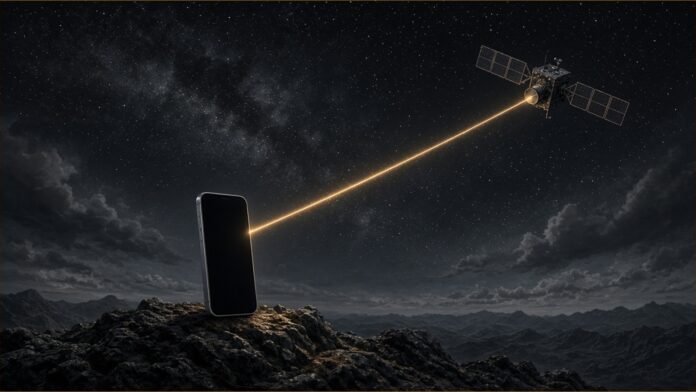
VEON Ltd. and Starlink Mobile said on 19 October 2026 that more than 11 million unique VEON customers have now connected to Starlink Mobile’s direct-to-device service at least once in places where a terrestrial cell signal cannot reach. That is a cumulative reach figure — how many people have tried the satellite path — not a count of active or paying users on any given day.
For phone users in Ukraine, Kazakhstan and Bangladesh, the pitch is messaging, essential apps and location sharing on an existing 4G/LTE handset when the ground network is out of range, damaged or down. VEON says it is the first operator group globally to launch Starlink Mobile across three markets, with a potential footprint of more than 40 million people across its networks — a company estimate of addressable reach, not current usage.
In brief
- VEON and Starlink Mobile report that more than 11 million unique VEON customers have connected to the direct-to-device service at least once (cumulative reach, not active users).
- Commercial launches: Kyivstar (Ukraine, 24 November 2025), Beeline (Kazakhstan, 29 September 2026) and Banglalink (Bangladesh, 9 October 2026).
- Still unclear from the release: how many of those 11 million are repeat or paying users, and how far the free periods extend beyond the initial windows named for Ukraine and Kazakhstan.
Three markets, one cumulative tally
The joint release groups the three launches into a single “at least once” total. Ukraine’s Kyivstar went live on 24 November 2025 as the first such service in Europe and is free to all of Kyivstar’s approximately 15.5 million 4G smartphone users. Beeline Kazakhstan launched on 29 September 2026, developed with the Ministry of Artificial Intelligence and Digital Development, and is offered free during an initial period. Banglalink launched on 9 October 2026 to 20 million customers, activatable through the MyBL super app, with the RYZE app to follow.
| Market | Operator | Launch | Offer (per release) |
|---|---|---|---|
| Ukraine | Kyivstar | 24 Nov 2025 | Free to ~15.5m 4G smartphone users |
| Kazakhstan | Beeline | 29 Sep 2026 | Free during an initial period |
| Bangladesh | Banglalink | 9 Oct 2026 | To 20m customers via MyBL (RYZE to follow) |
That table is the commercial footprint behind the headline number. The 11 million figure sits across all three; the release does not break it down by country.
What the service can and cannot do
Starlink Mobile works with existing 4G/LTE smartphones in open areas with a clear view of the sky, the companies say. Customers can send messages, use essential apps and share location when no terrestrial signal is available. The release’s Starlink Mobile boilerplate puts the constellation at 650 launched low-Earth-orbit satellites — again a company figure.
In Ukraine, Kyivstar has seen the heaviest use in the south and east, where the release frames connectivity as a matter of personal safety. In Bangladesh, the service is described as a way to stay reachable during cyclones, floods and long power outages. VEON Group CEO Kaan Terzioglu said more than 11 million people had “taken out their own phone, with no signal anywhere in sight, and connected through a Starlink Mobile satellite overhead,” naming eastern Ukraine, the Kazakh steppe and the Bay of Bengal as examples.
Why “at least once” is the key phrase
Marketing milestones in satellite-to-phone often blur a first connection with habitual use. Here the companies’ own wording is careful: unique customers who have connected at least once. That can include a single emergency SMS months ago as easily as daily use. The release also does not say how many sessions those customers ran, what share sit on free promotional access, or what happens when free periods end.
The 40 million “potential to reach” line is similarly forward-looking — VEON’s footprint opportunity, not proof that 40 million people will use the service. Readers comparing this to Starlink dish broadband or to other direct-to-device trials should keep those distinctions in mind.
Our read
Eleven million first connections in under a year is a serious distribution win for satellite-to-phone if the figure holds up under operator reporting. The open question for regulators and competitors is conversion: how many of those one-time connectors become regular users once free windows close, and whether EU spectrum and operator consortia (already watching MSS auctions) treat VEON’s three-market roll-out as a template or an outlier. Watch for a per-market breakdown or a paying-subscriber figure; until then, treat 11 million as cumulative reach.
How we sourced this
- Primary: VEON Ltd. / Starlink Mobile joint release on GlobeNewswire (19 October 2026, 06:00 ET). All market dates, free-offer wording, 11 million / 40 million / 650-satellite figures and the Terzioglu quote are from that release.
- This is separate from TSN’s coverage of Starlink terminal restrictions in Ukraine.
Sources
- VEON Ltd. / Starlink Mobile, “In less than one year, Starlink Mobile Connects 11 Million People Across VEON’s Three High Growth Markets” (GlobeNewswire, 19 October 2026).
Related stories
- Space Roundup: SpaceX Agrees to Buy Mobile Spectrum, NASA Goes Nuclear and Amazon Leo Nears
- SpaceX’s Latest: Dragon Delivers the Station’s Last New Solar Arrays, and Musk on Starlink Mobile
- Four EU Telcos Explore a Joint Bid for Satellite-to-Phone Spectrum
Follow @tsnmediahub on X for breaking AI news as it happens.
Follow on X