T-Mobile says an AI system built with Ericsson has improved peak-hour download speeds by about 16% at newly activated sites in New York City. In a newsroom post on 20 October 2026, chief network officer Ankur Kapoor said the technology, called AI-Managed Beamforming, is “now advancing in large-scale commercial trials using live network traffic.”
All the figures are T-Mobile’s own trial results and have not been independently tested. No rollout date was given. Still, the trial is one of the clearer examples of operators putting AI inside the radio network rather than just talking about it.
In brief
- T-Mobile and Ericsson are trialling AI-Managed Beamforming on T-Mobile’s live network, using a model trained on T-Mobile’s own data.
- At peak hours at new New York sites, T-Mobile reports improvements of approximately 16% in downlink user throughput and 12% in spectral efficiency.
- The figures are company-reported trial results, not independently verified; no rollout date was given.
How it works
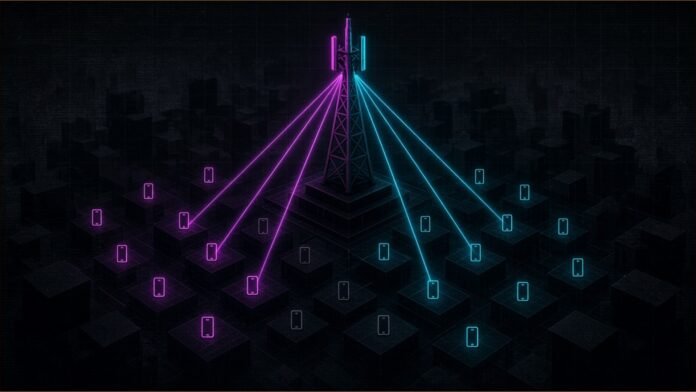
Beamforming lets a 5G network aim signals at users rather than broadcasting them widely. Kapoor compares older networks to floodlights and beamforming to “a spotlight”. To aim well, the network relies on Sounding Reference Signals (SRS), brief signals phones send so the network can map the path between device and cell site.
Those SRS resources are limited and have traditionally been allocated by fixed rules. T-Mobile says the new capability uses “a supervised-learning model trained on T-Mobile’s live network data and running directly on Ericsson’s optimized RAN compute and silicon” to predict where demand is rising and shift SRS resources where they will have most impact.
T-Mobile argues that training on its own network data gives it an edge over networks that contribute no tuning data. It also says beamforming works particularly well in TDD spectrum, where the same frequencies carry downlink and uplink, an area where T-Mobile holds a lot of mid-band spectrum.
The trial results
According to T-Mobile, the strongest gains came during peak hours across newly activated New York City sites. In those periods, it reports improvements of approximately:
| Metric (peak hours, New York trial sites) | Reported improvement |
|---|---|
| Advanced beamforming using full-band SRS | 50% increase |
| Downlink user throughput | 16% improvement |
| Spectral efficiency | 12% improvement |
| Downlink data volume | 10% increase |
T-Mobile gave no baseline speeds, site counts or trial dates, so the percentages cannot be turned into absolute speeds. The company also cited Ericsson’s June 2026 Mobility Report, which found global mobile data traffic grew 22% year on year, with video making up about 75% of mobile traffic.
Ericsson’s view
“AI-Managed Beamforming marks another important step toward networks that can respond more intelligently to demand, helping deliver stronger performance, greater efficiency and a more consistent experience, especially when demand is at its highest,” said Jaco du Plooy, Ericsson’s head of the customer unit for T-Mobile in the Americas.
The work builds on earlier joint work on AI-Native Link Adaptation. T-Mobile frames both as steps on its AI-RAN path towards 6G, which it says will need networks that can “sense, learn and respond”.
Our read
Getting double-digit gains from spectrum an operator already owns is valuable, and doing it with a model running on the radio hardware is a meaningful step for AI-RAN. But these are self-reported, peak-hour, best-case figures from new sites in one city. Until T-Mobile shares baselines or independent testers measure the effect, treat the 16% as a promising trial result rather than a network-wide upgrade.
Sources
- T-Mobile: “5G Advanced in Action, Better Experiences: T-Mobile Puts AI to Work for Customers” (Ankur Kapoor, 20 October 2026).
Related stories
Follow @tsnmediahub on X for breaking AI news as it happens.
Follow on X