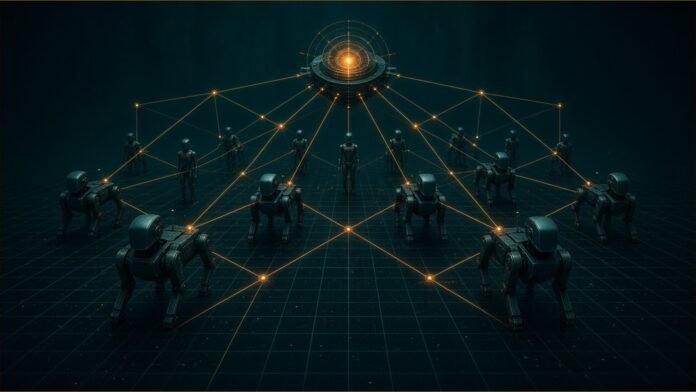
Chinese robot maker Unitree has released UniUni, desktop software for choreographing and supervising groups of its humanoid robots. At launch it works with Unitree’s H2 and G1 humanoids. Users can plan routes and formations, sequence moves to music, watch each robot’s status and stop the whole group in an emergency. The app is a free download for Windows and macOS. The capabilities described below are Unitree’s own claims and have not been independently tested.
What Unitree announced
Unitree announced the software on 16 October via @UnitreeRobotics on X, in a post published at 08:45 UTC (09:45 UK time) with a 50-second video. The post reads:
“Unitree Introducing: UniUni Intelligent Swarm Control System
It enables rapid, intelligent choreography of swarm robot movements and formations, real-time device status monitoring, safety braking, and more.
How many robots would you like to see perform together?”
“Swarm control” here means directing many robots at once from a single system, so that they move as a coordinated group rather than being operated one by one.
What the software does, according to Unitree
Unitree’s UniUni product page, which is in Chinese, lists the H2 and G1 as the supported robots and offers a “免费下载” (free download; translations from Chinese are TSN’s). The versions on offer are 1.1.14 for Windows PCs and 1.1.15 for Apple Silicon Macs. Users sign in with a Unitree account, and the app automatically scans for Unitree robots on the local network, finding and pairing them “in seconds”, the page says.
The page groups the features into several areas:
- Planning routes and formations. Users draw each robot’s path as a curve in a 2D view, while a 3D view shows the whole formation. Unitree says users can plan grid formations, spacing and offsets in bulk, with automatic collision detection.
- Sequencing moves. A drag-and-drop timeline links each robot’s track to its movements. Three run modes are offered: performing to music, rehearsing a dance, and looping a routine.
- AI-assisted choreography. Unitree says the software can generate movement paths and pick suitable motions from a user’s instructions, producing a sequence for the formation “with one click”. It also mentions an online marketplace of ready-made motions.
- Mapping and positioning. Users import laser-scanned point-cloud maps of the venue so that each robot can work out where it is. The page claims “厘米级空间定位” (centimetre-level spatial positioning) but gives no accuracy figure.
- Monitoring and safety. During a performance, the software shows whether each robot is online, its positioning status, temperature warnings and radar faults. It offers what the page calls “large and small” emergency stops.
One feature turns text into formations, with robots arranging themselves to spell out characters. The page describes this as “百机防撞连续执行” (continuous, collision-free execution for a hundred machines). Unitree does not present that as a maximum fleet size, and it has not said how many robots UniUni can control at once.
What Pandaily adds
The tech news site Pandaily reported on 17 October that UniUni is “free for all Unitree users”. Its account of the features matches the product page. According to Pandaily, the AI tool “arranges whole-body motions and syncs them to music”, robots locate themselves “through laser SLAM”, and operators get “a one-tap emergency stop for the whole group”. SLAM (simultaneous localisation and mapping) is a technique robots use to work out where they are within a map using their sensors.
Pandaily also noted what Unitree has not said. “Unitree has not disclosed the maximum number of robots UniUni can coordinate at once, and has not said which other models will be supported after the H2 and G1,” it reported. It added that Unitree “has also not published technical details on network requirements or positioning accuracy”.
Where Unitree says it has been used
The product page says the system has already been “实战验证” (proven in real performances) at several high-profile robot shows. It lists the CCTV Spring Festival Gala, China’s most-watched television broadcast; a show at the China Central Radio and TV Tower in Beijing; a China-US table tennis diplomacy event; and the Hong Kong Sevens rugby tournament. TSN has not independently checked which of those performances used UniUni.
Why it matters
Group dances by humanoid robots have become a familiar showcase for Chinese robot makers. Pandaily notes that such performances “typically require careful planning of timing, spacing and fallback behavior”. By releasing its group-control tools as a free app, Unitree is putting the kind of software behind those shows into the hands of customers who own several of its robots. Pandaily describes the release as turning group-control tooling “into a product that customers can run themselves”.
It also strengthens the software around Unitree’s hardware. Unitree is one of the Chinese humanoid makers that TSN has noted moving fast with cheaper hardware. Pandaily reports that Unitree recently opened a project page and partial weights for its UnifoLM-WLA-1.0 humanoid foundation model and refreshed the G1 line with the G1+.
What we don’t know
- How many robots it can handle. Unitree has not given a maximum.
- How well it works. Positioning accuracy, collision avoidance and AI choreography are company claims, with no independent tests published.
- Which robots come next. Only the H2 and G1 are supported at launch. Unitree has not said whether its other robots will follow.
- Network and safety details. Unitree has not published network requirements or a technical description of how the emergency stops work.
The Bottom Line
Unitree has made its swarm-choreography software, UniUni, a free download for owners of its H2 and G1 humanoids. Unitree says it covers path planning, AI-assisted choreography, live monitoring and group emergency stops. How many robots it can coordinate, and how accurately, are still unknown.
Related stories
- NVIDIA’s “Physical AI” Play: Teaching Robots to Think, Talk, and Actually DO Things
- Shenzhen Robot Maker Astribot Raises About RMB 1bn at a RMB 15bn Valuation, Its Fourth Round in About Six Months
- South Korea Clears 20 Robros Humanoid Robots to Work Alongside People in Factories
- Boston Dynamics Pushes Atlas Toward the Factory Floor While Spot 5.2 Goes Agentic
Sources
- Unitree (@UnitreeRobotics) on X, 16 October 2026
- UniUni product page (Unitree, in Chinese)
- Pandaily: Unitree Releases UniUni Swarm Control Software, Free for Its Users, Starting With H2 and G1 (17 October 2026)
Follow @tsnmediahub on X for breaking AI news as it happens.
Follow on X