In brief
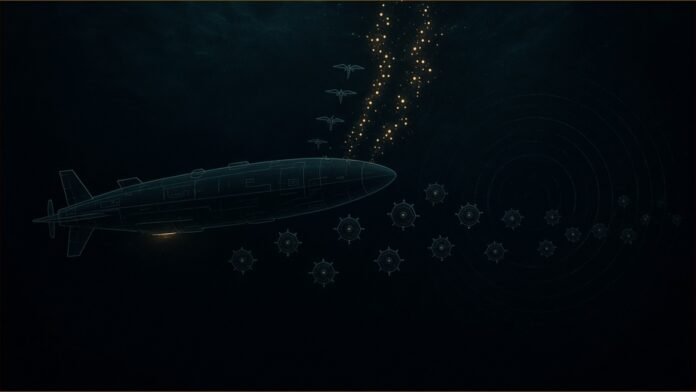
- Australia has revealed what its Ghost Shark underwater drones can carry: sea mines, swarms of aerial drones and supply caches.
- It shows how Australia plans to use uncrewed submarines to close off waterways and strike ships, and the payloads are being offered to the US and UK under AUKUS.
- The government has not said how many Ghost Sharks it is buying, beyond a A$1.7 billion fleet budget.
Australia’s Ghost Shark uncrewed submarines are being fitted to lay sea mines and launch swarms of aerial drones that can strike ships. The government says the payloads will help with “sea denial”, and Anduril says laying mines this way costs less and puts fewer people at risk.
For anyone watching the AUKUS pact between Australia, the UK and the US, this is the first time Australia has been specific about what its flagship undersea drone will do. Until now, ABC News says, the details were “heavily classified”.
What can Ghost Shark carry?
The government’s media release of 19 October says the payloads include “the remote delivery of supply caches, sea mines and uncrewed aerial vehicles”. It says the government is unveiling them “for the first time”.
More detail came at a press conference at Anduril Australia’s factory in Sydney, as reported by ABC News and Defence Connect. That is the factory Conroy says Ghost Sharks are now “rolling off”.
| Payload or system | What was said | Source |
|---|---|---|
| Aerial drones | Can “launch swarms of Anduril Altius aerial drones”, used “for reconnaissance or carry four kilograms of explosives to target enemy vessels” | ABC |
| Sea mines | “Up to 12 sea mines at a time”, which Defence says can “quickly close access to critical waterways” | ABC |
| Supply caches | “Special supply caches”, for special forces “in hard-to-reach locations” | ABC |
| Bluebottle uncrewed surface vessels | Will get “thin line towed array sonar for detecting submarines” | Defence Connect |
| Speartooth uncrewed underwater vehicles | Payloads also being integrated | Government release |
What did ministers say?
“Those Ghost Sharks now have teeth,” Defence Industry Minister Pat Conroy told reporters, according to ABC. “Teeth with the ability to deny areas through them through mining. Teeth with the ability to strike targets thousands of nautical miles away from Australia.”
David Goodrich of Anduril Australia said the drone “will autonomously, accurately and securely deploy naval mines at significantly lower cost and risk than using a surface ship or crewed asset”, ABC reports.
Deputy Prime Minister and Defence Minister Richard Marles said in the release that the payloads, developed under AUKUS Pillar II, were “a critical part of our work alongside the United States and the United Kingdom”.
How much is Australia spending, and how many is it buying?
The release says the government is investing “up to $5.8 billion over the decade for autonomous and uncrewed undersea warfare capabilities, including $1.7 billion to acquire a new fleet” of Ghost Sharks. These are Australian dollars: A$5.8 billion and A$1.7 billion.
The number of vessels has not been disclosed. ABC reports that “the total number is not being revealed”, but that “dozens and dozens” are expected to reach the navy.
Conroy said in the release that Ghost Sharks are “now rolling off the line at an increasing rate into the hands of the Australian Navy”.
How did we get here?
- September 2025: contracts for the Ghost Shark fleet are signed (“last September”, according to ABC).
- January 2026: the first Ghost Shark is delivered, ABC reports.
- May 2026: AUKUS defence ministers announce the first Pillar II Signature Project, on payloads for uncrewed undersea vehicles, according to the release.
- 19 October 2026: the government reveals the payloads.
- This month: some payloads take part in Exercise Maritime Big Play Pacific in San Diego, alongside the US and UK.
Will the US and UK buy it?
The new capabilities are being offered to the two partners under AUKUS Pillar Two, ABC reports. Conroy said the focus is on payloads rather than the vessel itself. “The decision around marquee projects was to invest in common payloads and sensors,” he said. “We all have a range of our own platforms to deliver them.”
Chief of Navy Vice Admiral Matthew Buckley said the ability to deliver uncrewed systems quickly “adds numbers to our fleet and complements our crewed ships and submarines”, according to Defence Connect.
Our read
This is TSN’s analysis. The shift is from a drone that watches to one that can close a strait. By selling common payloads rather than the Ghost Shark itself, Canberra has a route to AUKUS uptake even if Washington and London stick with their own vessels. The unanswered question is scale: without a fleet number, it is hard to judge how much water these drones can really deny.
How we sourced this
- The ministerial release would not load directly (it returned server errors), so we read its text through a reader service. Payload types, spending figures and ministers’ written quotes are taken from it.
- The specific numbers (12 mines, 4kg explosives, Altius by name, towed-array sonar) come from ABC and Defence Connect reporting of the press conference. The release itself does not give them.
- All money is in Australian dollars.
Sources
- Australian Government, Defence ministers: Australia advances undersea warfare capabilities, 19 October 2026
- ABC News: Australia’s fleet of Ghost Sharks will carry armed aerial drones and sea mines, 19 October 2026
- Defence Connect: Australia unveils sea mines, logistics cache and drone swarm payloads for Ghost Shark XL AUV, 19 October 2026
Related stories
- US Navy Says a Carrier Strike Group Has Deployed With an Unmanned Surface Vessel
- US Air Force Says an F-22 Pilot Directed a YFQ-44A Combat Drone in Flight
- Anduril Lets Employees Sell Shares at a Roughly $90 Billion Valuation, Bloomberg Reports
- Anduril Unveils Steelfin Family of Surface-to-Air Interceptor Missiles; Flight Testing Next Year, Company Says
Follow @tsnmediahub on X for breaking AI news as it happens.
Follow on X