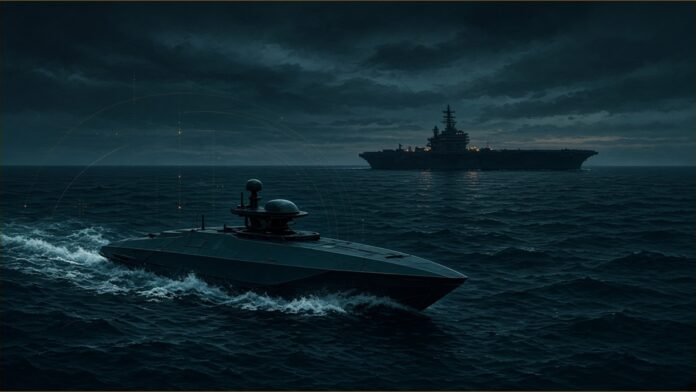
A US Navy carrier strike group has deployed with an uncrewed surface vessel for the first time, according to the service’s acting secretary, Hung Cao. He said the Theodore Roosevelt Carrier Strike Group left on 8 October with the drone boat. The Navy has not said which vessel it is.
What Cao said
Cao made the remarks on Thursday during a panel with Defense Secretary Pete Hegseth and other senior officials at the Association of the US Army’s (AUSA) annual conference, DefenseScoop reported. He said:
“The Teddy Roosevelt Carrier Strike Group just deployed on October 8 with a medium-sized unmanned surface vessel. This is the first carrier strike group to ever deploy with a large-size unmanned surface vessel, and this is a force multiplier.” He added: “Imagine having more guns out there.”
Cao described the vessel as both “medium-sized” and “large-size” in the same remarks. He did not specify the type of drone, and DefenseScoop says several Navy spokespeople did not clarify the model when asked this week. Pentagon officials referred questions to the Navy.
According to DefenseScoop, USS Theodore Roosevelt left California late last month and is heading towards the Middle East. The Navy has not published details of the deployment.
Which vessel could it be?
There is no confirmed answer. DefenseScoop notes that last year the Navy merged its Large and Medium Unmanned Surface Vessel programmes (LUSV and MUSV) into a single Modular Attack Surface Craft (MASC) programme. Those craft are meant to carry different payloads depending on the mission, including containerised weapons, sensors and other electronic equipment. DefenseScoop also notes that Leidos’s Sea Hunter and Seahawk, the original MUSV prototypes, were delivered for surface fleet missions this year. Asked whether either was deploying with the carrier group, a Leidos source referred DefenseScoop to the Navy, since the vessels are now Navy-owned.
The Navy’s wider drone push
The announcement comes as the US services race to adopt drones and autonomous systems. DefenseScoop reports that Cao said on Tuesday he had appointed Christopher Miller as the Navy’s portfolio acquisition executive for robotic and autonomous systems (PAE RAS), a new organisation launched this year to connect surface, undersea and aerial drones across the fleet.
On the same AUSA panel, Cao pointed to an earlier use of uncrewed craft. He said Saronic’s Corsair uncrewed surface vessel was used over the summer to rescue a downed helicopter pilot and gunner in the Strait of Hormuz. “Then we also use the unmanned underwater vehicles to de-mine that area,” Cao said. “It can’t be done in an uncontested area unless it’s using unmanned underwater vehicles.”
Why it matters
Carrier strike groups are the core of US naval power, built around crewed warships. Sending an uncrewed vessel out with one marks a step from testing towards routine operations, which Cao called “a force multiplier”. Without the vessel’s identity, size class, payload or role, though, it is hard to judge what the drone adds to the group.
What is still unknown
- Which uncrewed vessel deployed, and whether it is medium or large. Cao used both terms.
- What it carries and what tasks it will perform.
- Whether the Navy plans to deploy uncrewed vessels with other strike groups.
What this means
- The acting Navy Secretary says the Theodore Roosevelt group is the first carrier strike group to deploy with an uncrewed surface vessel, leaving on 8 October.
- The Navy has not named the vessel or released any details. So far, this is a statement made at a conference panel.
- It fits the Navy’s broader shift towards mixing crewed ships with drones, overseen by a new robotic and autonomous systems office.
Sources
Related stories
- Defence Tech Roundup: A Conditional Counter-Drone Deal, X-BAT Funding, an AI-Contractor Bill and an FPV Order
- CHAOS Industries Unveils VESPID, a Family of Very Low-Cost Interceptors Against Drones
- Ukraine’s Defence Minister Says Bars Interceptor Drones Hit Five of Five Jet-Powered Drones, and Heavy Turrets Are “in the Hundreds”
- Anduril Lets Employees Sell Shares at a Roughly $90 Billion Valuation, Bloomberg Reports
Follow @tsnmediahub on X for breaking AI news as it happens.
Follow on X