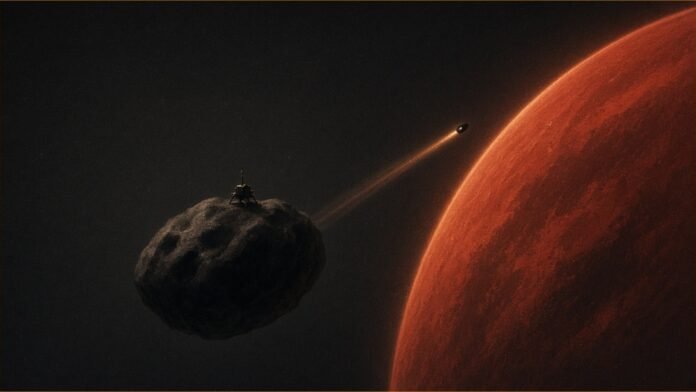
Japan’s space agency has launched a spacecraft that aims to land on Phobos, the larger of Mars’s two moons, and bring a piece of it back to Earth. The Japan Aerospace Exploration Agency (JAXA) said it launched the Martian Moons eXploration (MMX) spacecraft “aboard H3 Launch Vehicle flight No.10 at 04:41:03 JST on October 20, 2026 from the Tanegashima Space Center”. That was 20:41 London time on 19 October.
According to JAXA, “approximately 71 minutes and 13 seconds after liftoff, the separation of the MMX spacecraft was confirmed. The MMX spacecraft was then injected into the predetermined orbit.” The mission now faces a long journey. If it succeeds, it would be the first time samples have been returned from either Martian moon, and it could help settle a long-running question about where those moons came from.
In brief
- JAXA launched MMX on H3 flight No.10 at 04:41:03 JST on 20 October 2026 (20:41 London, 19 October); the spacecraft separated about 71 minutes after lift-off.
- Ars Technica reports the $578 million mission should reach Mars next August, attempt up to two Phobos landings in 2029 and return at least 10 grams of material in 2031.
- NASA supplied a sampler and a spectrometer, and US researchers will get 15% of the Phobos samples, according to Ars Technica.
A clean launch on a new-look rocket
JAXA says the H3 rocket “flew as planned”. Ars Technica reports that this H3 debuted a more powerful configuration with four strap-on solid rocket boosters, full-throttle main engines and an extended payload fairing, to handle what it calls Japan’s heaviest and most ambitious interplanetary mission yet. The spacecraft weighs nearly 9,900 pounds (4.5 tonnes), two-thirds of it propellant, according to the outlet.
JAXA president Hiroshi Yamakawa declared the launch a success. “A long journey of five years has just started,” he said, as quoted by Ars Technica. Project manager Yasuhiro Kawakatsu said the spacecraft had made contact with ground controllers, unfurled its solar panels and was in a “very stable condition”. “So far, so good,” he said.
Five years, two moons and a rover
Ars Technica describes MMX as a $578 million, five-year expedition. After a 10-month voyage, the spacecraft is due to arrive at Mars next August and spend about three years near the planet, studying both Phobos and its smaller sibling, Deimos. Because Phobos’s gravity is so weak, the craft cannot orbit it in the usual way. Instead it will fly a so-called quasi-satellite orbit, staying bound to Mars while manoeuvring around the moon.
In late 2028 or early 2029, the mothership is due to release Idefix, a shoebox-sized, four-wheeled rover from the French and German space agencies, Ars reports. Idefix may drive across Phobos for up to 100 days, in gravity less than a thousandth of Earth’s. Then, later in 2029, the main spacecraft will attempt up to two landings on Phobos itself.
On the surface, MMX will use two independent sampling tools, according to Ars. A coring drill on its robotic arm will take a cigar-shaped sample, while a NASA-supplied pneumatic sampler on one landing leg will fire high-pressure nitrogen gas to sweep material into a canister. Scientists expect to collect at least 10 grams. The spacecraft is due to leave for Earth in 2030 and drop a sample capsule into South Australia in 2031.
Why Phobos matters
The central question is whether Phobos is a captured asteroid or debris from a giant impact on Mars early in its history. “One of the most intriguing questions about Phobos and Deimos is simply why these two little moons are there in the first place,” Tom Statler, NASA’s lead scientist for solar system small bodies, told Ars Technica. Samples analysed in the laboratory, he said, should show which explanation fits.
NASA’s contribution includes the pneumatic sampler and a gamma-ray and neutron spectrometer to measure the moons’ elemental make-up. In return, US researchers will get 15% of the Phobos samples, Ars reports. Because Phobos sits so close to Mars, the samples may even contain traces of Martian material that landed on the moon.
Previous attempts have failed. Ars notes that Russia’s Phobos-Grunt sample-return mission failed soon after launch in 2011, and the Soviet Union lost contact with two Phobos-bound spacecraft launched in 1988.
Our read
Japan’s Hayabusa and Hayabusa2 missions made it the leader in returning pristine samples from small bodies, and MMX is the boldest test yet of that expertise. A successful launch is only the first step; the riskiest moments, the landings in Phobos’s feeble gravity, are three years away. If it works, MMX would give scientists their first hands-on evidence of how Mars got its moons, and a dress rehearsal for returning samples from Mars itself.
Sources
- JAXA: “Launch result of the Martian Moons eXploration (MMX) spacecraft aboard H3 Launch Vehicle flight No.10” (20 October 2026, JST).
- Ars Technica: “Japan launches mission to bring home a piece of the Martian moon Phobos” (Stephen Clark, 20 October 2026).
Related stories
Follow @tsnmediahub on X for breaking AI news as it happens.
Follow on X