
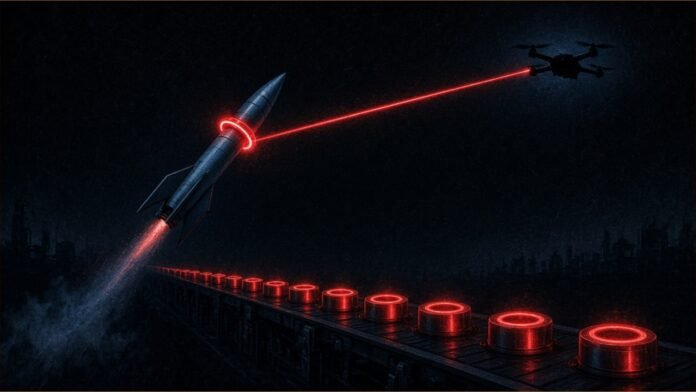
The US Department of War has agreed a framework with BAE Systems to buy up to 25,000 laser-guidance kits a year for its Advanced Precision Kill Weapon System (APKWS) for up to seven years. The kits are increasingly used to shoot down drones. The department announced the deal on 19 October, but stressed that it is “pending congressional authorization and appropriations”.
This is a signal of intent rather than a signed purchase. The framework aims to give BAE enough certainty to expand production lines and hire, so that the US and its allies have a steady supply of cheaper drone interceptors. Neither side has put a price on it.
In brief
- The US Department of War and BAE Systems have agreed a framework for up to 25,000 APKWS guidance kits a year for up to seven years.
- A further pathway would take output to 35,000 a year for allies, unlocked by Foreign Military Sales requests.
- Congress still has to authorise and fund the purchases, and no dollar value has been announced.
What the framework covers
According to the department, the multi-year agreement “outlines the procurement of up to 25,000 APKWS guidance sections annually for up to seven years”. It was finalised with the Army, Navy, Air Force and Marine Corps. The department says it gives BAE the “sustained demand signal” it needs to buy long-lead items and expand its skilled workforce.
There is also room to grow beyond that. The department says that beyond the 25,000-a-year baseline, the framework sets out “an actionable pathway to surge output up to 35,000 units annually for international allies”. That extra capacity would be unlocked as partner nations formalise orders through Foreign Military Sales Letters of Request.
BAE’s own release frames the deal as raising production capacity “up to 35,000 units per year”. It says it will increase production while it negotiates a multi-year contract within the framework. In other words, the contract itself is still to come.
Michael P. Duffey, Under Secretary of War for Acquisition and Sustainment, argued the deal is about cost as much as volume. “By securing multi-year demand, this agreement keeps production lines running at capacity, provides our forces with interceptor inventory, and flips the cost calculus in the taxpayer’s favor,” he said.
Why BAE’s rocket kit is being used against drones
APKWS is not a missile in its own right. BAE says its laser-guidance kits “transform unguided 2.75-inch rockets into precision-guided munitions”, and that they can be used air-to-surface, surface-to-surface, surface-to-air and air-to-air. All four US services field them, and they are available to allies.
That flexibility has given the kits a new role. Defense News reported that APKWS has become a cheaper alternative to air-to-air missiles for shooting down drones. BAE’s release names counter-unmanned aircraft systems as one of its missions, and the department calls it a “combat-proven, high-lethality interceptor”.
“APKWS delivers proven, reliable and affordable precision at scale to counter evolving threats and ensure our warfighters maintain a decisive advantage,” said Tom Arseneault, president and chief executive of BAE Systems Inc. The kits are built at BAE’s plants in Hudson, New Hampshire, and Austin, Texas.
Demand is already building
The 25,000 figure is not new to BAE. According to Defense News, a company official said in 2023 that APKWS was in full-rate production with room to grow to 25,000 units a year, and BAE said in February that it had delivered its 100,000th kit.
Orders are also coming from several directions. Defense News reported that the Navy’s current five-year APKWS contract, awarded in August 2025, covers up to 55,000 kits for the Navy, the Army and foreign customers. Saudi Arabia won State Department approval in July for a possible package including up to 20,000 kits, and Italy is weighing a purchase of 5,031 kits for counter-drone defence.
The deal is also part of a pattern. Defense News said it is the latest in a series of framework agreements the Pentagon has signed this year to boost munitions production, after similar moves on Patriot PAC-3 MSE and THAAD interceptors. TSN has covered other recent counter-drone awards, including Raytheon’s LIDS contract and Epirus’s Leonidas work for the Army.
The BAE framework targets the cost gap in drone defence
Using guided rockets that are cheaper than air-to-air missiles against drones goes straight at the cost problem of air defence. When defenders spend far more on each interception than an attacker spends on each drone, protecting bases, ships and civilian infrastructure becomes hard to sustain, and stockpiles of expensive missiles run down quickly. The department and BAE present this deal as a counter-drone measure, though the same kits also serve as air-to-surface weapons, so it is not purely defensive. Cheaper interceptors are only one answer: TSN has also covered Germany’s net-firing interceptor drones and a US counter-drone contract with a $500 million ceiling that includes Leonardo DRS.
A seven-year demand signal is what the department says BAE needs to invest in production lines and staff. But a framework is only as solid as the budgets behind it. No price has been published, the multi-year contract is still being negotiated, and the extra allied output depends on Foreign Military Sales requests. The real test is whether Congress funds the purchases and how quickly that contract follows.
Sources
- US Department of War: Department of War and BAE Systems Sign Framework Agreement to Surge Counter-Drone Production to 25,000 Precision Interceptors Annually, 19 October 2026
- BAE Systems (via PR Newswire): BAE Systems, US Department of War sign long-term agreement to increase APKWS production, 19 October 2026
- Defense News: Pentagon, BAE sign deal for up to 25,000 precision-guided munition kits a year, 19 October 2026
Get TSN’s biggest tech stories, explained.
News and insights across AI, tech, crypto and cybersecurity. Every source linked. Unsubscribe anytime.
Get the newsletterRelated stories
- Raytheon Wins $729 Million to Supply Its LIDS Counter-Drone System to the US Army, Qatar and Jordan
- Leonardo DRS Wins a Place on a $500 Million-Ceiling US Counter-Drone Contract
- Epirus Gets $18M Army Contract to Make Its Leonidas Counter-Drone System Mobile
- Germany Signs Net-Firing Interceptor Drone Deal; Report Puts It Above €1.1bn
- Shield to Buy Echodyne for $5.3bn and Raise $2.5bn
Follow @tsnmediahub on X for breaking AI news as it happens.
Follow on X


