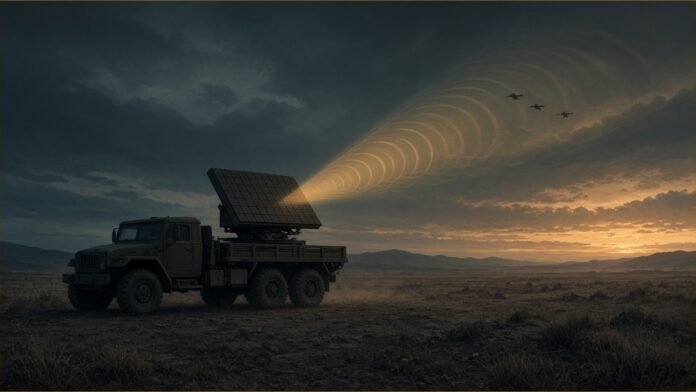
Epirus, the maker of the Leonidas high-power microwave weapon for shooting down drones, has an $18M contract with the US Army to make the system mobile, according to Tectonic Defense. The deal reworks an earlier award for fixed-site units. The Army now wants versions that can move with its forces.
What was announced
Tectonic Defense reports that Epirus announced on 16 October that it has “secured a $18M contract with the Army’s PAE Fires to make its flagship drone-zapping high-powered microwave (HPM) system, Leonidas, mobile and adaptable to different vehicle platforms”. TSN could not find the announcement on Epirus’s own newsroom.
The contract builds on a $43.5M award from last summer under the Army’s Integrated Fires Protection Capability High-Power Microwave (IFPC-HPM) programme. Under that original award, Epirus was to deliver two Leonidas units in a fixed-site configuration. Tectonic says the Army has awarded Epirus more than $120M in Leonidas contracts under IFPC-HPM since 2023.
According to the company, as quoted by Tectonic, the restructured contract moves Leonidas into “adaptable Leonidas form factors”, giving “the Army with a broader range of options for deploying HPM systems across diverse missions and environments”.
Why the Army changed course
Epirus chief executive Andy Lowery told Tectonic that the change came from Lt. Gen. Frank Lozano, who leads PAE Fires. “[Lozano] looked at Army 2030 and said, ‘I don’t think fixed and semi-fixed directed energy makes sense for my future force,'” Lowery said. “So he rewrote the requirement to say, ‘For 2030, if I’m going to have directed energy as part of the layers within the short-range air defense mission set, it should be mobile.'”
What will be delivered
Lowery could not say which vehicles the systems will be mounted on. He said Epirus will deliver a “mix” of large mobile Leonidas Ground Vehicle configurations and Leonidas Medium units. According to Lowery, the Medium units have about a third of the power and range of the large version, but are smaller, lighter and more mobile. No delivery dates have been given.
Tectonic notes that Epirus has already worked with General Dynamics Land Systems to put Leonidas on an F-600 truck, a robotic ground vehicle and Stryker armoured vehicles. It also won an $11M Marine Corps contract in August to put the system on crewed and uncrewed ground vehicles.
How Leonidas works
Leonidas projects intense microwave energy at nearby drones, disabling their electronics, Tectonic explains. Epirus describes it as an “operationally deployed, solid-state, software-defined high-power microwave platform” designed to defeat individual drones and swarms “with one-to-many effects”. Its software lets operators change waveforms, adjust power and define safe zones.
Lowery presents microwaves as a complement to the laser weapons getting more attention. “It’s not a competitor to lasers—the laser is a spear, and [Leonidas] is the shield, and it works really well in conjunction,” he said. “If [drones] get past the laser, and it’s a big swarm, we can use the HPM.”
Part of a wider push
The contract follows a separate agreement Epirus announced on 13 October with the Army’s DEVCOM Ground Vehicle Systems Center. That cooperative research and development agreement (CRADA) will explore how to integrate Leonidas-based high-power microwave systems onto Army ground vehicles to protect units on the move.
What we don’t know
- Which vehicles will carry the mobile Leonidas systems.
- How many units will be delivered, and when.
- How the $18M is split between the large and Medium versions.
What this means
- Epirus has an $18M Army contract to make Leonidas mobile, restructuring an earlier award for two fixed-site units, Tectonic Defense reports.
- Deliveries will mix large vehicle-mounted systems and a smaller Leonidas Medium version. Vehicles and dates have not been disclosed.
- The shift reflects the Army’s view, as relayed by Epirus’s CEO, that counter-drone directed energy needs to move with its forces.
Sources
- Tectonic Defense: Exclusive: Epirus snags $18M Army contract to take Leonidas mobile
- Epirus: Epirus and US Army DEVCOM GVSC announce CRADA to enable mobile HPM system development
Related stories
Follow @tsnmediahub on X for breaking AI news as it happens.
Follow on X