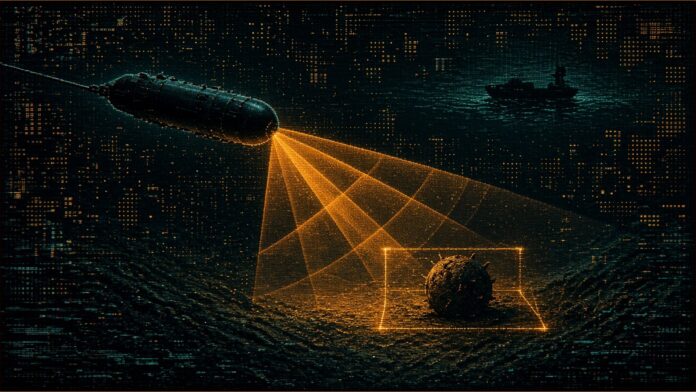
Finding a sea mine has traditionally meant putting a ship and its crew close to it. A new US Navy contract for Thales mine-hunting equipment is meant to change that distance. Thales subsidiary Advanced Acoustic Concepts (AAC) has won a $53.9m contract to build and deliver two Remote Mine Hunting (RMH) modules plus engineering support, Thales said on 2 November.
The headline figure in the announcement is larger. The award includes options for more modules that could lift the total to about $196.2m, but options are not funded orders: the Navy has committed to two modules, and any more depend on later decisions. The award itself is not new either. The SAM.gov award notice, contract N00024-26-C-6304, shows it was awarded on 5 August and posted on 3 September, two months before Thales announced it.
In brief
- AAC, a Thales subsidiary, holds a $53.9m US Navy contract for two Remote Mine Hunting modules and engineering support.
- The system is designed to find and classify mines from a stand-off distance, keeping sailors and ships out of minefields.
- Unknown: test results, a delivery schedule and whether the Navy will exercise options worth up to about $196.2m in total.
Thales mine-hunting kit keeps sailors at a distance
Thales describes the RMH system as a way to let sailors “remotely detect, locate and classify undersea mines while operating from safer stand-off distances”. The company says the module suite combines sonar, mission management software and remotely operated vehicle technology.
Two parts carry most of the work. The first is a multiview towed synthetic aperture sonar (SAS), which Thales says gives high-resolution detection and imaging and cuts false targets. Synthetic aperture sonar builds a sharper picture by combining many pings as the sensor moves, much as synthetic aperture radar does from aircraft and satellites. The second is what Thales calls “AI augmented Automatic Target Recognition” software, which helps operators sort, classify and map the sonar data so they can decide faster which contacts are mines.
Mike Carnovale, president of AAC, said the programme brings together “sonar, classification software and future remote neutralization capabilities into a single operational solution” for “both manned and unmanned surface vessel platforms”. Rob Geckle, chief executive of Thales North America, said countering undersea mines “remains fundamental to maritime security”.
Mine countermeasures are moving to uncrewed platforms
The contract fits a wider shift in the US Navy towards remote and uncrewed systems. TSN has covered a carrier strike group deploying with an unmanned surface vessel and Applied Intuition’s Navy award for AI perception on destroyers. Navies elsewhere are going the same way, as with Australia’s Ghost Shark drone submarines.
AAC is Thales’s US-based undersea warfare subsidiary, and the release says the deal combines “international expertise and American innovation”, which in practice means a French group’s technology delivered through a US company.
A small order with a clear safety case
This is a modest order by defence standards, and it should be read that way. Two modules and engineering support for $53.9m is the funded commitment; the $196.2m figure is a ceiling the Navy may never reach. Companies like to lead with the cumulative number, but readers judging how big a win this is should start from the smaller one.
The more interesting part is the purpose. Mine hunting is one of the clearest cases where autonomy and AI reduce risk to people rather than adding to it. A sonar towed at a distance, with software that flags likely mines and filters out rocks and debris, means fewer crews working in a minefield. The open question is performance at sea. Thales’s claims about fewer false targets and faster classification are the company’s own, and the release gives no test figures, detection rates or delivery schedule. Automatic target recognition is only as good as the data it was trained on, and the release describes software that helps sailors decide rather than deciding for them, which is where the judgement should stay.
The gap between award and announcement is also worth noting. An award in August and an announcement in November is not unusual, but it means this is not a fresh decision by the Navy.
What to watch on the RMH contract
The next markers are delivery of the two modules and whether the Navy exercises any of the options. Each option exercised would show up as a contract modification, which is the real test of whether the Navy wants more of the system.
Sources
- Thales Defense & Security: Thales Selected to Deliver Next-Generation Mine-Hunting Capability for the U.S. Navy (2 November 2026)
- SAM.gov: award notice, contract N00024-26-C-6304 (posted 3 September 2026)
Follow @tsnmediahub on X for breaking AI news as it happens.
Follow on X