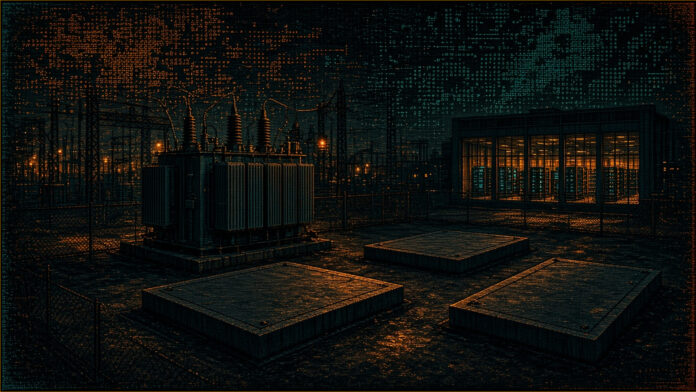
A Johns Hopkins University study says the United States could run short of transformers and other grid-supporting equipment from 2027, with data centres accounting for most of the modelled gap.
In a Hub release published at 16:00 GMT on 17 November 2026, the university said researchers “found the country could run short of critical grid-supporting equipment, such as transformers and converters, as early as next year, with acute shortages hitting by 2030.” The work, by Boyu Yao and Yury Dvorkin, is published in Cell Reports Sustainability (DOI 10.1016/j.crsus.2026.100923). The figures below are the study’s model projections as set out in the Johns Hopkins release. The journal page itself did not render for this report.
The release says that, historically, US power demand has grown by about 1 or 2 per cent a year, but that “thanks to power-hungry data centers, growth in electric vehicles, and other needs, power use is projected to grow 21% by 2030.” That 21 per cent figure is a projection cited in the Johns Hopkins article, not presented as a measurement the authors made themselves.
Under “baseline scenarios, or modest growth in power demand,” the team projects that “by 2030 the nation would likely have enough transformers, but fall about 16% short of other grid-supporting equipment.” “But if high power demand continues as expected, over the next four years the researchers project the U.S. will be almost 15% short on transformers and 30% short on other critical equipment.” “As much as two-thirds of all the expected equipment shortages will be fueled by data centers, according to the researchers.”
If international trade is disrupted as well, the release says, the result “could be as much as a 70% drop in materials coming in from unstable trade partners, leading to a transformer shortage of about 25%, and a 36% shortage for other equipment.” The team also projects that “the U.S. will run short of copper next year,” and that “Steel and nickel will be nearly impossible to source by 2030.”
The release also notes that transformers “are typically custom-built rather than mass-produced,” and that existing units “that are aging out must be refurbished or replaced.” Dvorkin said lead times “have quadrupled over the last four years, from six months to more than two years.” “Utilities will compete for transformers with the data center industry,” he said. “By 2030 we’re likely to have transformer shortages even without the most aggressive power demand growth.” He also said households are likely to feel the bottlenecks through higher electric bills and more frequent power outages as power companies compete for kit. That last point is his projection, offered in the university release, not a measured change in bills or outage rates.
The team points to possible easing measures. Low-cost sensors, it says, could monitor actual temperature and load rather than conservative fixed ratings, so operators could get more from the transformers they already have; methods to recycle transformer materials at the end of their life; and standardisation to improve “transformer substitutability.” The release notes that the sensor approach “is currently not widely used.” Those are options the authors set out, not policies already in force. The work was supported by a Johns Hopkins University Discovery Award and National Science Foundation grant OISE-2330450.
The study sits alongside other TSN coverage of grid kit and data-centre power, including Vantage’s booking of more than 1GW of Heron solid-state transformers for AI sites, SemiAnalysis’s forecast of 50GW of data centres in 2027, and the IEA’s projection of a 30% copper shortfall by 2035.
A modelled 2027 date is not a counted shortfall
Every number in the Johns Hopkins release is a model result, or a projection the authors are citing, under stated scenarios. A baseline case in which, in the release’s wording, the nation “would likely have enough transformers” in 2030, but would fall about 16 per cent short of other grid-supporting equipment, sits beside Dvorkin’s separate remark that transformer shortages are likely by 2030 “even without the most aggressive power demand growth.” Those two sentences should be kept as the team’s own wording, not collapsed into a single claim. They are also distinct from the high-demand case, in which transformers are almost 15 per cent short and other equipment 30 per cent short. A further trade-disruption case, with a transformer shortage of about 25 per cent, is another branch of the same tree. None of those figures is a warehouse count of units already missing, and the 2027 “as early as next year” wording is the study’s earliest modelled pressure point, not a confirmation that the gap has already opened.
The same caution applies to the claim that data centres will fuel as much as two-thirds of the expected equipment shortages, and to the copper, steel and nickel findings. They are the team’s projections from power-demand and supply-chain data, as described in the university release. The 21 per cent rise in power use by 2030 is, in that release, a cited projection about demand, not a result the authors present as their own measurement of the grid. Until the paper’s full tables can be read directly, the responsible account is the one Johns Hopkins has published: a peer-reviewed model that warns of equipment and materials tightness from 2027, with data centres as the largest modelled driver, and with practical ideas — sensors, recycling, standardisation — offered as options, not as policies already in force.
Sources
- Johns Hopkins University Hub, “Transformer shortages loom for strained U.S. power grid,” 17 November 2026, 16:00 GMT.
- Boyu Yao and Yury Dvorkin, “Grid-supporting equipment supply chains constrain the feasible pace of power system expansion,” Cell Reports Sustainability, November 2026, DOI 10.1016/j.crsus.2026.100923.
Get TSN’s biggest tech stories, explained.
News and insights across AI, tech, crypto and cybersecurity. Every source linked. Unsubscribe anytime.
Get the newsletterRelated stories
Vantage Books Over 1GW of Heron Solid-State Transformers for AI Sites is the closest recent TSN account of transformer supply for AI sites, and is the next read.
- SemiAnalysis Forecasts 50GW of Data Centres in 2027; Gerstner Says 25
- IEA Sees a 30% Copper Shortfall by 2035 as AI Adds to Metal Demand
Follow @tsnmediahub on X for breaking AI news as it happens.
Follow on X