China’s Ministry of Commerce and eight other departments have issued opinions on building a recycling system for renewable resources, covering household waste as well as used electric-vehicle batteries, retired solar panels and wind-turbine blades. The document was published on the ministry’s website on 17 November 2026, at 11:57 Beijing time (03:57 GMT). English renderings in this article are TSN’s own translations of the official Chinese texts.
The opinions are titled “Opinions on Deepening the Development of a Renewable-Resources Recycling System and Promoting High-Quality Development of the Recycling Industry” (关于深入推进再生资源回收体系建设 促进回收行业高质量发展的意见). They carry the document number 商流通发〔2026〕206号. The posted text is signed by the nine departments and dated 11 November 2026; the ministry lists an issue date of 12 November. The same posting marks the text as abridged (本文有删减). The other signatories are the National Development and Reform Commission, the Ministry of Industry and Information Technology, the Ministry of Ecology and Environment, the Ministry of Housing and Urban-Rural Development, the State Administration for Market Regulation, the Government Offices Administration of the State Council, the National Energy Administration, and the All-China Federation of Supply and Marketing Cooperatives.
The 2030 language is an aim, not a result, and the opinions list no budget. By 2030, the document says, China should “preliminarily establish a renewable-resources recycling system with a sound and complete recovery network, convenient and smooth drop-off for residents, efficient and advanced sorting, and green, well-regulated end treatment.”
Sixteen measures, many of them about furniture and appliances
Yuan Xiaoming, assistant minister of commerce, presented the opinions at a State Council Information Office briefing in Beijing on 17 November. A Chinese transcript is posted on the Ministry of Commerce site. Yuan said the opinions contain “16 specific measures,” which he grouped under five headings: spreading typical recycling models, handling key categories, upgrading the industry, building a responsibility system, and strengthening coordination.
A large share of the published text is about ordinary household recycling, not batteries. Early sections promote linking household refuse-sorting networks with recycling points, “internet plus recycling” services and mobile collection vehicles. They set out models for bulky waste furniture, including contracted clearance, paid doorstep collection and free public collection days, and for used appliances, including trade-in schemes, closer ties between manufacturers and dismantlers, and “official storehouses” that reuse office equipment. The document also says the work should tackle problems such as it being “harder to throw away than to buy” (扔比买难).
That household focus was echoed at the briefing. Zhong Bin, director of the Department of Solid Wastes and Chemicals at the Ministry of Ecology and Environment, said that, by the ministry’s own tally, qualified firms had, from 2012 to 2025, handled more than 1 billion units of what China calls the “four machines and one computer” — televisions, refrigerators, washing machines, air-conditioners and computers — and recovered more than 22 million tonnes of recyclable resources.
Li Jialu, director of the Ministry of Commerce’s Department of Circulation Industry Development, cited “relevant association data” for 2025: recycling of the main varieties reached 417 million tonnes, up 4.1 per cent, with a value of 1.39 trillion yuan, up 3.8 per cent. He also said coverage of the collection network was still incomplete, operators were highly fragmented, and problems of the industry being “small, scattered and weak” had yet to be fundamentally changed.
Batteries, solar panels and blades sit in one chapter
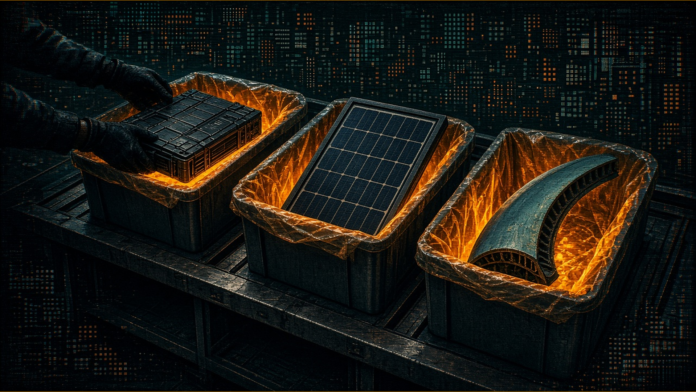
The “new three” waste streams — power batteries, photovoltaic modules and wind-turbine blades — have their own chapter, but they are one part of the plan, not the whole of it. On batteries, the published opinions call for revisions to the detailed rules on scrapping motor vehicles, and for promoting “vehicle-and-battery integrated scrapping” of new-energy vehicles, so that a car and its battery are retired together. They also say the government should research and formulate a digital-identity management system for new-energy vehicle power batteries, and related administrative regulations.
Yuan, answering a question on the same chapter, put that in plainer official language. He said the plan was to establish a digital-identity system for new-energy vehicle power batteries and to extend producer responsibility; to promote vehicle-and-battery integrated scrapping; and to close gaps in the recycling system for non-vehicle-mounted power batteries as well as energy-storage and consumer batteries, so that batteries of all kinds “can be traced when retired and recycled in an orderly way” (退役有踪、回收有序). Those are aims set out at the briefing, not a report that such a system already exists.
On wind and solar equipment, the opinions encourage power-generation firms to build recycling systems for retired equipment, and they call for a market-based docking mechanism between power-sector state-owned enterprises and comprehensive-utilisation firms. They also say the government should formulate administrative measures for the recycling and treatment of retired wind-turbine blades and photovoltaic modules, and they encourage companies to apply artificial intelligence and other advanced equipment. Yuan added a further 2030 aim, again as something to “strive for”: a comprehensive, orderly and technically advanced recycling system for the “new three” wastes.
The same digital theme runs through the wider industry chapter. The opinions say big data, cloud computing and artificial intelligence should be used to raise the digital and intelligent level of the recycling industry, and they encourage pilot cities and firms to build information platforms so that residents can find drop-off points and companies can match supply and demand.
Readers who want a plant-level view of battery recycling already have two TSN markers: Clarios’s agreed purchase of Ecobat’s US plants, which the companies said recycle about 40 million batteries a year, and Pohang’s automated centre for grading used EV batteries. A separate laboratory claim, on a recyclable flow battery that held most of its capacity over thousands of cycles, is about a different chemistry, but it sits in the same question of what happens to energy hardware at the end of its first life.
A 2030 aim is not a recycling budget
The easiest misreading of this announcement is to treat it as a funded industrial programme for electric-vehicle batteries, solar glass and turbine blades. It is not that, on the text that has been published. The 2030 sentence in the opinions is about preliminarily establishing a system. Yuan’s extra 2030 line on the “new three” wastes is something to strive for. Neither figure is accompanied by a spending total, a subsidy schedule or a mandated recycling rate. Until a budget or a binding quota appears, the document should be read as policy architecture.
The shape of that architecture also matters. Several of the 16 measures, and the first part of Yuan’s five-part summary, are about sofas, fridges and neighbourhood collection points. The digital battery identity, the vehicle-and-battery scrapping rule and the promised standards for blades and modules are real policy tools, but they sit inside a broader attempt to make household recycling less awkward. Using the 2025 association totals of 417 million tonnes and 1.39 trillion yuan as if they were already a battery-recycling result would make the same mistake: Li attributed those numbers to mixed “main varieties,” and he immediately added that the network was still patchy.
What the opinions can do, if they are followed through, is pull more of the “new three” wastes into a system that already has a household core: a digital record for vehicle batteries, a rule that the pack is retired with the car, and written measures for blades and panels, with state-owned generators and utilisation firms expected to meet in the market. What they cannot be asked to prove, on today’s paper, is that the capacity, the tracking or the funding is already in place for the retirement wave those industries will produce.
The next facts to watch are the actual digital-identity rules, the blade and module measures, and any later budget or quota that would turn a 2030 aim into a funded requirement.
Sources
- Ministry of Commerce of the People’s Republic of China and eight other departments, “Opinions on Deepening the Development of a Renewable-Resources Recycling System and Promoting High-Quality Development of the Recycling Industry,” 商流通发〔2026〕206号, signed 11 November 2026, issued 12 November, published 17 November 2026, 11:57 Beijing time (03:57 GMT). The posting is marked as abridged.
- Ministry of Commerce, Chinese transcript of the 17 November 2026 State Council Information Office briefing on the opinions.
- State Council Information Office, English press-conference page, 17 November 2026.
Get TSN’s biggest tech stories, explained.
News and insights across AI, tech, crypto and cybersecurity. Every source linked. Unsubscribe anytime.
Get the newsletterRelated stories
The nearest TSN follow-ons are plant-level battery recycling and a laboratory claim about a recyclable storage chemistry.
- Clarios to Buy Ecobat’s US Plants Recycling 40m Batteries a Year
- Pohang Opens an Automated Centre to Grade Used EV Batteries
- Recyclable Flow Battery Kept 98.1% of Capacity Over 2,200 Lab Cycles
Follow @tsnmediahub on X for breaking AI news as it happens.
Follow on X