WinDC and Armada have signed a letter of intent for a planned rollout of modular AI data centres in Australia and New Zealand. The capacity and investment figures that follow, including a long-range target of up to 3 GW, are the companies’ plans, not a completed contract or a built network.
In a blog post dated 16 November 2026, the US modular infrastructure company Armada said the two firms “have signed a letter of intent.” Two days later, in a Sydney post dated 18 November, Australian energy-to-compute developer WinDC described the same arrangement in more promotional language, saying “Australia has landed an AI deal worth up to US$30 billion.” On the published record, the document both companies are pointing to is a letter of intent. It is not a closed construction contract, a list of consented sites, or a committed financing package.
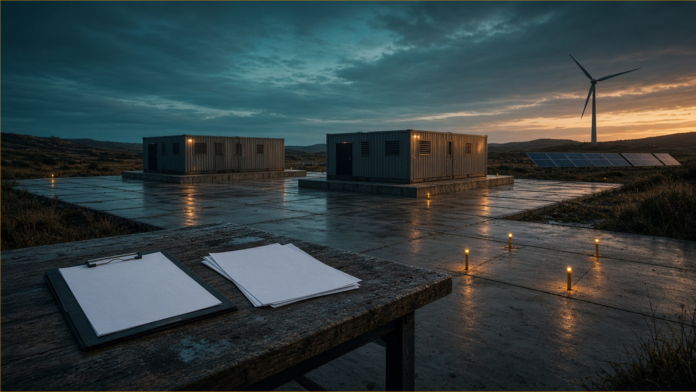
The near-term plan, both companies say, is an initial deployment of about 11 MW of Armada Leviathan units across five Australian states. WinDC describes each Leviathan as providing “up to 2MW of computing infrastructure per unit,” to be placed at or near existing energy generation sites, including wind and solar facilities. It says it is targeting deployment timelines of approximately 90 days “where sites, power and approvals are ready.” That 90-day figure is a company target that starts after the siting, power and approvals work is done. It is not a promise that every pad will be live in three months.
Further out, both companies describe a further 230 MW of new capacity in 2027, and a longer-range plan of up to 3 GW across approximately 40 sites in Australia and New Zealand by the end of 2030. They put the associated project investment at more than US$30 billion, including more than US$20 billion in Armada’s US-manufactured infrastructure. Those dollar and capacity figures are the companies’ own plans. They have not published a site-by-site list, a signed offtake book, or a financing close that would convert the letter of intent into a committed build.
WinDC’s chief executive, Andrew Sjoquist, tied the near-term work to that 2027 target. “Our immediate focus is delivering 230MW of new capacity in 2027, while building towards a national network that could attract more than US$30 billion in investment by the end of the decade,” he said in the company’s post.
WinDC also says the model can use renewable electricity that would otherwise be curtailed. It states that more than seven terawatt-hours of utility-scale wind and solar generation were curtailed across Australia’s National Electricity Market in 2025, “according to figures cited in the WinDC-Armada agreement.” That curtailment figure is attributed to the agreement as WinDC presents it. It has not been independently checked in this article.
The companies place the plan in the American SI Exports Program, the US Commerce Department initiative that designated 33 “super intelligence” AI export consortia this week. Armada said it has been named a Priority Team Leader under that programme and that it leads the “American Sovereign SI Stack,” a consortium with Dell Technologies and Microsoft. WinDC says its proposed Australian rollout is included in Armada’s export plans, and that designated consortium leaders receive US government advocacy, prioritised export-licence processing and referrals to federal financing agencies. Those statements are the companies’ account of Armada’s role. TSN’s earlier report on the Commerce designation recorded the official 16 November announcement, but did not independently confirm a complete public list of named consortia from a stable official text. WinDC and Armada also say they “intend to explore potential financing support for future deployments, including through the Export-Import Bank of the United States (EXIM).” That is an intention to explore a loan, not an approved facility.
Armada already appears in TSN’s coverage of modular AI infrastructure as one of the 17 companies NVIDIA has listed as partners for its DSX POD factory-built container design. The WinDC plan is a different project, built around Leviathan units at or near generation sites rather than a generic container hall. It also sits alongside other early-stage Australian data-centre proposals TSN has covered, including IREN’s planned 900 MW Redbank campus near Wagga Wagga and AirTrunk’s A$4.25 billion green loan for its SYD3 campus in Western Sydney. Those are campus-scale developments, not the same modular, generation-site model, but they are part of the same country-level build-out against which this letter of intent should be read.
A letter of intent is not a built 3 GW network
The most important fact in the two company posts is also the easiest to over-read. Armada says a letter of intent has been signed. WinDC’s headline language treats the same paper as an “AI deal worth up to US$30 billion” and, in Sjoquist’s remarks, as evidence that the US government is “backing” advanced AI technology to be built in Australia. A letter of intent can be a serious commercial step. It is not, by itself, a grid connection, a planning consent, a construction start, or a cheque for US$30 billion. The 11 MW first phase, the 230 MW target for 2027 and the 3 GW, 40-site plan for the end of 2030 should be kept in that register: they are the companies’ staged ambitions, and only the first of them is described as an initial deployment.
The same caution applies to the supporting claims. The 90-day deployment timeline is conditional on sites, power and approvals already being ready. The curtailment figure is cited from the agreement as WinDC presents it, not from an official NEM statistical release quoted in this article. The SI Exports framing is Armada’s and WinDC’s description of a US programme whose official public name-list was not independently reproduced in TSN’s earlier Commerce story. EXIM is named only as a financing route the companies intend to explore. None of those points makes the letter of intent insignificant. They do mean the next facts worth watching are narrower than the 3 GW headline: whether specific sites are consented, whether the first 11 MW is actually energised, and whether any export-credit or project finance is later announced as a closed facility rather than an intention to look.
Sources
- Armada, “Armada and the American SI Exports Program: sovereign infrastructure for American AI,” 16 November 2026.
- WinDC, “US Government backs WinDC’s AI factory rollout in Australia,” 18 November 2026.
Get TSN’s biggest tech stories, explained.
News and insights across AI, tech, crypto and cybersecurity. Every source linked. Unsubscribe anytime.
Get the newsletterRelated stories
US Commerce Designates 33 Super Intelligence AI Export Consortia is the closest recent TSN account of the US programme Armada and WinDC now say they are operating under, and is the next read.
- IREN Proposes Redbank, a 900MW Data-Centre Campus Near Wagga Wagga
- AirTrunk Secures A$4.25bn Green Loan From 32 Lenders for Sydney SYD3
- NVIDIA Says DSX POD Can Bring AI Factories Online in 14 Days
Follow @tsnmediahub on X for breaking AI news as it happens.
Follow on X