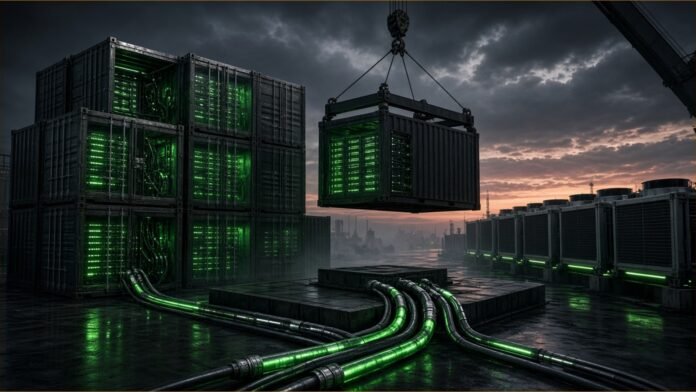
“An AI factory creates value when it starts producing tokens — not when construction is complete,” Jensen Huang said on Wednesday. At GTC Berlin, NVIDIA’s chief executive put a number on how much of that construction he wants to remove: a data centre that arrives in shipping containers, already cabled, plumbed and tested, and can be running in as little as two weeks.
The product is DSX POD, a reference design for complete AI data centres built around NVIDIA’s next-generation Vera Rubin systems. Partners assemble and validate everything inside modular containers before shipping, and NVIDIA says that cuts deployment at a prepared site from six months to as little as 14 days. NVIDIA frames the pitch in money as much as engineering: the sooner a site starts producing tokens for customers, the sooner it starts earning.
In brief
- NVIDIA’s DSX POD packages Vera Rubin AI data centres into factory-built containers, with 17 partners due to deliver them worldwide in early 2027.
- NVIDIA claims set-up at a prepared site falls from six months to as little as 14 days, and pairs the launch with water and power-saving claims for its wider DSX platform.
- Prices, sizes and first customers have not been disclosed, and none of the figures has been independently tested.
The wiring moves to the factory, but the site still has to be ready
Under DSX POD, partners do the rack-to-rack cabling, wiring, piping and functional checks in their own plants. The containers then connect to power, cooling and networking that the customer has already built, using a standard 800-volt direct-current power input, according to NVIDIA’s technical blog.
The blog is candid about the limits. The containers still need land, foundations, grid power and heat-rejection plant waiting for them, and NVIDIA says the design changes where integration happens rather than removing on-site work. Conventional builds remain an option; the container route is pitched at large deployments where a predictable schedule matters most. The 14-day figure, in other words, starts the clock after the slow part of site preparation is done.
Seventeen companies are lined up to build and deliver the units: Anduril, Armada, Bull, Crusoe, DayOne, Dell Technologies, Delta, Eaton, Foxconn (Ingrasys), GIGABYTE, HPE, Lenovo, Pegatron, Quanta Cloud Technology, Schneider Electric, Vertiv and Wistron. Delivery is due “worldwide in early 2027”. NVIDIA gave no prices, container sizes or launch customers.
NVIDIA also claims big water and power savings for Europe
A companion announcement made the case for the wider DSX platform in Europe on water and power. Vera Rubin racks are fully liquid-cooled at coolant temperatures of up to 45C, which lets operators reject heat through dry coolers, essentially large radiators, instead of evaporative cooling towers. NVIDIA says that can cut facility cooling water to near zero and, at 2-gigawatt scale, save 54 million litres a day, about what 180,000 households use. Hot climates may still need extra mechanical cooling in peak periods.
Its power software makes bolder claims. DSX MaxLPS allocates power dynamically within a fixed budget, which NVIDIA says lets operators produce the same output with up to 30% less power. CoreWeave, Firmus, Google Cloud, IREN, Lambda, Nebius, Nscale and Sharon AI are exploring the software. Partners have published early results:
| Trial (partner) | Hardware | Claimed result |
|---|---|---|
| MaxLPS proof of concept (Lambda) | HGX B200 systems | 24% more cluster token throughput, 19% more GPU capacity in a fixed power budget |
| MaxLPS evaluation, Iceland (Nscale) | Four GB300 NVL72 racks | 49% more inference throughput, 37% more managed GPU capacity within 264kW |
| DSX Flex grid trial (Emerald AI, EPRI, Nebius, National Grid) | Blackwell Ultra cluster | Up to 40% lower cluster power draw during simulated grid events |
The last trial is the clearest UK link. DSX Flex is designed to let a data centre throttle its demand when the grid is stressed, and Britain’s National Grid took part in the test, in which critical workloads kept running. NVIDIA’s Ian Buck told reporters before the event that when “the grid needs an extra gigawatt, our data centers can be a resource to respond to that need”, DatacenterDynamics reported.
A month of DSX announcements points to a packaged product
DSX POD is the latest step in a run of DSX news. Last week NVIDIA open-sourced its Run:ai orchestration platform as part of the platform, a day after it released DSX management software alongside Vera Rubin rack designs for the Open Compute Project. Three of those tools, Config Manager, Rack Management Service and Cluster Readiness Engine, are now in developer preview, with clouds including CoreWeave, Crusoe, G42 and Nscale exploring them.
Together they suggest NVIDIA wants to sell not just chips and racks but a whole data centre as a repeatable unit, with partners doing the building. Whether 14 days holds up will not be known until the first containers reach real sites, which on NVIDIA’s own timetable means early 2027.
Related stories
- NVIDIA Makes Its Full Run:ai Platform Open Source as Part of NVIDIA DSX AI Factory
- NVIDIA Opens Vera Rubin Rack Designs to OCP, Meta Adopts Spectrum-6 and Google’s Falcon Comes to ConnectX-10
Sources
- NVIDIA: NVIDIA Introduces DSX POD AI Factories to Accelerate Europe’s Infrastructure Deployment, 21 October 2026
- NVIDIA: European Ecosystem Builds World’s Most Efficient AI Factories With NVIDIA DSX, 21 October 2026
- NVIDIA Technical Blog: Achieve Productive AI Capacity Faster and More Predictably With NVIDIA DSX POD
- DatacenterDynamics: Nvidia launches DSX POD, claims the Vera-Rubin reference architecture will make AI data centers more water and energy efficient, 21 October 2026
Follow @tsnmediahub on X for breaking AI news as it happens.
Follow on X