
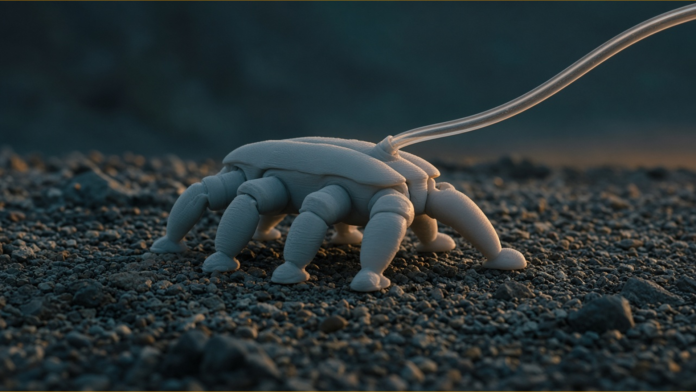
Engineers at the University of California San Diego have built a six-legged soft robot that is 3D-printed in a single pass from one material, runs on compressed air rather than electronics, and reached speeds of up to 4.72 metres per second, the university said in a news story accompanying a paper in the 18 November 2026 issue of Science Robotics. The paper, “Printing powerful soft robots on a desktop,” by Yichen Zhai and Michael T. Tolley, describes a monolithically printed hexapod whose pneumatic oscillator is inspired by the compound steam engine. For now, the university says, the machine “can only function when tethered to a source of compressed air.”
In brief
- The UC San Diego soft robot is 3D-printed in one go from a single material, has no onboard electronics, and is driven by pressurised air through an internal network of chambers, valves and tubes.
- In tests it reached 4.72 metres per second, which the team says is more than 100 times faster than its 2022 predecessor, which managed about 4 centimetres per second.
- The robot ran on sand, mulch, concrete, gravel and lawn, ran down stairs, swam and still worked underwater. Untethered operation and steering remain future work, and proposed uses such as disaster response are aspirations.
A compound-steam-engine trick made the soft robot much faster
The new soft robot comes from the Bioinspired Robotics and Design Laboratory at the UC San Diego Jacobs School of Engineering, led by postdoctoral researcher Yichen Zhai and Professor Michael T. Tolley. It builds on the group’s first 3D-printed, air-powered walking robot, developed in 2022 and later described in Advanced Intelligent Systems, which could travel only about 4 centimetres a second because of limits on the air pressure and airflow it could handle.
Raising those pressures was the obvious route to more speed, but it created a new waste problem: high-pressure air could be exhausted while it still held a lot of unused energy. The team’s answer was a series of chambers and valves that let the same air circulate twice, first in smaller, high-pressure chambers to power the valves, then in larger, low-pressure chambers to move the legs, in the manner of a compound steam engine. The university says that change allowed the new robot to run more than 100 times faster than the 2022 design.
Zhai said: “Our first walking robot demonstrated what was possible, but it was too slow. We hoped to overcome this limitation, and we were fortunate to find a solution to make the new robot 100 times faster.” Tolley said: “The key challenge was to implement a time-tested solution (the compound steam engine) in a soft running robot that can be printed in a single piece out of a single material. We see this as a step towards complex and powerful robots that can be printed on the desktop using inexpensive materials.”
The team tested the robot on concrete, gravel, lawn, mulch and sand. It could run down stairs, swim, and still function underwater. The Science Robotics paper also notes that the architecture could be operated with a liquid working medium, tap water. The work was funded by the US National Science Foundation. Zhai and Tolley are inventors on a US provisional patent application related to the work, the paper’s competing-interests statement says.
The hose is still part of the machine
The university is clear about the present limit. “For now, the robot can only function when tethered to a source of compressed air, such as a traditional air compressor.” The next steps the researchers describe are designs that use less compressed air, so a future version might run untethered from a portable cartridge, and designs capable of more complex motions, including steering and object manipulation. Those remain plans.
The same caution applies to the settings in which this class of electronics-free robots “could eventually be used,” in the university’s words: scientific reconnaissance in areas with high radiation or magnetic fields, disaster response and space exploration. Those are aspirations, not tasks this tethered hexapod has been shown to carry out.
That distinction matters when the result is set beside other recent machines. MIT’s insect-scale microrobot with onboard sensing and compute was also a laboratory demonstration, and it too still depended on an off-board power tether even as it carried its own camera and computer. Maryland’s RoboScout, which won DARPA’s $1.5 million triage prize, was judged in a field challenge rather than a locomotion paper. Hong Kong’s planned defibrillator-delivery drone trial is a scheduled outdoor pilot for a humanitarian task, which this soft robot has not yet been asked to perform.
A fast lab gait is not an untethered field robot
The striking number in the paper is the top speed: 4.72 metres per second, from a fully soft, electronics-free, single-material print. That is a genuine locomotion result, and the 100-fold improvement on the 2022 walker is the team’s own comparison, grounded in the compound-engine reuse of the air supply. It is also a result obtained on a hose. Every terrain claim — sand, mulch, concrete, gravel, lawn, stairs, swimming, underwater walking — describes a robot that has to stay connected to a compressor. The photograph of a pale hexapod crossing rough ground is easy to misread as a self-contained explorer. It is not.
The future-work list is therefore the right frame, not a footnote. Untethered operation will depend on using less air, or on carrying a cartridge, and the team has not shown that yet. Steering and object manipulation are likewise still to be designed. Until those steps are demonstrated, talk of disaster response or space reconnaissance should stay in the same register as the university’s “could eventually be used.” The NSF funding and the desktop-printing ambition are real; they still leave a tethered laboratory gait short of a field-ready platform.
There is still a clear engineering lesson. By packing a high-frequency, four-phase pneumatic oscillator into a single print, Zhai and Tolley have shown that an electronics-free soft robot can be fast on mixed ground and in water, provided it is fed with air. The same soft robot remains a compressor-fed laboratory machine until an untethered design is shown. That is worth taking seriously on its own terms. The next paper will be more persuasive if the hose has gone, or if the machine can turn.
Get TSN’s biggest tech stories, explained.
News and insights across AI, tech, crypto and cybersecurity. Every source linked. Unsubscribe anytime.
Get the newsletterRelated stories
- MIT Microrobot Flies With Onboard Sensing and Compute
- Maryland’s RoboScout Wins DARPA’s $1.5 Million Triage Prize
- Hong Kong to Pilot Drones Delivering Defibrillators in Hill Rescues
Sources
- UC San Diego Today, The Fastest Soft Robot Ever Built Doesn’t Need Electronics to Function, 18 November 2026
- Yichen Zhai and Michael T. Tolley, Printing powerful soft robots on a desktop, Science Robotics, 18 November 2026, doi: 10.1126/scirobotics.aei1264
Follow @tsnmediahub on X for breaking AI news as it happens.
Follow on X


