The University of Maryland’s RoboScout team has won the systems competition at the DARPA Triage Challenge, taking a $1.5 million grand prize after finals held on 13 November 2026 at Disaster City, a training site in College Station, Texas. DARPA published the results on 16 November, and the university posted its own account the same day.
The contest was a test of disaster-response technology, not a report from a real incident. DARPA said competitors used autonomous systems and human-machine teams to move through simulated catastrophic events, including a tornado hitting an open-air market, smoke, heavy darkness and complex obstacle lanes. The University of Maryland said its team’s runs involved actors, manikins and trained medics, in scenarios that included a military compound, the aftermath of a tornado in a residential area, and an attack on critical infrastructure. Those were staged exercises at a training ground.
Drones and robot dogs fed a medic interface
The university described the DARPA Triage Challenge as a three-year event intended to improve triage in mass-casualty situations, both civilian and military, through the use of autonomous systems. Team RoboScout was led by Willis H. Young Professor Derek Paley. It used autonomous drones, ground robots and artificial intelligence to help human personnel locate people, assess injuries and set a priority for care.
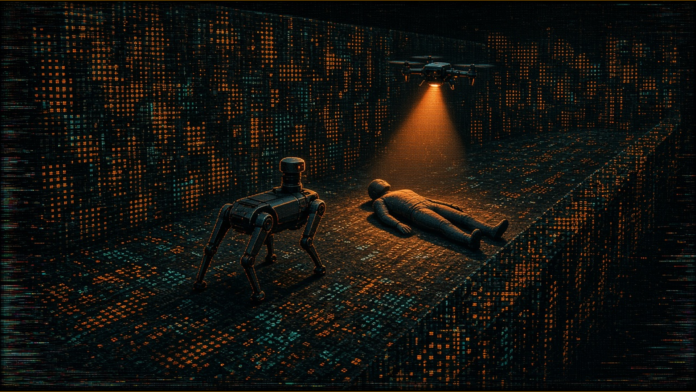
According to the university, drones and robotic dogs equipped with colour and thermal cameras, radar and microphones searched for “victims” and looked for signs of injury, blood loss, respiratory distress, trauma or amputation, while measuring heart rates, alertness, oxygen levels and other vitals. That information was then passed to human first responders, with colour-coded virtual “push-pins” appearing on their tablets to indicate levels of priority. Rain Technology Solutions, a team member, supplied the medic interface that the university said gives first responders situational awareness.
RoboScout also received a $12,500 gate prize for accurate vitals, which DARPA listed under its technical-capability awards. The University of Maryland said the team came from behind to take the top spot as the final events closed.
Paley described the team’s core software, which he called Triage AI, as “basically an inference engine for robotic assessment of patient status using both historical and live observational data.” In the same remarks he said: “The robots and drones are the current embodiment of this core IP. They are the mobile sensor platforms that feed the observations into our inference engine and from there we can make deductions about both observable and unobservable health states including triage status and evacuation priority.”
He also credited a “culture of experimentation and field testing,” and said the team had partnered with the US Air Force’s Center for the Sustainment of Trauma and Readiness Skills to run several tests, including a mass-casualty simulation at the Fairfax County Urban Search and Rescue Training Facility earlier this year. Those, too, were training events.
Other prizes, and a short window for a follow-on topic
DARPA’s systems runner-up was DART, which received $500,000. In a separate technical-capabilities ranking, UAS-DTU took first place and $300,000, and Guardian Angel was runner-up on $150,000; both of those teams were marked as self-funded. DART also collected three $12,500 gate prizes, for find-and-locate, rapid triage and trauma assessment.
In the data competition, which DARPA described as the prediction of life-saving interventions and resource allocation, a team called Disruptors won $1 million. The runner-up, OCA-SENTINEL, received $300,000.
DARPA is a US defence research agency, and the challenge sits in a line of work that mixes civilian disaster response with military trauma care. The framing that matters for this result is still the one on the ground at Disaster City: robots and drones scouting a prepared training site, with medics in the loop, rather than machines making treatment decisions in a real emergency. Similar practical tests, at a smaller scale, have already been a theme in TSN’s Tech for Good coverage, including Guangzhou’s rescue-robot contest on fire and flood tasks and Hong Kong’s planned trial of drones carrying defibrillators into hill rescues.
Anyone wanting to follow the research can still look at a short, open window. DARPA said it has an SBIR topic, TRIAGE-X, open until 25 November 2026, which seeks autonomous triage systems that can recognise chemical toxidromes and deliver the corresponding antidote or other life-saving intervention. That is a research call, not a fielded system.
A colour-coded pin is not a diagnosis
A $1.5 million win at Disaster City is a serious engineering result, and it should be read as one. It is also a result from a purpose-built training city, scored on lanes that DARPA had designed, with actors and manikins standing in for casualties. That is the right way to compare teams. It is a weak way to claim that the same stack will hold up when radio links drop, when a building has actually collapsed, or when a crowd is moving in ways no drill has rehearsed.
The more interesting, and sharper, claim sits in Paley’s description of Triage AI. An inference engine that uses live sensor data and historical records to estimate “unobservable health states,” then writes a triage status and an evacuation priority onto a medic’s tablet, is doing more than mapping a heart rate. It is offering a judgement. The colour-coded pin is a useful briefing tool if the estimate is good, and a dangerous one if a first responder treats the pin as a finding. The university’s own account is careful on the last step: the robots search and measure; human personnel still set the priority for care. That division is worth keeping in view as the software is described as an engine for “deductions.”
The prize table points in the same direction. DART won the gates for finding people, for rapid triage and for trauma assessment, while RoboScout won on accurate vitals and then on the overall systems score. DARPA’s own list already shows that no single team led every part of the problem. The open TRIAGE-X topic, which asks for systems that can recognise chemical poisoning patterns and physically deliver an antidote, would raise that bar again. It is a research brief with a deadline in a week’s time, not evidence that such a capability already exists.
The next facts to watch are whether RoboScout’s medic interface is tested outside a prepared training ground, and whether later write-ups separate what the sensors measured from what the inference engine inferred.
Sources
- DARPA, “DARPA Triage Challenge completes Finals event,” 16 November 2026.
- University of Maryland A. James Clark School of Engineering, “Team RoboScout Wins DARPA Triage Challenge,” 16 November 2026.
- DARPA Triage Challenge programme page.
- US Department of Defense SBIR topic listing for TRIAGE-X, open until 25 November 2026.
Get TSN’s biggest tech stories, explained.
News and insights across AI, tech, crypto and cybersecurity. Every source linked. Unsubscribe anytime.
Get the newsletterRelated stories
The nearest TSN follow-ons are other tests of robots and drones that assist, rather than replace, human rescue crews.
- Tech for Good This Week: Blood Tests, Methane Leaks and Lab Models
- Hong Kong to Pilot Drones Delivering Defibrillators in Hill Rescues
- Guangzhou Rescue Robot Final Tests 29 Teams on Fire and Flood Tasks
Follow @tsnmediahub on X for breaking AI news as it happens.
Follow on X