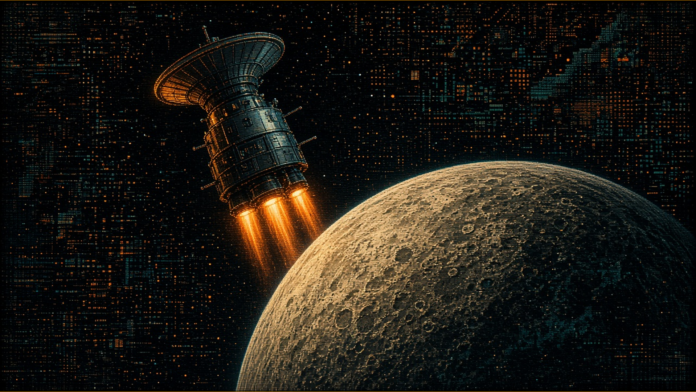
BepiColombo is in orbit around Mercury after an insertion burn on 21 November ended earlier than planned. The European Space Agency, in an operations account dated 23 November, said the manoeuvre began at 18:24 UTC, 635 kilometres above the planet, and was meant to last 37 minutes. When contact was restored, the spacecraft was in safe mode.
ESA said the shortened burn achieved “around 77% of the total planned velocity change.” The fault has been “traced to a software issue involving attitude guidance and thruster control.” Teams at the European Space Operations Centre in Darmstadt and at Airbus, the lead spacecraft manufacturer, are still investigating. The agency also said BepiColombo is safe, in a stable orbit, and on track for the next milestones of the joint ESA and Japan Aerospace Exploration Agency mission.
A longer first orbit, with the later dates left intact
The orbit now being flown by BepiColombo is 75 hours, ESA said, rather than the 58 hours originally planned. The remaining insertion sequence has already been adapted to that trajectory, “with no additional burns required.” Those changes, it said, leave intact the separation of the two science orbiters on 9 December (10 December in Japan), and the Mercury Planetary Orbiter’s ability to reach its planned science orbit.
After that separation, ESA’s MPO and JAXA’s Mercury Magnetospheric Orbiter, Mio, go their own ways. Mio’s protective sunshield, MOSIF, stays attached to MPO until it is ejected on 16 December. Further burns are then intended to guide MPO to its final orbit by March 2027, with science operations due to start in April 2027.
JAXA’s Mio team, in a 24 November note, said the spacecraft reached Mercury orbit on 22 November Japan time, the first time Japanese and European probes have arrived at the planet. It confirmed that the insertion burn ended earlier than planned because of a software problem on MPO, that the resulting orbit is higher than designed, and that the spacecraft is in a healthy state. Separation of Mio, it said, remains planned for 10 December Japan time. The note points readers to ESA’s operations article for the detailed account.
ESA also said the arrival was the first time a mission has entered orbit around another planet using “weak stability capture” (the same article also calls it “weak gravity capture”): arriving more slowly than is typical, a method previously used by some spacecraft going to the Moon. The 21 November burn was intended to turn that temporary capture into a lasting orbit. Flight Dynamics manager Frank Budnik is quoted confirming “Mercury orbit capture” after the team had reconstructed the path.
A successful orbit insertion is the result this mission needed, even with a glitch in the middle of the burn. That is a different kind of space-operations story from ULA’s Vulcan failure to deliver the first Amazon Leo mission, where the vehicle did not complete the job it was sent to do. It also sits apart from construction and partnership news such as Isar Aerospace starting work on its Nova Scotia launch complex or ESA’s SELYCE direct-to-device partnership with SES. Those are programmes being built or signed. BepiColombo is already at the planet, in a slightly wrong first orbit, with a software investigation still running.
Why a 75-hour orbit can still be a successful capture
The easiest misreading of a shortened burn is to treat any shortfall from a 37-minute plan as a failed insertion. ESA’s own figures cut against that. The spacecraft is in orbit. The velocity change was short of the plan, at around 77%, and the first period is longer, at 75 hours rather than 58. Those are real departures. They are also, in ESA’s account, departures the rest of the sequence can absorb without adding burns and without moving the December separation or the April 2027 start of science.
That is possible only because Mercury orbit insertion was never designed as a single, unrepeatable burn. ESA’s Flight Dynamics team describes a series of shorter firings, each done close to the planet and each followed by a fresh measurement of the actual orbit, so the next manoeuvre can be rewritten. A first BepiColombo orbit that is longer than planned is, on that logic, a new starting point rather than a broken plan. The investigation into the attitude-guidance and thruster-control software still matters, because the same software will be in the loop for later burns. A clean capture does not, by itself, close that inquiry.
JAXA’s confirmation is useful for a second reason. The shorter burn is attributed to MPO software, not to Mio, and the Japanese agency says the spacecraft is healthy and that its 10 December (Japan time) separation plan still holds. Readers should treat the 77% figure, the 75-hour period and the software heading as ESA’s present account, and the investigation as unfinished. The date that will test that account first is 9 December in Europe, 10 December in Japan, when the two orbiters are due to separate. If that happens on time, the glitch will have been an opening-night problem in a sequence that was built to be rewritten after every burn.
Sources
Get TSN’s biggest tech stories, explained.
News and insights across AI, tech, crypto and cybersecurity. Every source linked. Unsubscribe anytime.
Get the newsletterRelated stories
Follow @tsnmediahub on X for breaking AI news as it happens.
Follow on X