
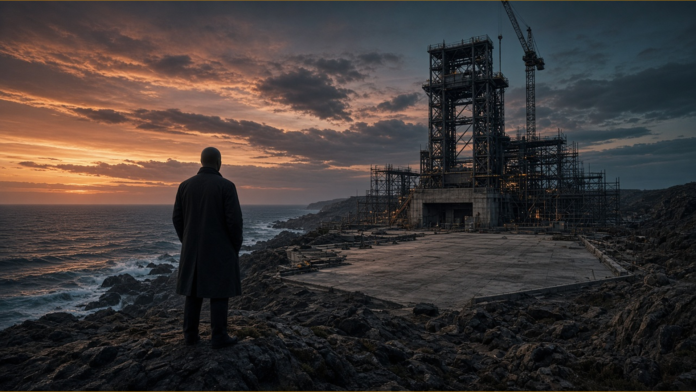
Isar Aerospace has taken over a dedicated launch complex at Spaceport Nova Scotia and begun building the pad it will operate there. In a joint release dated Halifax, 21 November 2026, and also published by Maritime Launch Services, the companies said MLS is handing “a dedicated launch complex at Spaceport Nova Scotia to Isar.” “This marks the moment at which Isar assumes operational responsibility for its own launch infrastructure on Canadian soil and the beginning of construction on what will become Isar’s dedicated launch pad in Canada.”
What Isar will build at Spaceport Nova Scotia
The German launch company “will develop, build and operate a dedicated launch complex, including a final assembly line and a payload preparation facility, for its Spectrum launch vehicle. First orbital launches are targeted for 2028.” That 2028 date is a company target, not a booked manifest or a regulator’s timetable. The notices give no investment figure, no jobs number and no list of customers.
The distinction between a tenant pad and a company-run complex is the point of the handover. MLS remains the developer of the wider spaceport, which it describes as a multi-user orbital launch facility near the coastal communities of Canso, Hazel Hill and Little Dover. Isar, under the partnership, takes operational responsibility for its own complex inside that site and starts construction. Stella Guillen, Isar’s chief commercial officer, said: “Starting construction on our launch complex at Spaceport Nova Scotia brings us a decisive step closer to launching from Canadian soil.”
Stephen Matier, president and chief executive of Maritime Launch Services, said: “Today’s handover marks an important step in the development of Spaceport Nova Scotia and demonstrates the strength of our multi-user spaceport model.” In that model, the spaceport can host more than one launch provider, while Isar builds and runs a dedicated pad, assembly line and payload facility of its own.
The location is intended for over-ocean trajectories to “mid- to high-inclination and polar orbits,” paths often used for Earth observation and communications satellites. Those are the uses the companies put in the foreground. The notices give no date for when concrete work on the pad will be finished, or when a first Spectrum vehicle will be stacked in the new assembly line.
Isar’s second site, and a factory figure from Munich
“Spaceport Nova Scotia will be Isar’s second launch site globally, and its first in North America.” The release does not name the first site. It does say that Isar is ramping up production of Spectrum at a purpose-built factory near Munich “with capacity of 40 vehicles per year.” That is Isar’s own capacity figure for the German plant, not a production schedule for Nova Scotia, and it is not a statement of how many vehicles the company is building today.
Isar also says that in September it “successfully reached orbit on its second mission,” and describes itself as the first European commercial space company to deliver satellites into orbit. That is the company’s own account of a flight that has already happened, and it is offered here as context for why a second, North American site is now being built, not as an independent verification of that mission.
A second site matters for a small-launch firm because a single pad concentrates weather, range and scheduling risk. It does not, by itself, bring the 2028 target any closer. Building a pad, an assembly line and a payload facility is a necessary step; it is not the same as a first Canadian launch. Until Isar or MLS publishes a construction timetable, a licence milestone or a named mission, the public record is a handover and a start of work, plus a target year.
The absence of money and jobs figures should be read the same way. The companies have announced a change of operational control and the start of construction, not the scale of the investment or the size of the local workforce. Those details may follow later. They are not in this release, and they should not be inferred from the handover alone.
For now, the hard facts are straightforward. Maritime Launch Services has handed Isar a dedicated complex at Spaceport Nova Scotia. Isar has assumed operational responsibility and begun to build a pad, a final assembly line and a payload preparation facility for Spectrum. First orbital launches from the site are targeted for 2028, on the company’s own wording. It is Isar’s second launch site, and its first in North America. What remains to be shown is how quickly that complex is actually built, and whether the 2028 target holds.
Sources
Get TSN’s biggest tech stories, explained.
News and insights across AI, tech, crypto and cybersecurity. Every source linked. Unsubscribe anytime.
Get the newsletterRelated stories
- Blue Origin Plans More Florida Pads to Raise New Glenn Flight Rate
- ICEYE Launches a €41-a-Share Cash Tender Offer for Avio
- SpaceX Tells FAA It Expects 10,000 Launches a Year, Seeks Priority
Follow @tsnmediahub on X for breaking AI news as it happens.
Follow on X


