
There is no single, independently established best large language model. Which of the best LLMs 2026 leads depends on the test, the effort setting, the agent harness, and whether the reader cares more about human preference, a composite intelligence score, coding, cost or openness.
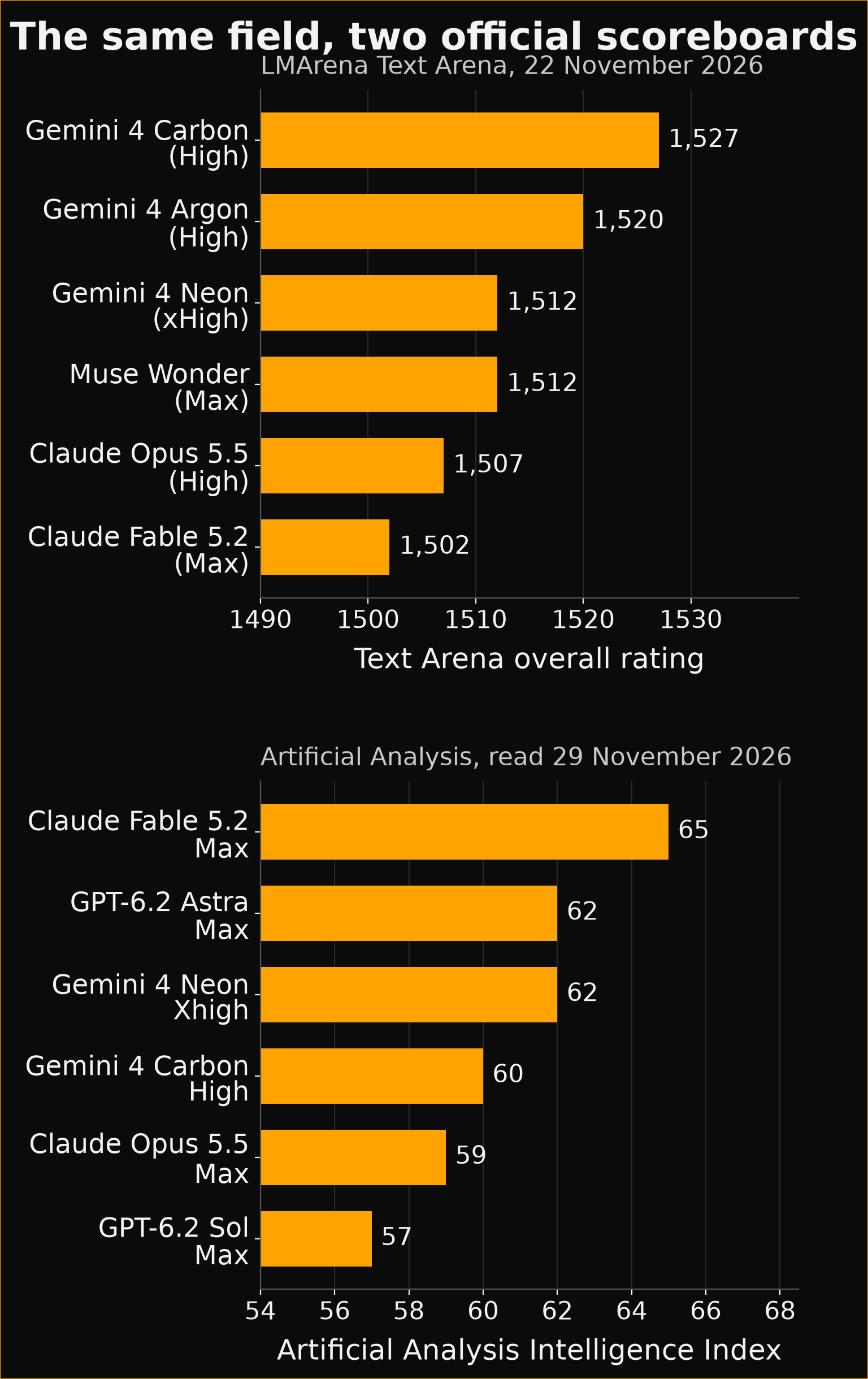
On the LMArena Text Arena snapshot dated 22 November 2026 (9,241,799 votes, 427 models), Google’s Gemini 4 Carbon (High) leads everyday-chat preference at a rating of 1,527, with Gemini 4 Argon (High) at 1,520 and Gemini 4 Neon (xHigh) tied with Meta’s Muse Wonder (Max) at 1,512. On the Artificial Analysis Intelligence Index, as the public table displayed it on 29 November 2026, Anthropic’s Claude Fable 5.2 (Max, Default Fallback) leads at 65, with OpenAI’s GPT-6.2 Astra (Max) and Gemini 4 Neon (Xhigh) close behind at 62. Astra is far cheaper per Artificial Analysis task than Fable in that same read: $4.00 against $26.54.
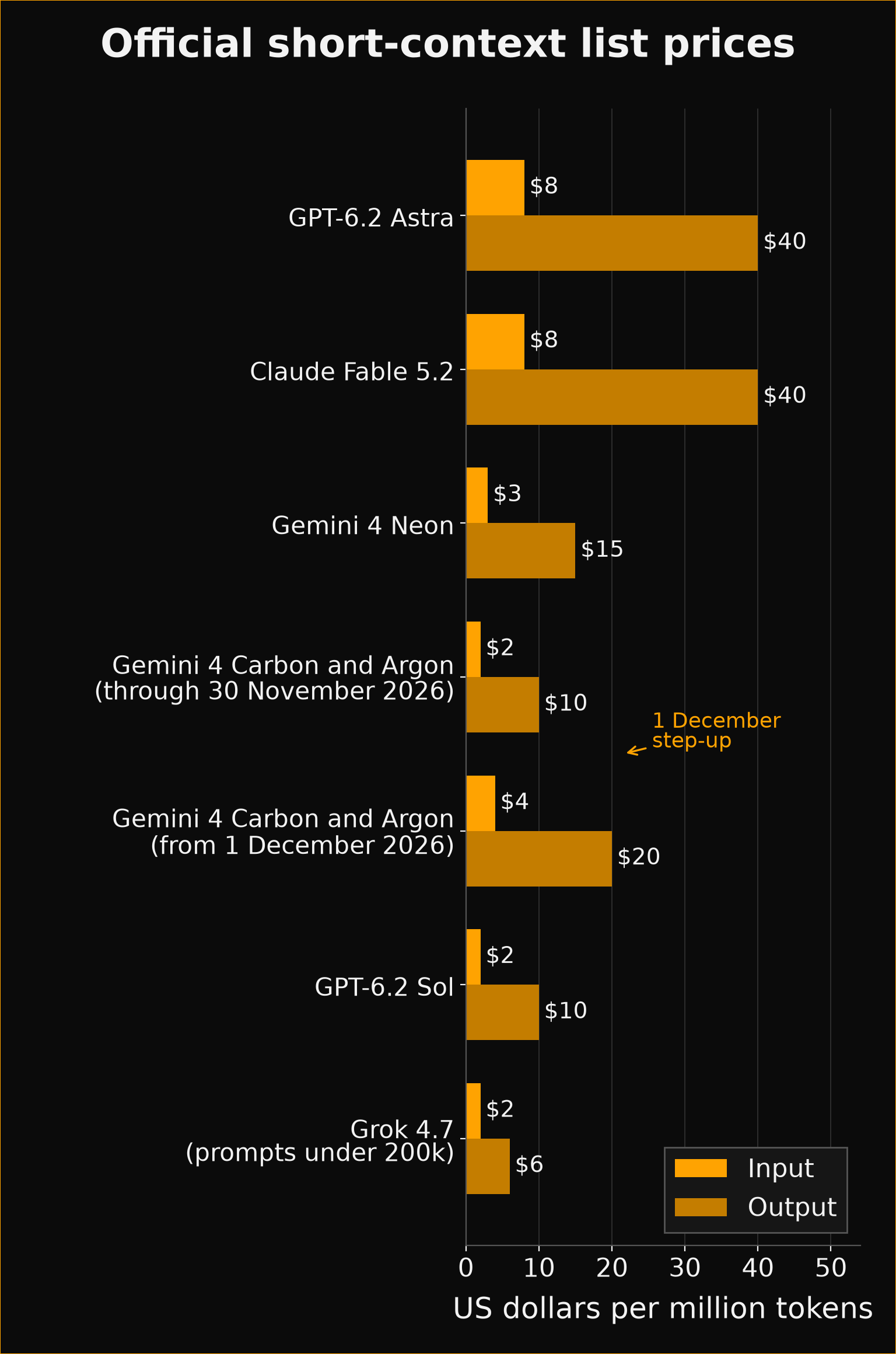
A practical deadline sits behind that split. Google’s introductory Gemini Developer API price for Gemini 4 Carbon and Gemini 4 Argon is $2 per million input tokens and $10 per million output tokens “through November 30, 2026”, then $4 and $20 “starting December 1, 2026”. Google’s 10 November Carbon availability post says the introductory period “expires on November 30, 2026”.
In brief
- Two widely cited official boards currently disagree, after a dense run of frontier releases from mid-October through mid-November.
- A reader who looks at only one board will get the wrong impression of the field; Google’s introductory Carbon and Argon API price also changes on 1 December 2026.
- The boards move, official pages read for this piece did not state a UK availability rule, and Kimi’s live pricing table could not be read, so no current Kimi list price is given.
Arena favours the Gemini 4 family and Muse Wonder
LMArena frames the overall Text Arena as a test of “which model is the best at everyday chat?” The figures below are the organisation’s published ratings from the 22 November 2026 snapshot, read on 29 November, and they show how human preference currently sorts the best LLMs 2026. Arena also prints its own “Cost per task (P50)” and “Blended price $/M (3:1)” columns; those are Arena’s numbers, not the labs’ official list prices.
| Model (setting) | Text Arena rating |
|---|---|
| Gemini 4 Carbon (High) | 1,527 |
| Gemini 4 Argon (High) | 1,520 |
| Gemini 4 Neon (xHigh) | 1,512 |
| Muse Wonder (Max) | 1,512 |
| Claude Opus 5.5 (High) | 1,507 |
| Claude Fable 5.2 (Max) | 1,502 |
Arena’s own labels on that page, which are the organisation’s characterisations rather than independent TSN findings, call Carbon (High) the Frontier model, “7 points above rank 2.” It names MiMo-V2.6-Pro as the Daily Driver, “Near-frontier performance at 1/10th the price,” and gives that model a Pareto-list score of 1,481 at $0.01 per task. It names DeepSeek-V4-Flash as the Efficient pick, “Solid performance at 1/100th the price,” with a Pareto-list score of 1,436 at $0.01 per task. That Arena name should not be silently equated with DeepSeek’s current API model deepseek-flash, which the official pricing page identifies as DeepSeek-V4.1-Flash-1017.
Fable 5.2, which leads the Intelligence Index in the 29 November Artificial Analysis read, is eighth on this Arena snapshot, 25 points behind Carbon. Muse Wonder’s joint-third place is the independent number to set against Meta’s 12 October description of Muse Wonder and Muse Wonder Full as “our most capable models to date,” in the announcement TSN covered when the models were launched.
Carbon also leads the Text Arena coding subset on the same 22 November snapshot (1,988,743 votes, 422 models), at 1,567, which Arena itself describes as “9 points above rank 2.” Neon (xHigh) is second at 1,558, Argon (High) third at 1,554, Claude Fable 5 (High) fourth at 1,551, Muse Wonder (Max) sixth at 1,549 and GPT-6 Astra (Max) seventh at 1,548. Claude Fable 5.2, GPT-6.2 Astra, GPT-6.2 Sol and Grok 4.7 were not in the published overall Text Arena top 15 of that snapshot, nor in the “insufficient cost data” list that starts at rank 20; their absence from those published slices is not a rank.
Google’s 10 November post presents Argon as “the ideal choice for the majority of software engineering and knowledge work” and Carbon as built for “tasks that test the limits of a model’s intelligence.” TSN’s earlier account of Carbon becoming generally available should be read with the later Neon release and with the 1 December price change in mind. Google’s 28 October statement that Carbon ranked “#1 on the recently updated v5.0 of Artificial Analysis Intelligence Index at 59” is a company figure from that date, before Fable 5.2, GPT-6.2 and Neon; the 29 November Artificial Analysis table shows Carbon (High) at 60, behind Fable 5.2.
Artificial Analysis puts Claude Fable 5.2 Max ahead
Artificial Analysis’s models leaderboard, read on 29 November, displays Intelligence Index scores as whole numbers. The organisation’s own on-page summary says “Claude Fable 5.2 (max) and Claude Fable 5.2 (xhigh) are the highest intelligence models, followed by GPT-6.2 Astra (max) and Claude Fable 5.2 (high).” Cost per task and time per task in the table are Artificial Analysis’s own harness measurements, not list prices.
| Model (setting) | Intelligence Index | AA cost per task |
|---|---|---|
| Claude Fable 5.2 Max, Default Fallback | 65 | $26.54 |
| GPT-6.2 Astra Max | 62 | $4.00 |
| Gemini 4 Neon Xhigh | 62 | $6.44 |
| Gemini 4 Carbon High | 60 | $7.76 |
| Claude Opus 5.5 Max, Default Fallback | 59 | $10.04 |
| GPT-6.2 Sol Max | 57 | $1.01 |
Two official figures for Neon should be kept apart. Google’s Neon introduction, dated 18 November and last updated 23 November, says Neon is “#3 overall with a score of 61” on the Intelligence Index at xHigh. The Artificial Analysis table on 29 November displays Gemini 4 Neon Xhigh at 62. Those numbers are not averaged here.
OpenAI’s 17 November announcement describes Astra as “our new frontier model for your hardest projects” and Sol as “our efficient, versatile model for everyday work.” TSN’s launch report already treated OpenAI’s own scorecard for GPT-6.2 as a vendor table, including the footnote that Agents’ Last Exam results for Fable 5.2 “exclude nine tasks that used a fallback model.” On the 29 November Artificial Analysis board, Astra (Max) matches Neon’s displayed Index score of 62 at a lower AA cost per task, and Sol (Max) is at 57 for $1.01.
For readers who want open weights from the best LLMs 2026 field, Artificial Analysis’s own filter on that board puts Kimi K3.1 Pro first at 47, then Tencent Hy4 at 35 and DeepSeek V4.1 Flash 1017 (Max) at 32. The FAQ on the same page says 56 of 127 models are listed as open weights.
| Model | Intelligence Index |
|---|---|
| Kimi K3.1 Pro | 47 |
| Tencent Hy4 | 35 |
| DeepSeek V4.1 Flash 1017 (Max) | 32 |
Grok 4.7 (Xhigh) is at 35 on that same table, with an AA cost per task of $7.77, well below the current frontier cluster. Official xAI pricing is $2 per million input tokens and $6 per million output tokens for prompts below 200,000 tokens ($4 / $12 at or above that threshold, billed at the higher rate for all tokens in the request), with a 500,000-token context window. The announcement page does not print a calendar day; official release notes place the launch in the September 2026 section. Its comparison table is against Grok 4.6, GPT-5.6 Sol and Fable 5.1, not against GPT-6.2, Fable 5.2 or the Gemini 4 family. Trade-press reports that Grok 4.7 tops VulcanBench are already covered, with that caveat, in TSN’s earlier piece.
Official list prices, and Google’s 1 December step-up
The rates below are the labs’ own short-context list prices, in US dollars per million tokens, as read on 29 November 2026. They are another way to sort the best LLMs 2026, and they are not the same thing as Arena’s cost-per-task column or Artificial Analysis’s cost per task.
| Model | Input / output per 1M tokens |
|---|---|
| GPT-6.2 Astra | $8 / $40 |
| Claude Fable 5.2 | $8 / $40 |
| Gemini 4 Neon | $3 / $15 |
| Gemini 4 Carbon and Argon | $2 / $10 through 30 November 2026; $4 / $20 from 1 December 2026 |
| GPT-6.2 Sol | $2 / $10 |
| Grok 4.7 (prompts under 200k) | $2 / $6 |
Other official sheets on the same day: Claude Opus 5.5 is $4 / $20; Muse Wonder in Standard mode is $4 / $20, while no Muse Wonder Full list price was found (it is a Muse Code subscriber model); DeepSeek-V4.1-Flash-1017 (deepseek-flash) is $0.15 input (cache miss) and $0.60 output off-peak, or $0.30 / $1.20 at peak. Kimi’s official API pricing page states a 1,048,576-token context for all K3-series models and batch inference at 60% of the standard price for kimi-k3.1-pro and kimi-k3, but the numeric price table did not render on 29 November, so no current Kimi list price is published here.
Company scorecards are not a third official board. Anthropic’s 9 November Fable 5.2 table compares GPT-6 Astra and Gemini 4 Carbon, not GPT-6.2 or Neon, and some rival settings in that table are uneven. OpenAI’s 17 November post, already noted above, is a vendor comparison with a stated footnote on Fable. Labs’ own cyber benches appear in several company posts; they are the companies’ own figures, and TSN has already set out why those figures should be read with caution in its Kimi K3.1 Pro article.
Google’s Neon post also says the model ranks “#1 overall on the Artificial Analysis Coding Agent Index (58.6).” The live coding-agents page, read on 29 November, identifies that index as v2.1, an equal-weight composite of FrontierCode-AA 2.0, Terminal-Bench 4.1 and SWE-Atlas-QnA-AA. The visible chart table is rendered in the browser; the official page data on that date shows Gemini 4 Neon (Xhigh) in Antigravity CLI at 58.64, narrowly ahead of Claude Fable 5.2 (Xhigh, Default Fallback) in Claude Code at 58.47. Google’s 58.6 and the 58.64 on the page are recorded separately and are not combined. Artificial Analysis itself says the results “reflect specific evaluated agent variants, not just generic product names.”
Choosing among the best LLMs 2026 depends on the job, not a single board
The two boards can disagree without either being wrong, because they are not measuring the same thing. Arena records what voters prefer in anonymised everyday chat. That is a real signal for consumer-facing assistants, and it is not a certificate of factual accuracy or a proof that generated code runs. Artificial Analysis’s Intelligence Index is a composite of nine evaluations in four equal categories. The public table shows those scores as whole numbers, and the cost and time columns are measurements inside that harness, which is why Astra can sit close to Fable on the Index at a much lower AA cost per task, and why a cheap official token rate can still become an expensive job if a model thinks for a long time. Fable 5.2 Max is also shown at 40.6 minutes per Intelligence Index task in the 29 November read, against 17.0 minutes for Astra Max and 10.8 minutes for Sol Max.
Labs often quote their own benches against older rivals, or at effort settings that are not aligned. That does not make the tables worthless; it does mean they should not be flattened into a single league. The same model name can move both quality and the bill between High, Max and xHigh, and a coding-agent result is a model-plus-harness pair, not a bare-model trophy.
The useful choice is therefore practical. For the hardest long-horizon work, readers will care about the top of the Intelligence Index and about the effort setting that produced it, and they will have to weigh Fable 5.2’s lead against its AA cost per task. For everyday volume, Sol’s $1.01 per AA task, DeepSeek’s official off-peak token rates, or Arena’s own Daily Driver and Efficient labels may matter more than a three-point Index gap. For open weights, Kimi K3.1 Pro is the leading model on the 29 November Artificial Analysis filter, not a default winner on the closed-model boards. Hosted APIs and open weights are different purchasing decisions, and so are a 500,000-token Grok context window and the 1,000,000-token-class windows listed for several rivals.
TSN’s earlier job-by-job assistant picker remains a useful companion for matching a consumer product to a task, but the model names and plan details in that 10 October 2026 piece predate Fable 5.2, GPT-6.2, Neon and Carbon’s general availability. The underlying models have moved on. Anyone still looking for one trophy among the best LLMs 2026 will be disappointed; the useful question is which test, cost and effort setting match the work. Figures in this piece were checked on 29 November 2026, Europe/London. Arena’s published snapshot is 22 November; Artificial Analysis’s public table does not print a snapshot date. Both boards change. The one date that will not wait is 1 December, when Google’s introductory Carbon and Argon API price steps up.
How we sourced this
LMArena figures are from the 22 November 2026 Text Arena snapshot, read on 29 November 2026. Intelligence Index figures are the whole numbers shown on Artificial Analysis’s public models table on 29 November. Coding Agent Index scores were taken from the official Artificial Analysis coding-agents page data on the same day, after the visible table did not render as static text; Google’s 58.6 remains the company’s citation of that index and is not substituted for the 58.64 shown in the page data. List prices are from the labs’ own pricing pages, read on 29 November. Kimi’s official numeric price table could not be read, so no current Kimi list price is given. Official pages read for this piece did not state a UK availability rule.
Sources
- LMArena Text Arena and the coding subset, snapshot 22 November 2026, read 29 November 2026
- Artificial Analysis models leaderboard, read 29 November 2026
- Artificial Analysis Coding Agent Index, read 29 November 2026
- OpenAI, Introducing GPT-6.2 Astra and Sol, 17 November 2026, and OpenAI API pricing
- Anthropic, Claude Fable and Mythos 5.2, 9 November 2026, and Claude API pricing
- Google, Introducing Gemini 4 Carbon, 28 October 2026; Gemini 4 Carbon now available, 10 November 2026; Introducing Gemini 4 Neon, 18 November 2026, updated 23 November 2026; Gemini Developer API pricing
- xAI, Grok 4.7; Grok 4.7 model docs; xAI release notes
- Meta, Introducing Muse Wonder models, 12 October 2026, and Meta Model API pricing
- DeepSeek API pricing and the DeepSeek-V4.1-Flash-1017 post, 17 October 2026
- Kimi API pricing and the Kimi K3.1 Pro tech blog
Get TSN’s biggest tech stories, explained.
News and insights across AI, tech, crypto and cybersecurity. Every source linked. Unsubscribe anytime.
Get the newsletterRelated stories
Grok, ChatGPT, Claude or Gemini? Pick the AI by the Job is the closest companion: a job-by-job consumer picker whose October 2026 lineup has since been overtaken by Fable 5.2, GPT-6.2, Neon and Carbon’s general availability.
- OpenAI Launches GPT-6.2 Astra and Sol, Now on Bedrock — the 17 November launch, with OpenAI’s own benches treated as a vendor scorecard.
- Gemini 4 Carbon Is Generally Available, Google Says — the 10 November availability post, now sitting just ahead of the 1 December introductory-price change.
Follow @tsnmediahub on X for breaking AI news as it happens.
Follow on X