Chats with the GLM 5.3 Flash model in Brave’s Leo assistant are now end-to-end encrypted and processed inside hardware enclaves run by NEAR AI, with the decryption key released only after the enclave proves what code it is running. Brave announced the change on 15 October 2026, and NEAR AI published its own account the same day. Brave says the feature is available in its Release, Beta and Nightly channels.
The point is to make an AI assistant’s privacy something a user can check rather than a promise. Leo sits inside the browser, next to the pages people read, and the questions they ask it can reveal health worries, debts or legal problems. Brave’s design aims to keep both Brave and NEAR AI from ever holding a readable copy of those conversations.
The key is released only after the enclave passes checks
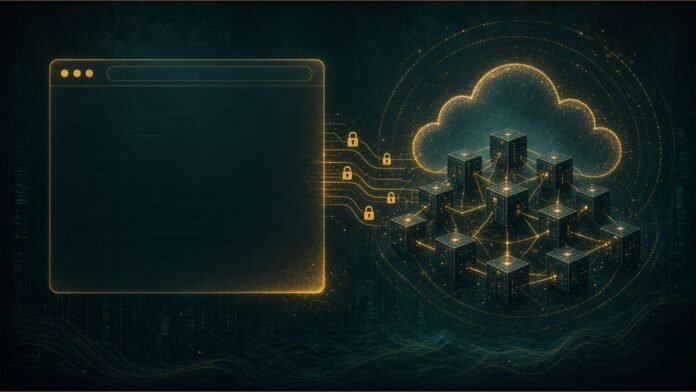
According to Brave, the process starts before any prompt leaves the device. NEAR AI’s trusted execution environment (TEE), built on Intel TDX processors and NVIDIA confidential-computing GPUs, must present hardware-signed attestation. NEAR AI says Brave’s open-source verifier checks the Intel quote against Intel’s signature, checks the GPUs with NVIDIA’s attestation service and rebuilds NEAR AI’s code from public source to confirm it matches what is running. “No pass, no key,” NEAR AI writes.
Once the checks pass, the browser encrypts each prompt with Oblivious HTTP to a key that exists only inside the enclave. The encrypted prompt travels through Brave’s open-source AI Gateway, which removes the user’s IP address before forwarding it. Brave says the relay sees the IP address but not the words, and the enclave sees the words but not the IP address. Inside the TEE the prompt is decrypted in protected memory, the model answers, and the reply goes back encrypted.
Brave says the model can also search the web from inside the enclave, using the Brave Search API with zero data retention, so search queries are not tied to the user’s IP address either. In its own tests, encrypting a prompt took 297 microseconds and decrypting a streamed reply 5.76 milliseconds, against a 19.9-second chat request, Brave said on LinkedIn.
From a Nightly experiment to every user who picks the model
Brave first used NEAR AI’s TEEs in November 2025, running DeepSeek V3.1 in its Nightly test browser. Brave now says those early protections “rested on policy, not cryptography”, because Brave’s own servers checked the enclave proofs. The new release open-sources the verifier, encryption and relay, and puts the key behind the attestation check.
GLM 5.3 Flash, from Z.ai, is an open-weights model released under the MIT licence, so the model being attested is one anyone can download and test. The Register described the move as “swimming against the tide” at a time when AI firms use conversations for training. NEAR AI says Brave has more than 128 million monthly users; that is NEAR AI’s figure. It also lists Venice AI, Abound and the Government of Bermuda among other users of its cloud.
Verifiable privacy moves the trust, it does not remove it
Most AI assistants protect chats with a privacy policy, and users have no way to check it. Brave’s approach is stronger because the guarantees are technical and can be checked: open code, reproducible builds and hardware attestation mean an outside researcher can see whether the enclave runs what it claims. That matters for the risks Brave lists in its post, including chats used for training, logs handed to courts in lawsuits, and leaky databases. A provider that never holds readable chats has nothing to give up.
The trust does not disappear, though. Users now rely on Intel’s and NVIDIA’s hardware and attestation services, and enclaves have had published hardware flaws over the years, which is why attestation and patch levels matter. They also rely on Brave’s verifier, which is open source but run by Brave, so in practice most users are trusting that others have audited it. The protection also covers only GLM 5.3 Flash. Leo users who pick another model do not get these protections. Brave has not said how many users have chosen the encrypted option.
For regulated users the design is interesting because it separates identity from content. In data-protection terms, neither party in the serving path holds both who asked and what was asked. That echoes a wider push towards confidential AI, such as Anthropic’s deal to license Opaque’s confidential AI technology, and contrasts with agents that ask for broad access to personal data; The Register cited Meta’s Muse, whose launch has drawn reporting on internal safety concerns. The NEAR ecosystem has been busy elsewhere too, as when Helius chief executive Mert Mumtaz joined the NEAR Foundation Council.
Quotes
Brendan Eich, Brave’s co-founder and chief executive, said in NEAR AI’s release that too much AI still runs on “‘trust me bro’ promises”, and that the integration brings “trust but verify” principles to AI chats in browsers. Illia Polosukhin, co-founder of NEAR, called the rollout to all Brave users “an exciting milestone”.
What’s still unknown
- How many Leo users choose GLM 5.3 Flash over models without these protections
- Whether independent researchers will publish audits of Brave’s verifier and NEAR AI’s enclave code
- Whether Brave will extend end-to-end encryption to other models in Leo
Sources
- Brave, “Another Brave User-First AI Win: Leo adds End-to-end Encryption, Oblivious HTTP, and Verifiable Confidential Computing”, 15 October 2026
- NEAR AI, “NEAR AI Cloud Brings Private Inference to Brave Leo”, 15 October 2026
- Brave on LinkedIn, 15 October 2026
- The Register, “Want your AI chats to stay private? Brave TEEs up end-to-end encryption”, 16 October 2026
- Brave on X, 15 October 2026
- NEAR AI on X, 15 October 2026
Get TSN’s biggest tech stories, explained.
News and insights across AI, tech, crypto and cybersecurity. Every source linked. Unsubscribe anytime.
Get the newsletterRelated stories
- Anthropic Strikes a Deal to License Opaque’s Confidential AI Technology and Hire Some of Its Team
- Helius CEO Mert Mumtaz Joins the NEAR Foundation Council
- NEAR and ZEC Now Tradable on Solana via Sunrise, Posts Claim
Follow @tsnmediahub on X for breaking AI news as it happens.
Follow on X