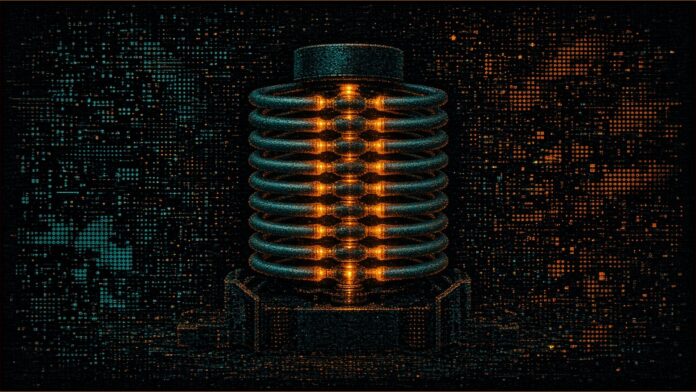
A Hong Kong University of Science and Technology team has published a stacked porous nickel-titanium structure meant to make elastocaloric cooling cheaper to manufacture and durable enough for long fatigue life. The Science paper by Su and colleagues, dated 5 November 2026 (Vol. 394, Issue 6824, pages 670–675), reports more than 10⁸ compression cycles and a specific cooling power of 3,850 W/kg. HKUST’s 6 November newsroom note translates the same cooling figure as 3.85 W g⁻¹ and frames the work as a laboratory refrigerant structure, not a shop-floor fridge.
Elastocaloric cooling uses a solid shape-memory alloy that heats when stressed and cools when the stress is released. The practical barrier has been making a refrigerant geometry that survives millions of load cycles without the cost of slow machining. This paper’s answer is a “stamping and stacking” (S-S) route: honeycomb-like chips stamped from commercial NiTi thin sheets, then layered into a tubular stack.
Science metrics versus the HKUST manufacturing claims
The peer-reviewed numbers and the university’s process claims should stay on separate lines. Science reports fatigue life above 10⁸ compression cycles, specific cooling power of 3,850 W/kg, and fabrication costs cut by about one order of magnitude against existing approaches. HKUST separately says the stamping line can turn out about 100 chips a minute, that the route is more than 100× faster and about 95% cheaper than wire electrical discharge machining (WEDM), that a prototype stack is 30 mm long with 200 chips, and that the maximum temperature span measured is 11.7 K.
HKUST also estimates service life above 10 years under the conditions it tested. That estimate belongs to the university’s framing of the lab campaign; it is not an independent field trial of a commercial appliance. Multiple international patents have been filed, the newsroom says, with funding from Hong Kong’s Research Grants Council Strategic Topics scheme and the Innovation and Technology Commission’s RAISe+/ITF programmes. Corresponding author Qingping Sun is named on the HKUST release.
Sun’s quoted point is manufacturing, not a product launch: “The cost-effective manufacturing of refrigerant structure is a key factor in determining whether elastocaloric cooling can move from the laboratory prototypes to mass-produced products.” He adds that the stacked design “combin[es] high-performance SMA materials with a low-cost manufacturing process, providing a practical pathway to large-scale production of elastocaloric cooling structure.”
How this sits next to other TSN energy and materials stories
TSN’s recent climate and science file has tracked grid storage and model-led discovery more than solid-state cooling. Victoria’s SEC signed a 10-year offtake for a planned Glenrowan battery that still awaits financial close before construction. On the model side, Deep Principle opened Hydrogen-1.0, a large open-weight science model whose own chemistry benchmarks are company-reported. Nuclear SMR supply chains appear in NuScale’s Doosan upper-RCS fabrication deal.
None of those posts is an elastocaloric result. They are useful context for where TSN has already covered clean-energy hardware and science tooling, and for keeping this NiTi stack in its correct lane: a peer-reviewed materials and manufacturing advance with prototype metrics, not a deployed cooling product and not a grid offtake.
Why the fatigue number matters more than the fridge headline
For readers scanning “100 million cycles,” the useful distinction is duty cycle under compression tests versus years on a kitchen compressor. The Science fatigue figure is a laboratory compression-cycle count on the stacked NiTi architecture. HKUST’s “more than 10 years” line is an estimate under those tested conditions. Neither number is a warranty for a consumer refrigerator, and neither source claims a commercial SKU, retail price or regulatory appliance approval.
The manufacturing claim is the nearer-term commercial hinge. If stamping and stacking really do cut cost by roughly an order of magnitude (Science) and about 95% versus WEDM (HKUST), the bottleneck shifts from exotic machining of NiTi geometries toward alloy supply, joining quality across hundreds of chips, and system-level heat exchangers that can actually use the 11.7 K span the prototype showed. That is still engineering work after the paper.
Prior HKUST-linked elastocaloric work cited in the newsroom as background — a January Nature sub-zero freezer demonstration and an August Joule zero-degradation device — is earlier team context, not this paper’s results. This draft uses only the Science and 6 November HKUST figures for the stacked porous structure itself.
UK and other non-Hong Kong readers should read it as a materials result from a Hong Kong lab with RGC and ITC funding. Neither primary announces a UK product registration, BEIS grant or supermarket pilot tied to this stack.
What to watch next
Three public breadcrumbs would move the story: a follow-on paper or HKUST note that reports system-level coefficient of performance for a full cooling loop built on the S-S stack; independent replication of the >10⁸ cycle fatigue claim; or a named industrial partner taking the stamped chips beyond the 30 mm / 200-chip prototype. Until then, the dual primary record is a Science elastocaloric cooling architecture with extreme fatigue life on the page, and an HKUST manufacturing narrative that prices and speeds the route relative to WEDM — prototype science, not a commercial fridge.
Sources
Primary:
- Su et al., “Stacked porous NiTi structure with low cost and ultrahigh fatigue life for elastocaloric cooling,” Science (5 Nov 2026), DOI 10.1126/science.aeh7074
- HKUST: Researchers Develop Low-Cost Elastocaloric Refrigerant Structure with Over 100 Million Cycle Life (6 Nov 2026)
Related TSN:
- Victoria’s SEC Signs 10-Year Deal for Planned Glenrowan Battery
- Deep Principle Opens Hydrogen-1.0, a 753B-Parameter Science Model
- NuScale Signs Doosan Deal for Upper RCS Fabrication
Related stories
- Victoria’s SEC Signs 10-Year Deal for Planned Glenrowan Battery
- Deep Principle Opens Hydrogen-1.0, a 753B-Parameter Science Model
- NuScale Signs Doosan Deal for Upper RCS Fabrication
Follow @tsnmediahub on X for breaking AI news as it happens.
Follow on X