Honeywell Aerospace and Shield AI said on 13 October 2026 that Honeywell’s engineers used Shield AI’s autonomy software to fly their first self-flying aircraft within about six weeks, and have since flown two aircraft together on a surveillance mission near Phoenix, Arizona.
These are the two companies’ own accounts in a joint announcement. No independent observers or test data were cited.
What Hivemind is
Shield AI, a US defence technology company, makes Hivemind, software that lets aircraft and other vehicles pilot themselves. Hivemind Enterprise is the version it offers to other companies. According to the announcement, it handles basics such as route planning, mission management and communication between aircraft, so a partner can focus on adding its own AI models and sensors.
Six weeks to a first flight
The companies say Honeywell’s autonomy team started training on Hivemind Enterprise “in late April.” “Six weeks later, in mid-June,” the team flew a small multirotor drone owned by Honeywell, a BFD-SE8, on its own for the first time.
In the announcement, Tom Schaefer, Shield AI’s vice president for Hivemind Enterprise, said Honeywell’s engineers “flew their first autonomous aircraft within weeks, work their engineering leads estimated would normally take a year.” The release’s summary puts that estimate at 54 weeks. Both figures are the companies’ estimates.
On 8 July, in Plymouth, Minnesota, Honeywell held its first official demonstration. The companies say the aircraft took off by itself, followed a planned route, steered around a no-fly zone and returned to base.
The two-aircraft mission
The companies then spent three months building a second demonstration. Honeywell trained its own AI model to detect and track targets, built the mission in simulation, and tested it in Minnesota and Arizona.
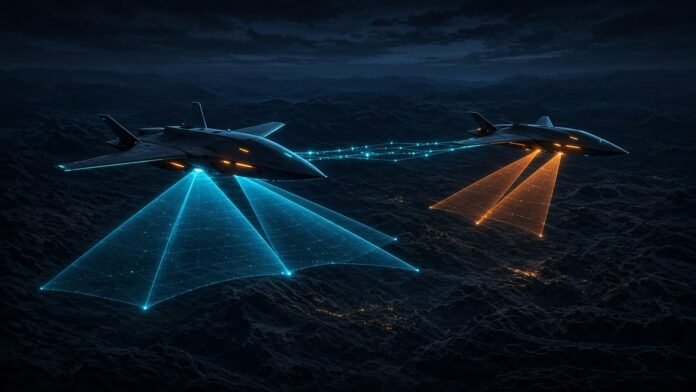
On 8 October near Phoenix, according to the announcement, a “scout” aircraft used onboard cameras and Honeywell’s AI model to detect, identify and track a target. Hivemind then passed the target’s location to a second aircraft, which “navigated autonomously to the target, delivered a payload, and returned to base with the scout.” The companies did not say what the payload or the target was.
This kind of task is known as ISR: intelligence, surveillance and reconnaissance. Both aircraft carried Honeywell’s o480 inertial navigation system, which tracks position using motion sensors rather than relying only on satellite signals. The companies say the two aircraft “shared target information and divided mission tasks autonomously.”
What the companies said
“Hivemind Enterprise handled the autonomy basics, so the team could spend its time on its own detection and tracking model,” Schaefer said.
Todd Giles, Honeywell Aerospace’s chief technology officer, said: “Open architectures are changing the pace of innovation in aerospace, and this milestone demonstrates how Honeywell Aerospace can rapidly translate advanced autonomy into real-world capability.”
What comes next
The work follows a memorandum of understanding the two companies signed in July 2026. They say they will next work out how Hivemind connects with Honeywell’s avionics, navigation and sensing systems, and apply the work to larger uncrewed aircraft and to commercial aviation. Shield AI says Hivemind has flown more than 40 types of platform, including F-16 fighter jets, helicopters and a satellite.
What this means
- Off-the-shelf autonomy could speed up drone development. The companies say Honeywell cut a year-long job to weeks by building on Shield AI’s software.
- Drones are being taught to work in teams. The Phoenix mission had one aircraft find a target and another act on it, without a human pilot.
- The claims are unverified. All results come from the companies, with no outside test data published.
Sources
- Shield AI and Honeywell Aerospace, “Honeywell Aerospace flies first autonomous aircraft 6 weeks after starting Shield AI Hivemind training, completes two-aircraft ISR mission”, 13 October 2026. https://shield.ai/honeywell-aerospace-flies-first-autonomous-aircraft-6-weeks-after-starting-shield-ai-hivemind-training-completes-two-aircraft-isr-mission/
Related stories
- Defence Tech Roundup: A Conditional Counter-Drone Deal, X-BAT Funding, an AI-Contractor Bill and an FPV Order
- Raytheon Wins $729 Million to Supply Its LIDS Counter-Drone System to the US Army, Qatar and Jordan
- Lantronix Introduces Spotter, a Small Computer Board to Help Drones and Robots Run Themselves