Israel Aerospace Industries (IAI) announced HawkGuard on 12 October 2026, in a statement published by EDR Magazine. TSN could not reach IAI’s own website. The claim of “successful tests” is the company’s own.
Israel Aerospace Industries (IAI) has unveiled HawkGuard, a new system to protect troops and sites from drones, at the AUSA Annual Meeting & Exposition, the Association of the United States Army’s show in Washington, D.C. [1].
How it works
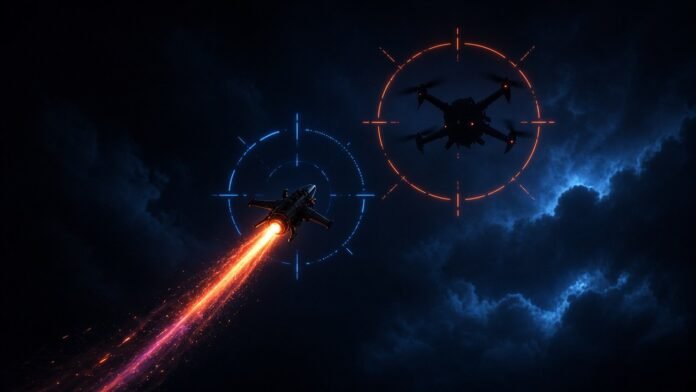
HawkGuard uses radar and electro-optical (camera) sensors, plus AI-enabled command and control, to spot incoming threats. It then launches interceptor drones that destroy them “via direct kinetic interception, without an explosive warhead” [1]. In plain terms, the interceptor hits the target physically instead of blowing up near it.
IAI says this avoids “the blast and secondary effects associated with conventional explosive interceptors” [1].
IAI says the system is compact and modular. It can be fitted to armoured vehicles and other mobile platforms, or used to protect fixed sites, strategic infrastructure and offshore assets [1].
It adds one more layer to IAI’s existing counter-drone set-up, which combines detection, identification, command and control, electronic warfare and interception [1].
Tests
IAI says HawkGuard “recently completed a series of successful tests demonstrating its ability to detect, track and neutralize a range of drone threats” [1].
IAI has not published details. Ynetnews reports that IAI did not say which drones were used, how many interceptions were made, or when the system will be in service [2].
What IAI says
Guy Bar Lev, IAI’s President and CEO, said: “The future of force protection will depend on the ability to respond rapidly and effectively to an increasingly diverse and evolving aerial threat. At IAI, our vision is to provide forces with a layered and adaptable defense architecture that protects them across the full spectrum of threats. HawkGuard is another step toward that vision, adding a kinetic interception capability to counter the growing challenge posed by drones” [1].
Dror Bar, CEO of IAI’s ELTA Systems unit, called it “a flexible and cost-effective way to address drones and other localized aerial threats” [1].
What this means
- Hitting, not exploding. HawkGuard is built to ram drones rather than use explosives, which IAI says avoids blast damage nearby.
- For vehicles and fixed sites. IAI pitches it for both moving armoured vehicles and places like infrastructure and offshore assets.
- Proof still to come. The test claims are IAI’s, with no published figures, and there is no date for service.
Sources
- EDR Magazine, “AUSA 2026: IAI expands force protection and multi-layered C-UAS architecture with HawkGuard” (IAI announcement dated Washington D.C., 12 October 2026), published 13 October 2026. https://www.edrmagazine.eu/ausa-2026-iai-expands-force-protection-and-multi-layered-c-uas-architecture-with-hawkguard
- Ynetnews, “IAI unveils HawkGuard, a drone-defense system that rams aerial threats without explosive warheads”, 13 October 2026. https://www.ynetnews.com/tech-and-digital/article/r10iissifg