
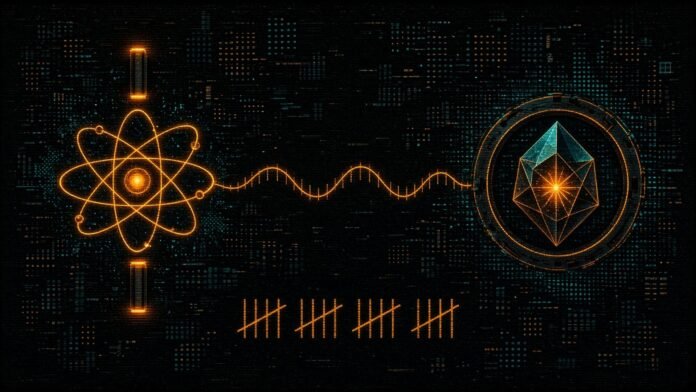
On 9 October 2026 IonQ announced what it calls a “world-first” memory-enhanced link between two kinds of quantum hardware. A paper posted on 7 October backs the numbers. That paper is a preprint, a draft shared before peer review, so the result has not yet been independently reviewed.
What IonQ reports
Company-reported (IonQ). IonQ says it achieved “entanglement rates above 1,000 per second (1 kHz) between a trapped ion qubit and a solid-state memory, through a photonic interconnect” [1]. Entanglement is a quantum link between two particles; a quantum memory holds a quantum state long enough for other operations to happen; an interconnect carries the link between separate machines or modules, here using single particles of light (photons). The rate is how many linked pairs are made each second.
The preprint gives more detail. It entangles a trapped barium ion (a single charged atom held in place by electric fields) with a silicon-vacancy centre, a defect in a diamond crystal inside a tiny optical cavity. A detected photon signals success, so each pair is known to exist. The authors report pairs “at an average rate of 1.03(1) kHz with a fidelity of 87.9(7)%”, fidelity being how closely the pair matches the ideal state [2].
Who says “record”
IonQ calls the result a “world-first” and says it demonstrates “the fastest quantum interconnect rate between qubits of any platform” [1]. Those are IonQ’s claims; TSN has not checked them against other platforms. The release also says the rate is “more than four times faster than the previous record” for trapped ions, held by the group of IonQ co-founder Chris Monroe at Duke University, which also collaborated on the paper [1]. That sentence is IonQ’s, not a quote from Duke. Monroe is IonQ’s chief scientist. The paper’s own comparison is narrower: “four times the rate of the fastest photonic link between two trapped ions”, which it puts at 250 pairs a second, from a 2024 Physical Review Letters paper [2][3].
What this does not show
- Enough speed. IonQ says the rate is “fast enough to support distributed quantum computing” [1]. The paper says its result is “a step toward the 10–100 kHz rates required for distributed quantum computation” [2], ten to a hundred times higher.
- A like-for-like record. The earlier record linked two ions; this links an ion and a different kind of qubit. That earlier paper reported a fidelity lower bound above 94% [3]; this one reports 87.9%.
- A product or a network. It is a laboratory link between two devices; the release describes no network of machines.
- Error-corrected scale. Neither the release nor the abstract describes error-corrected computation.
- Peer review. The paper is a preprint.
The Bottom Line
IonQ reports, and a preprint states, that a trapped-ion qubit and a diamond-based memory were entangled about 1,030 times a second at 87.9% fidelity. “World-first” and “fastest of any platform” are IonQ’s claims. The authors themselves describe the result as a step toward much higher rates.
Related on TSN: Quantum Hardware Check: DARPA’s Final Test Stage, Universal Quantum’s $100m Round and New Error-Correction Results
Sources
- IonQ, “IonQ Demonstrates World-First Quantum Memory-Enhanced Interconnect for Distributed Quantum Applications”, 9 October 2026 (company press release; source of the quotes and the “record” claims). https://www.ionq.com/news/ionq-demonstrates-world-first-quantum-memory-enhanced-interconnect-for-distributed-quantum-applications
- Lukas Hartung et al., “Quantum Networking at the Speed of Quantum Computation: Kilohertz Entanglement in a Heterogeneous Quantum System”, arXiv:2610.10705, submitted 7 October 2026 (preprint, not peer-reviewed; abstract and paper text). https://arxiv.org/abs/2610.10705
- J. O’Reilly et al., “Fast Photon-Mediated Entanglement of Continuously Cooled Trapped Ions for Quantum Networking”, Physical Review Letters 133, 090802 (2024) (peer-reviewed; the earlier trapped-ion record IonQ and the preprint cite; abstract read on arXiv: https://arxiv.org/abs/2404.16167). https://doi.org/10.1103/PhysRevLett.133.090802
