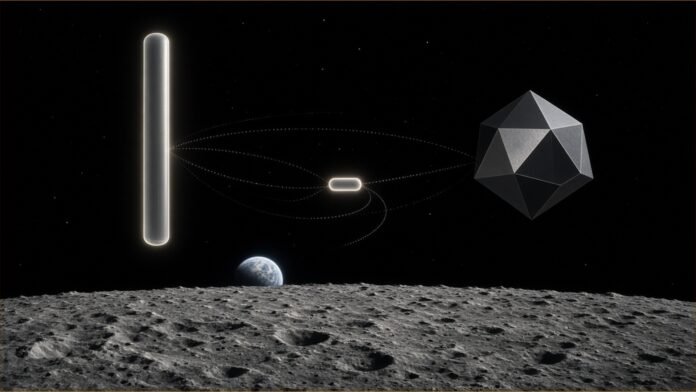
Astronauts heading for the Moon in 2028 will no longer meet their lander in the distant lunar orbit NASA had planned around. NASA said on 23 October that SpaceX’s Starship will instead dock with the Orion crew capsule in Earth orbit and push it to the Moon, while Blue Origin will drop refuelling in space from its first crewed mission.
The changes, set out by NASA, are meant to make both landers simpler and faster to build. Both companies are now competing for the first landing: NASA will choose which one goes first “based on lander readiness”, and neither is yet assigned to a specific Moon landing.
In brief
- What’s new: NASA has dropped the distant “halo” orbit for lander meet-ups and changed how both Starship and Blue Moon will reach the Moon.
- Why it matters: The changes cut how much fuel the landers need, the biggest obstacle to a 2028 landing.
- What’s unknown: How many Starship refuelling flights are needed, and which lander will be ready first.
Starship will push Orion all the way to the Moon
Under the old plan, Orion and the lander were to meet in a near-rectilinear halo orbit, a long, looping path around the Moon that was easy for Orion to reach but demanding for the landers. NASA says each company now gets its own meeting orbit, chosen to suit its system.
For SpaceX, a series of “tanker” Starships will fill a “depot” Starship in low Earth orbit, which will in turn fuel the lander. The Starship lander will then wait for Orion and its crew in Earth orbit, dock with it, and fire its engines to send both spacecraft to low lunar orbit. NASA says it is modifying Orion so that Starship can push it, and that using a low orbit around the Moon “will significantly lower the amount of propellant Starship needs to aggregate in space”. SpaceX must show the refuelling works on an uncrewed demonstration flight first.
How many tanker flights that takes is still disputed. Ars Technica reported that a NASA safety panel put the figure at “about 22”, that Elon Musk said it would be six to eight, and that NASA officials declined to give a number. NASA Administrator Jared Isaacman called Musk’s figure the “ultimate potential end state” of Starship, Ars reported.
Blue Origin will skip refuelling for its first landing
Blue Origin is taking a different route. NASA says the company will defer refuelling in space. Instead, three transfer stages, based on its Mark 1 and Mark 2 lander hardware, will send the Blue Moon Mark 2 lander to an elliptical polar orbit around the Moon, where it will meet Orion before the crew descend to the lunar South Pole. Blue Origin will fly the whole sequence uncrewed first.
NASA says this orbit offers faster returns from the surface to Orion and needs less lander fuel than the old halo orbit. Ars reported that the plan uses four launches of Blue Origin’s New Glenn rocket, and that NASA is also working on letting Orion meet Blue Moon in a much lower orbit, helped by an “extended” version of United Launch Alliance’s Centaur V upper stage.
Artemis III becomes a docking rehearsal near Earth
Before anyone lands, NASA’s Artemis III mission will stay in low Earth orbit in 2027. Its four astronauts, NASA’s Randy Bresnik, Frank Rubio and Andre Douglas and the European Space Agency’s Luca Parmitano, will spend 14 days docking Orion with test versions of both landers. They will spend about two days inside the Blue Moon test vehicle; the Starship docking will last up to two hours and the crew will not go aboard.
The Orion capsule for that flight carries an upgraded heat shield, after NASA confirmed the Artemis II heat shield performed as expected. Under the original contracts, Starship was to land on Artemis III and IV and Blue Moon on Artemis V. Now both companies have added milestones, including two demonstrations of SpaceX’s Starship crew cabin and new crew-in-the-loop testing at Blue Origin. On the surface, NASA plans two Moonwalks of about two hours each in suits made by Axiom Space.
“We are executing President Trump’s National Space Policy to complete the long-awaited return of American astronauts to the lunar surface in 2028 and establish a Moon Base,” Isaacman said. The agency has also set a goal of a lunar surface reactor by 2030.
NASA is moving the hard work from the landers to itself
The striking thing about these changes is who is taking on the burden. For years the halo orbit suited Orion, which needs extra help to reach a low lunar orbit, and left the landers to cover the distance. Now NASA is adapting Orion and its rocket to help the landers instead: Starship gets to do the heavy pushing from Earth orbit, and Blue Origin gets a shorter trip down to the surface.
Making the two companies compete on readiness is a sensible hedge. Under the old contracts, one delay at SpaceX would have held up two missions. Now whichever lander is ready first flies first, which gives both a reason to keep to schedule and gives NASA a fallback.
But the plan still rests on hardware that has not flown. Starship’s refuelling has not been shown in orbit, and the gap between 22 tanker flights and six to eight is the gap between a very hard mission and a manageable one. Blue Origin’s route avoids refuelling but needs four New Glenn launches to go right. The next real test is Artemis III next year, and before that, the first uncrewed lander demonstration that NASA requires.
SpaceX’s lander now carries more of the mission
For SpaceX, the change adds weight to Starship’s role in a company whose finances are now more visible, after TSN covered its plans to go public and its latest quarterly results. NASA’s own release puts the next milestone plainly: both companies must fly uncrewed demonstrations of their crewed landers before NASA will certify either for astronauts.
Sources
- NASA, “NASA, Partners Accelerate Lander Development for 2028 Moon Missions”, 23 October 2026
- NASA, “NASA’s Artemis III Mission to Test Future Moon Lander Operations”, 23 October 2026
- Ars Technica, “NASA updates lander plans for Moon landings, finally solves long-festering Orion issue”, 23 October 2026
Related stories
- NASA Says Post-Flight Analysis Confirms Orion’s Artemis II Heat Shield Performed as Expected
- Space Roundup: SpaceX Agrees to Buy Mobile Spectrum, NASA Goes Nuclear and Amazon Leo Nears Launch
- SpaceX Is Going Public at $2 Trillion. It Could Be the Biggest IPO in History.
- SpaceX Turns a $4.4bn Quarterly Profit as AI Revenue Overtakes Starlink
Follow @tsnmediahub on X for breaking AI news as it happens.
Follow on X