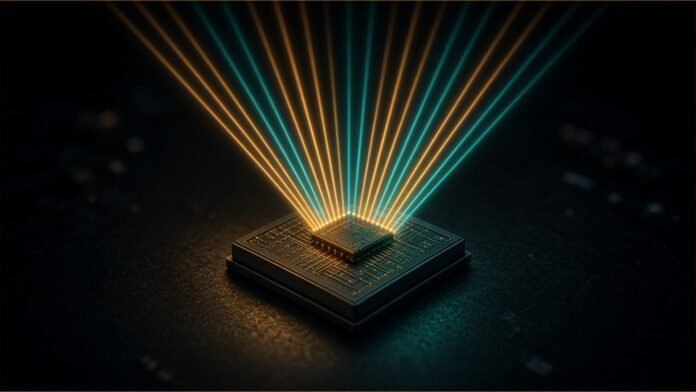
NIST reported on 16 October 2026 that researchers at the National Institute of Standards and Technology and colleagues have demonstrated a new way to generate a miniature “tape measure” for light — a microchip frequency comb that can make high-quality optical measurements without needing to be tethered to bulky laboratory equipment.
NIST says the device could help ultraprecise mobile timekeeping, and in turn provide navigation signals when GPS is unavailable or jammed. Keep that as a research aim: this is a laboratory demonstration of a chip technique, not a claim that GPS-denied navigation products are shipping.
What a frequency comb is doing here
Frequency combs generate a spectrum of precise, evenly spaced colours that act like tick marks on a ruler to measure light frequencies. They are essential components of optical atomic clocks, which produce extremely precise timing signals. Mobile optical clocks, NIST notes, could be used beyond timekeeping — for example in military navigation and resource exploration — but those remain application targets, not announced deployments of this chip.
The two-laser microresonator approach
Scientists at NIST and JQI (a NIST–University of Maryland partnership) send light from two lasers around a tiny ring known as a microresonator. The light interacts with itself to produce the evenly spaced comb “tick marks.” NIST says the technique avoids a problem with previous single-laser methods that needed additional, power-hungry equipment to produce stable, high-quality ticks.
Fabrication scale, from NIST’s photo caption: wafers like the one shown contain more than 400 chips, and each chip houses up to 300 tiny ring-shaped resonators that form the heart of the microcomb technology.
Why the “untethered” claim matters
Laboratory frequency combs already deliver extraordinary accuracy when they can lean on racks of supporting gear. Shrinking the comb onto a chip and removing that tether is what makes mobile optical clocks conceivable. NIST’s headline language about “revolutionizing” mobile timekeeping is aspirational marketing around a real device demo; this post sticks to what NIST demonstrated — high-quality optical measurements without bulky lab tethering — and the stated aim of aiding mobile clocks and GPS-denied navigation research.
Context on TSN
Precision timekeeping is moving in the background of civil time standards too: TSN covered BIPM ending leap seconds for continuous UTC from 2027. On the UK quantum instrumentation side, see UK quantum firms’ funding share for networking and apprenticeships. Neither is the same device; both show why chip-scale timing and quantum-adjacent photonics keep showing up in policy and funding news.
What’s still unknown
- Size, power and stability figures for a fieldable clock built on this comb
- Timeline from demo to a portable optical clock prototype
- How performance compares with other microcomb approaches under vibration and temperature swing
What to watch
- Follow-on NIST/JQI papers with Allan deviation or field-test data
- Integration announcements with portable optical-clock programmes
- Any national-security or navigation pilot that cites this architecture — still none in today’s release
What this means
- NIST/JQI demonstrated a chip-based frequency comb for high-quality optical measurements without bulky lab tethering.
- Aimed at ultraprecise mobile timekeeping / GPS-denied navigation research — could help, not a deployed product.
- Wafer scale cited: >400 chips; each chip up to 300 ring resonators (NIST caption).
Sources
Related stories
- BIPM Ends Leap Seconds for Continuous UTC from 2027
- UK Quantum Firms Share £50m with Networking and Apprenticeship Pots
Follow @tsnmediahub on X for breaking AI news as it happens.
Follow on X