QuEra Computing said on 15 October 2026 that its scientists will serve as co-principal investigators on three of the nine teams selected for the US Department of Energy ARPA-E Quantum Computing for Computational Chemistry (QC3) programme.
QC3 is a three-year programme announced in March 2026 that directs $37 million across performers. Today’s news is QuEra naming its co-PI roles now underway, not a fresh standalone grant announcement.
The three teams
QuEra says its scientists contribute neutral-atom access, expertise, and algorithm/architecture co-design on:
- SuperKIQ (led by Lawrence Berkeley National Laboratory) — Krylov-inspired algorithms aimed at high-temperature superconductors; also NASA Ames, USC, Michigan State, Citrine Informatics, Azulene Labs
- MAGNETIQC (led by Lawrence Livermore National Laboratory) — quantum and ML tools for ultra-strong, lightweight magnets; also Columbia, NERSC Application Technology Group, Citrine Informatics
- Quantum Computing for Hydrogen Fuel Production (led by Phasecraft) — electrolysis simulation aimed at reducing iridium use; also Johnson Matthey and Harvard
What ARPA-E asks for
QuEra summarises the programme’s bar: identify an application worth a quadrillion BTU of energy or a gigaton of CO₂-equivalent, and pursue a scalable hundredfold improvement over classical state of the art, validated at about 100 logical qubits. ARPA-E’s premise, as QuEra relays it, is full-stack co-design so small gains at each layer compound.
QuEra adds that five of nine selected primes are hardware companies running their own machines, and that QuEra is the external hardware partner for three of the remaining four non-hardware-prime projects. The solicitation required a letter of intent from a quantum hardware provider.
Neutral atoms as the gating hardware choice
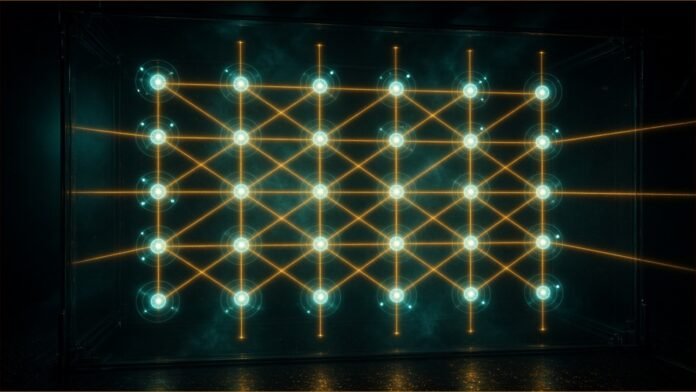
QuEra’s release stresses that QC3 required every applicant to submit a letter of intent from a quantum hardware provider, so hardware choice was a gate at application time. QuEra argues neutral atoms — identical particles, laser-controlled and reconfigurable — give connectivity useful for both algorithms and error correction. That is QuEra’s architectural pitch to ARPA-E teams, not an independent benchmark of QC3 progress.
Roadmap claim — keep it labelled
QuEra writes that its “updated roadmap targets 1,000 logical qubits by 2029.” That is a company roadmap claim, not a QC3 deliverable or an independent milestone.
QuEra also cites earlier co-design publications (including a June 2026 PRX Quantum STAR architecture paper with Los Alamos and a 2025 Nature algorithmic fault-tolerance result) as evidence for its method. Those are prior results, not QC3 outcomes — do not present them as programme deliverables.
Quotes
Shengtao Wang, QuEra’s VP of algorithms and applications, said the architecture’s flexibility is “especially valuable in a long-term program like ARPA-E’s QC3.” Stefan Ostermann, director of quantum applications, said the earliest quantum-advantage examples will come from co-design across algorithm, error correction and hardware — aligning with DOE’s QC3 approach.
Context from earlier TSN coverage
TSN recently covered RIKEN’s five silicon spin qubits run in parallel and ORCA Computing’s PT-3 photonic system in London. QuEra’s item is a national-programme co-PI role on chemistry applications, not a new machine launch.
Note on sourcing
Figures and quotes in this post are taken from the named primary or named same-day report linked in Sources; company goals and forecasts stay attributed to the companies (or to Yole via Wolfspeed where stated).
Why it matters
Energy agencies are trying to force vendor roadmaps to meet chemistry workloads with measurable energy or emissions stakes. QuEra’s announcement shows which three QC3 teams picked its neutral-atom stack as the external hardware partner — useful context even though the $37 million envelope is months old.
What’s still unknown
- Dollar split per team inside the $37 million
- When each team expects a 100-logical-qubit validation milestone
- Whether QuEra’s 2029 logical-qubit roadmap slips or holds
What to watch
Watch ARPA-E project pages for SuperKIQ, MAGNETIQC and the Phasecraft hydrogen team for interim technical reports.
What this means
- QuEra scientists are co-PIs on three of nine QC3 teams.
- Programme: March 2026, $37m, three years — roles now underway.
- 1,000 logical qubits by 2029 is QuEra’s roadmap claim.
Sources
Related stories
- RIKEN Researchers Run Five Silicon Spin Qubits at Once While Keeping Fidelity Near 99.9%
- ORCA Computing Launches PT-3 Photonic Quantum Computer at Digital Realty’s London Lab
Follow @tsnmediahub on X for breaking AI news as it happens.
Follow on X