In brief
- Independent trackers say Russia’s Cosmos 2612 has spent weeks manoeuvring to fly alongside ICEYE-X36, a US-registered commercial radar satellite, without its operator’s consent.
- One tracker calls it, to his knowledge, the first rendezvous of two active satellites in low Earth orbit where one owner did not agree, and there is no strict legal limit on how close satellites may get.
- Nobody knows why. There is no sign of damage, and ICEYE, Russia and the US Space Force have made no public statement.
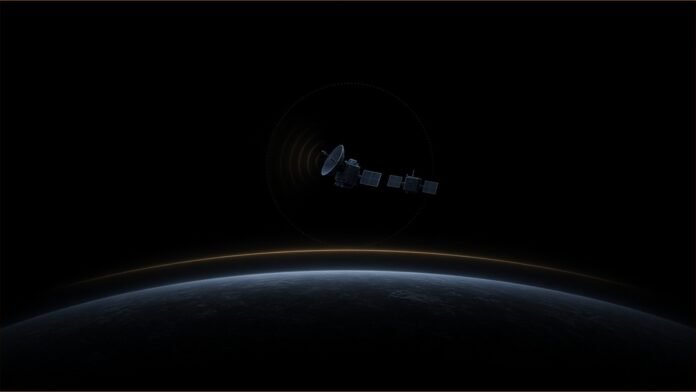
A Russian military satellite is flying in close formation with a Western commercial radar satellite, according to independent satellite trackers. Nothing suggests it has done any harm.
It matters for anyone who relies on satellites, from militaries to companies buying images from space. Trackers say this is a deliberate, uninvited close approach between two working satellites. A space law professor told Axios there is no strict legal limit on how close satellites can get, though countries generally stay more than six miles apart.
What are the trackers seeing?
Dutch satellite tracker Marco Langbroek, a lecturer in space situational awareness at TU Delft, raised the alarm on 17 October. “According to current orbital elements, the Russian #KOSMOS 2612 satellite is now within 1-2 km of #ICEYE-X36,” he wrote on X at 17:55 UTC (18:55 UK time). “This is an #RPO without consent.” RPO stands for rendezvous and proximity operation.
He said he had at first doubted that ICEYE-X36 was an intentional target. But manoeuvres by Cosmos 2612 “starting on Sept 30, were clearly designed to bring the two objects very close and synchronise their orbital periods, orbital altitude and eccentricity,” he wrote.
Astrophysicist Jonathan McDowell, who tracks spacecraft using public data, put it simply: “ICEYE is a radar sat. Kosmos-2612 is an inspector satellite,” he posted. Earlier the same day he wrote that Cosmos 2612 was “stationkeeping within 5 km or less of ICEYE X36”. “To my knowledge this is the first LEO rendezvous of two active satellites where the owner of one of the sats did not give approval,” he added.
How close did it get?
That is not clear. The estimates vary by source and by time, and public tracking data is not precise enough to measure metres.
Space-tracking firm LeoLabs told Axios the two were roughly three miles (about 5km) apart on the afternoon of 17 October. It said the movement “appears to be a deliberate approach”. Langbroek later said the newest data suggested a close approach early on 18 October, followed by a small manoeuvre that “makes reconstruction of timing and distance difficult”.
AeroTime reported that the satellites may have come within a few hundred metres, or possibly closer, at about 01:35 UTC on 18 October. It added that uncertainty in public data prevents a reliable figure. Some smaller figures circulating online cannot be checked from public data, and TSN is not using them.
How did Cosmos 2612 get there?
AeroTime, citing analysis by Integrity ISR and the Center for Strategic and International Studies (CSIS), describes a weeks-long sequence:
| Date | What trackers report |
|---|---|
| April 2026 | Cosmos 2609–2614 launched |
| 26 May | Cosmos 2609 within 2.5km of X36 |
| 30 September | Cosmos 2612 raises orbit ~46.5km |
| 12 October | Drops to ~555km, same plane |
| 16–17 October | Holds within a few km |
| 18 October | Another manoeuvre, ~12:26 UTC |
Integrity ISR calculated that the two-week sequence took about 57 metres per second of velocity change, AeroTime reports. ICEYE-X36, which weighs about 90kg, last made a detectable manoeuvre in late June.
“This is clearly not over yet,” Langbroek wrote on 19 October, reporting the latest manoeuvre.
Has ICEYE-X36 been damaged?
There is no evidence of that. “I see no indications in the orbital elements of ICEYE-X36 so far that it was disturbed in its orbit (i.e. no indication it was hit),” Langbroek wrote on 18 October. “Whether it functions, only the users can tell us.”
He has also warned that blame would be hard to pin down if anything did happen. “Attribution is very difficult in space,” he wrote.
The purpose of Cosmos 2612 has not been publicly established. AeroTime notes that CSIS analysts say sharing another satellite’s orbital plane makes close operations possible “with relatively little additional fuel”, whether for inspection or something hostile.
Who owns ICEYE-X36, and does Ukraine use it?
ICEYE-X36 was built by ICEYE, a company founded in Finland, and is registered in the US, according to trackers and AeroTime. ICEYE has supplied radar imagery to Ukraine under an August 2022 agreement, expanded in January 2026, AeroTime reports.
But ICEYE “has not identified ICEYE-X36 as one of the satellites serving Ukrainian operations,” AeroTime says. A Ukrainian official told Axios it was unclear whether this specific satellite supports the country.
What have officials said?
Nothing in public. ICEYE spokespeople declined to comment to Axios, and the US Defense Department declined to comment on 17 and 18 October. AeroTime says ICEYE had made no public statement as of 19 October.
TSN found no public statement from Russia or the US Space Force about the latest approach. Earlier this year, the Space Force said Cosmos satellites had positioned themselves near a “Western commercial radar satellite used by Ukraine for imagery intelligence”, Axios reports, without naming it.
McDowell said he does not think the move “quite violates the Outer Space Treaty though (but IANAL)”, meaning “I am not a lawyer”, in a post on 17 October.
Our read
This is TSN’s analysis. The facts so far point to a deliberate, costly piece of orbital flying, not a chance encounter. They do not show an attack. The open questions are what Cosmos 2612 is for and whether ICEYE or Washington will say anything. Until they do, independent trackers are the only public check on a contest that is otherwise invisible.
How we sourced this
- We read Marco Langbroek’s thread and Jonathan McDowell’s posts through the X API and quote them exactly. We also read Langbroek’s 17 October post on the SeeSat-L mailing list.
- Figures on the manoeuvre history come from AeroTime, which cites Integrity ISR, CSIS and COMSPOC. We could not find AeroTime’s “few hundred metres” estimate in Langbroek’s own posts, so it is credited to AeroTime.
- Distances are estimates from public orbital data. We do not give a precise minimum distance.
Sources
- Marco Langbroek on X: Cosmos 2612 thread, 17–19 October 2026
- Jonathan McDowell on X: “ICEYE is a radar sat. Kosmos-2612 is an inspector satellite.”, 17 October 2026
- Jonathan McDowell on X: Cosmos 2612 stationkeeping, 17 October 2026
- SeeSat-L: Marco Langbroek, “Re: Cosmos-2612 closing in on ICEYE-X36”, 17 October 2026
- AeroTime: ICEYE-X36 radar satellite had close approach with Russian military satellite, 19 October 2026
- Axios: Russia nears U.S. satellite, raising alarm about intent, 17 October 2026
Related stories
Follow @tsnmediahub on X for breaking AI news as it happens.
Follow on X