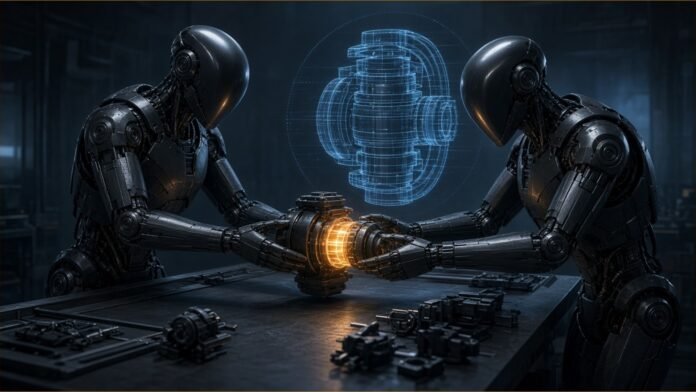
German motion-technology group Schaeffler has opened a factory in Taicang, China, where humanoid robots assemble parts for the next generation of humanoid robots. In a press release on 20 October 2026, the company said the site shows “what ‘humanoids making humanoids’ looks like in practice: humanoid robots assembling key joint modules – including actuators – for the next generation of humanoid robots.”
Schaeffler calls it a “lighthouse factory”. It says the site “marks the start of mass production of these components”, and lets customers and partners train and test physical AI systems in real industrial conditions. The move matters because humanoid makers need reliable supplies of actuators, the motors and gearing that drive each joint, and Schaeffler is positioning itself as a key supplier.
In brief
- Schaeffler has opened a humanoid-robotics “lighthouse factory” of about 7,500 square metres in Taicang, China.
- On its assembly line, “Six humanoids work together at five stations” to build joint modules, including linear and rotary actuators, the company says.
- Schaeffler says two new Greater China customers in Q3 2026 lifted its global incoming orders for humanoid robotics to “some 400 million euros”.
What happens inside
According to Schaeffler, the building houses “an intelligent assembly line, a training and data acquisition center, a platform for digital twins, and a data center across approximately 7,500 square meters of floor space.” It covers the whole process, from testing individual robot skills to using them in real manufacturing.
At the heart of the site is an assembly line Schaeffler developed for key humanoid components, including linear and rotary actuators. “Six humanoids work together at five stations,” the company says. They stage and sort parts, join them, and inspect, label and package them. Schaeffler did not name the humanoid model or maker used on the line.
A digital twin mirrors the line in real time. Sensors record assembly accuracy, the duration of each work step, energy use and the condition of equipment. Schaeffler says changes can be tested digitally before being made on the real line, leading to “significantly shorter development times and more stable and reliable production.”
Training robots for the factory floor
Alongside the line, Schaeffler trains humanoid robots for industrial jobs in its training and data acquisition centre. Tasks include visual inspection of parts, packaging, material handling and transport, moving containers, and replenishing materials at the line side.
The training environments are modelled on conditions in Schaeffler’s roughly 100 manufacturing plants, so skills learned in training can be tested and refined directly on the assembly line. Robot performance is improved using linked data from training, simulation and production, the company says.
“With the lighthouse factory in Taicang, we are creating something that has never before been seen in Schaeffler’s global network: a closed manufacturing loop where humanoids assemble components for humanoids,” said Jochen Schröder, chief operating officer of Schaeffler AG. He added that the company wants to become “a leading supplier and preferred technology partner for humanoid robotics.”
Orders and the China bet
Schaeffler says demand is rising. It recently announced two new customers from the Greater China region in Q3 2026, and “With this, global incoming orders for humanoid robotics rose to some 400 million euros.” The release does not name those customers.
“China’s humanoid robotics industry is entering a fast growth period,” said Yilin Zhang, Schaeffler’s regional chief executive for Greater China. He called the Taicang opening “another important move in Schaeffler’s long-term commitment to China and business development in humanoid robotics.”
| Figure (Schaeffler) | Detail |
|---|---|
| Floor space | About 7,500 square metres |
| Humanoids on the line | Six, at five stations |
| Global humanoid-robotics orders | Some €400 million |
Our read
Using humanoids to build humanoid parts is partly a showcase, but it also gives Schaeffler a live test bed for both its components and the robots that will use them. The €400 million order book shows the supplier side of the humanoid boom is turning into real business, much of it in China. The open questions are which robots work the line and how productive they are compared with conventional automation, details Schaeffler has not disclosed.
Sources
- Schaeffler: “Humanoids making humanoids: Schaeffler opens lighthouse factory in Taicang” (20 October 2026).
Related stories
- Boston Dynamics Pushes Atlas Toward the Factory Floor While Spot 5.2 Goes Agentic
- NEURA Robotics Unveils Neuron AI, a Model That Lets Robots Combine Sight, Touch, Sound and Memory
- Agility Robotics–Churchill Capital XI S-4 Declared Effective; Vote Set for 2 November
Follow @tsnmediahub on X for breaking AI news as it happens.
Follow on X