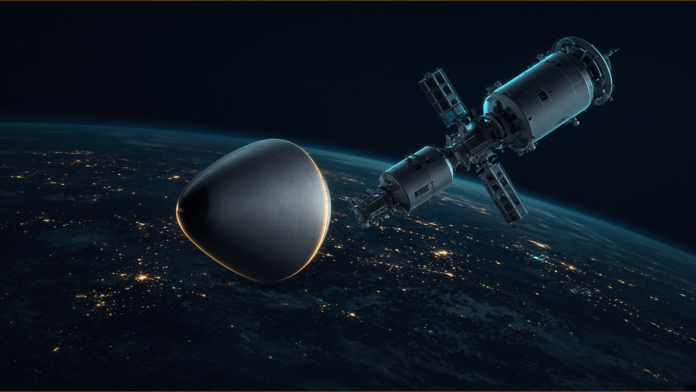
Shenzhou-24 has docked with China’s Tiangong space station, carrying Pakistan’s Muhammad Zeeshan Ali, the first foreign astronaut to board the outpost. In a TSN translation of a China Manned Space Agency docking notice, the agency said the spacecraft docked at the forward port of the Tianhe core module at 11:56 Beijing time (03:56 GMT) on 25 November, after an autonomous fast rendezvous lasting “about 3.5 hours”.
The flight had left the ground earlier the same morning. In a TSN translation of the CMSA launch notice, the agency said a Long March 2F Y24 rocket lifted off from the Jiuquan Satellite Launch Centre at 08:18 Beijing time (00:18 GMT) on 25 November, and that the launch was a “complete success”. The spacecraft separated from the rocket about ten minutes after lift-off, entered its planned orbit, and the crew was in good condition, the notice said. The station complex was already in a docking orbit and in good working condition, it added, and ready for the arriving crew to come aboard.
A few hours after docking, the astronauts already on the station opened the hatch. In a TSN translation of a CMSA notice on the crew’s arrival, the agency said the Shenzhou-23 crew opened the “home door” at 14:35 Beijing time (06:35 GMT) on 25 November and welcomed the Shenzhou-24 crew, in what it called the first “space handshake” between Chinese and foreign astronauts. It was, the notice said, the ninth “space reunion” in Chinese spaceflight, and the first time Tiangong had received a foreign astronaut. The six astronauts then had a group photograph. The same notice said they would later carry out an in-orbit rotation on the station. The length of Ali’s stay, and the craft on which he will return, are not set out in the CMSA notices published today.
The programme’s first foreign flyer
The launch notice, again in TSN translation, described Shenzhou-24 as the eighth crewed mission since China’s space station entered its application and development phase, the 41st launch of the programme since it was approved, and the first crewed mission with a foreign astronaut. To date, it said, 31 Chinese astronauts and one foreign astronaut, a total of 50 person-flights, have entered space to carry out flight missions. It also recorded the outing as the 680th flight of a Long March rocket and the 24th flight of a Shenzhou spacecraft.
During the Shenzhou-24 mission, the same notice said, the crew will carry out experiments and applications in space life and human research, microgravity physical science and new space technology, including several China-foreign cooperative science experiments. The three-person crew has been identified, according to the CMSA and Chinese foreign ministry spokesperson Mao Ning, as Tang Hongbo, Wu Yi and Ali, who is flying as a payload specialist.
Pakistan’s deputy prime minister and foreign minister, Ishaq Dar, welcomed the launch on X at 03:44 GMT on 25 November, after lift-off and before the published docking time. “I warmly congratulate the peoples of Pakistan and China on the successful launch of Shenzhou-24, carrying a Pakistani astronaut to the Tiangong Space Station.”
A narrow opening for a China-only station
Until this flight, Tiangong had been a China-only outpost in a way the International Space Station has not. The arrival of a Pakistani payload specialist does not turn the station into a multinational programme overnight, and it should not be read that way. It is a first, and it is a tightly framed first: a visiting specialist from a close partner of China, flying on a Chinese spacecraft, docking at a Chinese core module, and being welcomed by a Chinese crew already on board.
That framing is still a change. The CMSA is now prepared to describe a Shenzhou-24 flight as the first crewed mission with a foreign astronaut, and to count one foreign astronaut in the running total of people who have flown in the programme. In the closing lines of the arrival notice, in a TSN translation, the agency also said that China’s Tiangong “welcomes partners from around the world to visit”. That is an official invitation in general terms. It is not a published list of future flyers, and nothing in the notices issued today names another country’s astronaut as next in line.
The scientific side of the mission already assumes some international work, even if crew-sharing has not. Several of the experiments listed for this flight are described as China-foreign cooperation projects. That is a quieter form of opening than a visiting crew member, and it has now been paired with one. What remains unpublished is just as important as what has been said. The official notices are silent on how long Ali will remain and on which spacecraft he will use to come home. Those details should be treated as unknown on the CMSA record, not filled in from elsewhere.
Sources
- CMSA: Shenzhou-24 docks with the space station complex (Chinese)
- CMSA: Shenzhou-24 launch is a complete success (Chinese)
- CMSA: Shenzhou-24 crew enters Tiangong; first China-foreign “space handshake” (Chinese)
- Ishaq Dar on X, 25 November 2026
Get TSN’s biggest tech stories, explained.
News and insights across AI, tech, crypto and cybersecurity. Every source linked. Unsubscribe anytime.
Get the newsletterFollow @tsnmediahub on X for breaking AI news as it happens.
Follow on X