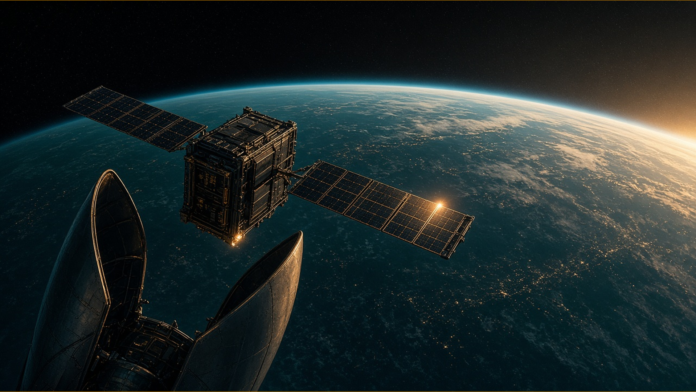
Google has booked Blue Origin’s New Glenn rocket for Project Suncatcher’s first dedicated heavy-lift launch, Blue Origin said on 19 November 2026, under a launch services agreement targeted for the first quarter of 2029. A Google research blog posted the same day under Travis Beals’s name — published at 13:00 GMT — called it “the first heavy-lift launch for Project Suncatcher,” Google’s “long-term moonshot to scale AI infrastructure in space by tapping into the abundant solar power in orbit.” The mission is meant to put satellites, “each with computing capacity at roughly the scale of a data center rack,” into sun-synchronous orbit. Neither company published a price or a satellite count.
In brief
- Blue Origin and Google have signed a launch services agreement for a dedicated New Glenn flight for Project Suncatcher, targeted for the first quarter of 2029.
- The payload is described as TPU-equipped, solar-powered satellites, each with roughly the computing capacity of a data-centre rack, bound for sun-synchronous orbit.
- No price or number of satellites is given. Google also says the flight builds on work with other satellite and launch partners.
New Glenn is booked for a sun-synchronous Project Suncatcher flight
Blue Origin describes Project Suncatcher as a research moonshot “exploring how an interconnected network of solar-powered satellites equipped with its AI chips, Tensor Processing Units (TPUs), could scale machine learning compute in space.” The 2029 mission, it says, “will be Google’s first dedicated heavy-lift launch for Project Suncatcher” and “a milestone in Google’s research to scale machine learning compute in space.”
Jordan Charles, Blue Origin’s senior vice president of New Glenn, said: “Project Suncatcher represents the ambitious missions New Glenn was built to support.” He added: “Its heavy-lift capacity and large payload volume give customers the flexibility to bring new capabilities to orbit. We’re proud to work with Google to explore space-based computing and its potential to expand the space economy.”
Beals, whom Blue Origin names as senior director of Project Suncatcher at Google, said: “This dedicated launch with Blue Origin represents a crucial milestone on our roadmap as we expand the boundaries of what’s possible for the future of compute.” The Google blog, which lists him as senior director, Paradigms of Intelligence, uses almost the same “crucial milestone” language and adds that the dedicated launch “builds on our ongoing work with other satellite and launch partners.”
That last line matters. This booking is a first dedicated heavy-lift for the project, not a claim that Blue Origin is the only launch provider on the roadmap.
The earlier prototype flew as a rideshare, not a heavy-lift
TSN’s earlier account of Project Suncatcher covered the project’s prototype satellite, which Google said had run an onboard model in orbit and returned a short reply to Earth after a 1 October launch on a SpaceX rideshare. That post also recorded Google’s plan, if radiation and heat tests went well, for “twin interconnected satellites in 2027” — a plan, at the time, with no launch date. Today’s releases leave unsaid whether the New Glenn flight targeted for the first quarter of 2029 is that pair, a later cluster, or something else. The companies also give no figure for how many satellites would ride this heavy-lift.
What they do specify is the orbit and a scale comparison. Sun-synchronous orbit is a polar path often used by Earth-observation spacecraft because it keeps a consistent lighting angle. A computing payload “at roughly the scale of a data center rack,” in Blue Origin’s phrasing, is a payload-class description, not a design drawing, and it is a long way from a ground data centre.
The rocket side of the story has its own unfinished business. Blue Origin has been planning more Florida pads to raise New Glenn’s flight rate, with a company goal of multiple flights a week by the end of the decade — a target, not a demonstrated cadence. New Glenn has already flown science hardware: NASA’s twin ESCAPADE spacecraft left Cape Canaveral on the rocket on 13 November 2025 and, after November 2026 Earth flybys, are still on their way to Mars. A dedicated rack-scale compute mission in 2029 would be a different kind of customer, and it would arrive only if that targeted quarter holds.
A 2029 target is a reservation, not a launch
The concrete fact in these releases is a contract and a window, not a countdown. “Targeted for the first quarter of 2029” is the companies’ own qualifier. A lot can move in more than two years: the rocket’s flight rate, the design of the satellites, and whatever Google learns from the prototype still in orbit. Until a manifest date is firmer, this should be read as Google reserving a dedicated heavy-lift for Project Suncatcher, not as a flight that is locked in.
The silences are part of the story. There is no price, and there is no satellite count. Without those, it is impossible to judge how large this step is against the single prototype that flew as a rideshare, or against the 2027 twin-satellite plan Google has already sketched. Readers should not collapse those three stages into one. The prototype showed a TPU could power up and answer from orbit. The 2027 pair remains a stated next milestone from the earlier blog. The New Glenn agreement is a later, heavier-lift booking, and the companies have left the link between the last two unstated.
Google’s reminder that it is still working with other satellite and launch partners points the same way. Blue Origin has the first dedicated heavy-lift; it has not been written in as the project’s only path to orbit. Charles is right that New Glenn was sold as a vehicle for ambitious, bulky payloads. Whether a sun-synchronous cluster of rack-scale TPU satellites is ready to fill that fairing in early 2029 is the question the next two years of tests, and the next set of filings or manifests, will have to answer.
Get TSN’s biggest tech stories, explained.
News and insights across AI, tech, crypto and cybersecurity. Every source linked. Unsubscribe anytime.
Get the newsletterRelated stories
- Google’s Project Suncatcher Satellite Sends First AI Reply From Orbit is the earlier TSN account of the prototype’s first on-orbit AI reply, and the right next stop for how the project got this far.
- Blue Origin Plans More Florida Pads to Raise New Glenn Flight Rate
- ESCAPADE Mars Twins Finish Powered Earth Flybys for Mars
Sources
- Travis Beals, We’re partnering with Blue Origin on our first heavy-lift Project Suncatcher launch, Google research blog, 19 November 2026
- Blue Origin, Google Selects Blue Origin’s New Glenn for Project Suncatcher, 19 November 2026
Follow @tsnmediahub on X for breaking AI news as it happens.
Follow on X