
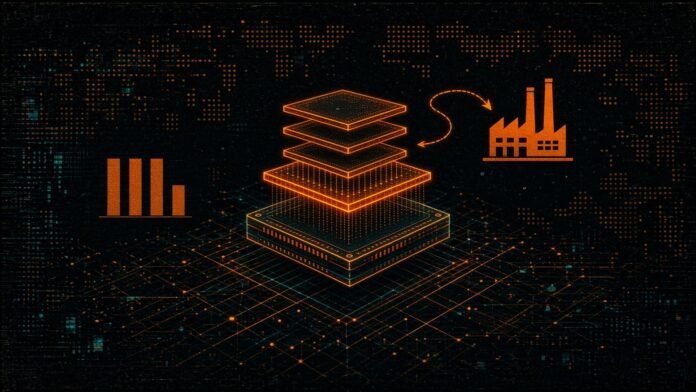
Two pieces of chip-industry news from 8 October 2026 show where some of the pressure in AI hardware now sits. GlobalFoundries (GF) has agreed to make silicon interposers, a part used in packaging advanced AI chips, for TSMC at its plant in New York. And TSMC, the world’s largest contract chipmaker, published its September revenue. Both come from the companies’ own releases.
Why packaging matters
The most powerful AI chips are no longer a single slab of silicon. A typical AI accelerator puts a large processor alongside stacks of high-bandwidth memory, and these need to be joined with thousands of very fine connections. TSMC’s CoWoS technology (“chip on wafer on substrate”) does this by mounting the chips side by side on a silicon interposer: a thin layer of silicon with dense wiring that links them, which then sits on a larger base.
GF presents the deal as a response to “growing demand for high-performance computing and AI systems” [1]. The squeeze is most acute in the memory and packaging that sit beside the processor; Nvidia has separately asked memory makers to build its NVHBM base dies at TSMC, and Taiwan still holds the bulk of the world’s advanced-chip capacity. Its Ed Kaste, senior vice president of the CMOS business, said: “Advanced packaging is becoming increasingly critical to delivering the performance, power efficiency and scale required for next-generation AI systems” [1].
GlobalFoundries and TSMC: silicon interposers made in New York
GF announced a “Multi-year $2 billion agreement” with TSMC to establish “a U.S.-based supply of silicon interposers for TSMC’s CoWoS advanced packaging ecosystem” [1]. Under it, “GF will provide manufacturing service to TSMC, and add fabrication capacity at its Malta, New York facility” [1].
Key points from GF’s release [1]:
- GF expects to become “the first U.S.-based source of silicon interposers” for these packaging technologies, including parts with embedded deep trench capacitors (tiny built-in capacitors that help keep power supply to the chips stable).
- “Volume production is expected to begin ramping at GF’s Malta site during the first half of 2028.”
- The agreement has an “initial term of five years” and “provides a framework for future capacity expansion”.
The release describes this as a manufacturing service agreement worth $2 billion over multiple years. It does not break down how the money flows, or how much new capacity it buys. The 2028 date is GF’s expectation, and the release carries the usual warning that forward-looking statements may not come true [1].
By GF’s own description, there is currently no US-based source of these interposers, so the deal would add a domestic supplier for one part of the CoWoS chain [1]. It would not, by itself, move the whole packaging process to America, and volume production is still more than a year away.
Update, 10 October 2026: Taiwan’s Economic Daily News reported on 9 October, in Chinese, that TSMC’s back-end CoWoS capacity “continues to be in short supply” and that TSMC “previously enlisted multiple firms” to help. Adding silicon-interposer capacity is one step, and there, it says, “besides the widely known Vanguard (VIS), there is also a UMC-group partner that a customer found” (TSN’s translation) [6]. The report does not say where its information comes from, does not name the UMC-group partner, and quotes no one at TSMC, Vanguard or UMC. Its description of the GF deal matches GF’s release [1]; it adds only the reported other names.
TSMC: September revenue
TSMC said its consolidated revenue for September 2026 was “approximately NT$511.86 billion, a decrease of 0.6 percent from August 2026 and an increase of 54.6 percent from September 2025” [2]. Revenue for January to September totalled “NT$3,898.73 billion, an increase of 41.1 percent” on the same period of 2025 [2].
In plain terms: September revenue was slightly down on August but more than half as much again as a year earlier, and the year so far is running about 41% ahead of 2025. TSMC gives the figures in New Taiwan dollars only. Its release offers no breakdown by product or customer, so it cannot show how much of the growth comes from AI chips. Because September was down on August, it is not a monthly record.
Update, 9 October 2026: SK hynix’s planned Gwangju memory cluster
The pressure on chip supply is not only in packaging. On Friday 9 October, SK Group chairman Chey Tae-won visited the planned site of a new memory-chip cluster at Gwangju, in south-western South Korea, with SK hynix chief executive Kwak Noh-jung, SK hynix says [3]. SK hynix makes high-bandwidth memory, the stacked chips placed beside AI processors described above, the business that just posted its first 100-trillion-won quarter. It announced the plan for “a new cluster” on a scale of 400 trillion won in the Honam region in June [3].
According to SK hynix’s release (TSN’s translation), Chey said chip demand “is growing faster than expected”, that bringing forward the whole Yongin cluster schedule “by 12 years” is still expected to fall short, and that SK “may have to build plants in parallel in Yongin and Jeonnam-Gwangju” [3]. Yongin, near Seoul, is SK hynix’s main new chip site. The Seoul Economic Daily reports his words to reporters as: “If we judge that conditions are in place to build, we will build as much as we can at the fastest possible speed” [4].
Several details are still unsettled, according to Korean press reports:
- No start date. The Seoul Economic Daily says the groundbreaking date “will be determined after a comprehensive review of power and water supply and construction schedules” [4]. Yonhap reports that the group “still needs to determine when construction will begin” [5].
- Size. Both outlets say the current plan is about two-thirds the size of Yongin [4][5]; the Seoul Economic Daily adds that it could be expanded depending on site conditions and demand [4].
- Timing. The Seoul Economic Daily reports that the government and the regional authority are targeting “mass production at the first fab in June 2030” [4]. That is their target, not a construction contract.
The release also says Chey has argued that memory production capacity must “more than double within the next five years” to lead in AI (TSN’s translation) [3].
What the companies’ releases do not settle
- That US interposer supply will start on time. Volume production is “expected” to ramp in the first half of 2028; that is GF’s forecast [1].
- How the $2 billion is structured. GF’s release does not say who pays what, or when [1].
- That AI caused TSMC’s growth. The monthly report gives a total only, with no split by product [2].
- Anything about share prices. TSN offers no investment advice.
- That SK hynix has committed 400 trillion won or set a build date for Gwangju. The figure describes a plan announced in June; the start date is still to be decided, and June 2030 is a government target [3][4][5].
- Who else supplies TSMC’s interposers. The Economic Daily News report is unattributed and names no UMC-group company, and TSN found no confirmation of it from TSMC or UMC [6].
Why new capacity keeps lagging the demand it is meant to meet
Read together, these three announcements describe the same bottleneck from three angles, and all three point to a lag rather than a fix. GF’s deal would give the United States its first domestic source of silicon interposers for CoWoS, but by the company’s own timetable volume production is not expected to ramp until the first half of 2028, more than a year away, and the release does not say how much capacity the $2 billion actually buys. TSMC’s September revenue, up 54.6% on a year earlier, shows demand running hot now; the new supply is being built for a shortage that already exists.
The pattern repeats in memory. SK hynix is the company supplying the high-bandwidth stacks that sit beside these processors, and its chairman’s language, that pulling the Yongin schedule forward “by 12 years” may still fall short and that plants may have to go up in parallel, is an admission that even an aggressive build-out trails the curve. The constraint on AI hardware is no longer headline processor performance but the slower, capital-heavy business of packaging and memory, where a new fab takes years and a new interposer line is dated to 2028. That is why a single domestic supplier, welcome as it is, changes the map only at the margin: it adds one node to a chain that is short in several places at once, and the lead times are measured in years, not quarters.
Sources
- GlobalFoundries, “GlobalFoundries reaches agreement to establish U.S.-based supply of silicon interposers for advanced AI packaging”, Malta, N.Y., 8 October 2026 (company announcement; contains forward-looking statements). https://gf.com/news-and-events/news/globalfoundries-reaches-agreement-to-establish-us-based-supply-of-silicon-interposers-for-advanced-ai-packaging/
- TSMC, “TSMC September 2026 Revenue Report”, Hsinchu, 8 October 2026 (company monthly revenue report). https://pr.tsmc.com/english/news/3343
- SK hynix Newsroom, “광주 부지 찾은 SK그룹 최태원 회장, ‘호남권 반도체 클러스터 속도감 있게 추진할 것'” (“SK Group Chairman Chey Tae-won visits Gwangju site: ‘Honam semiconductor cluster will be pushed ahead quickly'”), press release, 9 October 2026 (company release, in Korean; quotes translated by TSN). https://news.skhynix.co.kr/southwestern-region-investment/
- Nam So-jung, “SK Chairman Visits Gwangju Site, Vows Fastest Possible Chip Buildout”, Seoul Economic Daily, 9 October 2026, 17:29 KST (09:29 BST) (press report; English quote, start-date review, June 2030 target; its photo caption’s “Nov. 9” is an error). https://en.sedaily.com/finance/2026/10/09/sk-chairman-visits-gwangju-site-vows-fastest-possible-chip
- Kang Yoon-seung, “SK chief vows to speed up construction of new chip cluster in southwest”, Yonhap News Agency, 9 October 2026, 15:46 KST (07:46 BST) (press report). https://en.yna.co.kr/view/AEN20261009004000320
- Yin Hui-chung, “台積釋單格羅方德 拚先進封裝” (roughly, “TSMC releases orders to GlobalFoundries, pushes advanced packaging”), Economic Daily News (經濟日報), Taipei, 9 October 2026, 02:31 Taipei time (19:31 BST on 8 October) (press report, in Chinese, with no sources named; quotes translated by TSN; reported). https://money.udn.com/money/story/5612/9804045
Get TSN’s biggest tech stories, explained.
News and insights across AI, tech, crypto and cybersecurity. Every source linked. Unsubscribe anytime.
Get the newsletterFollow @tsnmediahub on X for breaking AI news as it happens.
Follow on X


