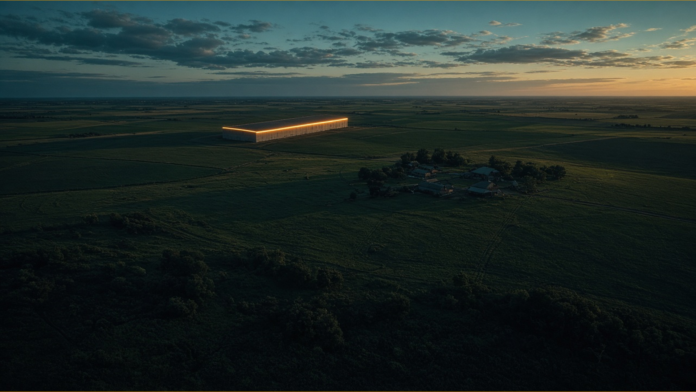
Alberta has introduced a bill that would set a provincial minimum setback of 600 metres for data centres of 10 megawatts and larger, the provincial government said on 18 November 2026. Bill 42, the Energy, Environment and Utilities Statutes Amendment Act, 2026, is a proposal. The government’s own page states that the changes would take effect “if passed,” and that the Alberta Utilities Commission “would become the primary provincial regulator of data centres 10 megawatts and larger.” Nothing in the announcement makes the setbacks law today.
In brief
- Bill 42, introduced on 18 November, would create 600-metre minimum setbacks for data centres of 10 megawatts and above, with the AUC as the main provincial regulator for that class of project.
- Proponents would pay for wires inside the project footprint. A new Data Centre Designation would offer more options for meeting electricity needs, the government says, without passing those costs on to ratepayers.
- The same bill would repeal the Oil Sands Emissions Limit Act, which Alberta says was passed in 2016 but never implemented through regulation. Corporate fines for illegal dumping would rise to a $100,000 minimum and a $1 million maximum.
Bill 42’s setbacks and the AUC role are still only a proposal
The government presents the data-centre package as a response to public input from four town halls in August and September 2026, a survey and other feedback. “If passed,” the page says, the legislation “will update legislation to give residents and landowners peace of mind that their property and utilities will be protected, while providing greater certainty about where large data centres can be built.” Setbacks are defined there as the minimum distance a data centre must stand from a community. The rules would also cover noise, water use and farmland protection, and would sit alongside existing noise requirements.
Municipalities could ask the AUC for an alternative setback “where local planning supports compatible development.” Designated industrial zones, brownfield sites and existing power-generation sites “would be recognized to encourage development in areas already suited for major industrial projects.” Data-centre companies “would be responsible for the costs of wires within their project footprint, preventing those costs from being passed on to Alberta ratepayers.” The new Data Centre Designation is described as a way to give qualifying projects more options for electricity supply “while protecting the affordability and reliability of Alberta’s electricity system.”
Those are the government’s design choices, written as future tense. Until the legislative assembly passes the bill, developers, landowners and municipalities are looking at a proposal, not a new provincial minimum.
The package is broader than siting. Bill 42 would also amend the Hydro and Electric Energy Act, the Alberta Utilities Commission Act, the Environmental Protection and Enhancement Act, the Mines and Minerals Act and the Forests Act, and would repeal the Oil Sands Emissions Limit Act. Alberta says that 2016 statute “was never implemented through regulation” and that repealing it “would not change the requirements oil sands facilities follow.” Separate clauses would raise illegal-dumping fines, including a $100,000 minimum and $1 million maximum for corporations, and lift the maximum corporate penalty for knowingly causing serious environmental contamination from $1 million to $6 million.
A 600-metre rule would change where large campuses can sit
Alberta is already on the data-centre map. Anthropic has been in talks to lease Beacon’s Alberta data-centre campus, a commercial negotiation that would have to live with whatever setback and AUC regime, if any, the assembly eventually adopts. Across the country, Anthropic has also been named as the tenant for EverWind’s Point Tupper AI campus in Nova Scotia, a reminder that Canadian siting fights are no longer hypothetical. In Taylor, Texas, a council has already voted through a large data-centre and power-plant deal whose land is not yet annexed — a different jurisdiction, but the same tension between campus scale and local control.
The 10-megawatt threshold is the hinge. Below it, the new provincial setback and the AUC’s new lead role would not, on the government’s description, automatically apply. Above it, a 600-metre buffer, noise, lighting, heat recovery, water and farmland rules would be administered centrally, unless a municipality persuades the AUC to vary the distance. That is a significant shift from a purely local planning default, and it is still contingent on the bill passing.
The repeal of the unused oil-sands emissions cap sits awkwardly in the same statute. Alberta says it changes nothing in practice because the cap was never switched on. Opponents are likely to argue that removing a statutory limit, even a dormant one, is a change in itself. Those arguments belong to the legislative debate. For data-centre readers, the immediate questions are whether Bill 42 passes, whether the 600-metre minimum survives amendment, and how the AUC treats Beacon-scale projects already in talk. Until a vote, the Bill 42 setback is a number on a proposal, not a line on a planning map.
Get TSN’s biggest tech stories, explained.
News and insights across AI, tech, crypto and cybersecurity. Every source linked. Unsubscribe anytime.
Get the newsletterRelated stories
- Anthropic in Talks to Lease Beacon’s Alberta Data Centre Campus is the closest TSN account of a large campus already being discussed in the province, and the right next stop for how Bill 42 could meet a live project.
- Anthropic Named as Tenant for EverWind’s Point Tupper AI Campus
- Taylor, Texas Council Votes 5-0 for a 664-Acre Data-Centre and Power-Plant Deal; the Land Is Not Yet Annexed
Sources
Follow @tsnmediahub on X for breaking AI news as it happens.
Follow on X