Deep Fission, which is developing a nuclear reactor designed to sit about a mile underground, has signed a binding agreement to supply power to an industrial park in Kansas. The company announced the deal in a press release on 20 October 2026 and described it as a 25-year agreement.
The deal is with the Great Plains Development Authority (GPDA), which owns the Great Plains Industrial Park in Parsons, Kansas. It turns a letter of intent the two sides signed in December 2025 into a definitive contract.
The reactor still has to be licensed by the US Nuclear Regulatory Commission (NRC), and the buyer has no minimum purchase obligation. All of the capacity figures and dates in the deal are targets.
In brief
- Deep Fission has signed a binding Master Energy Purchase Agreement with the Great Plains Development Authority in Kansas.
- It targets an initial 150 MW, with commercial operation by 30 September 2028, growing to 2,000 MW if demand grows.
- The project needs NRC licensing and Kansas approvals, and GPDA has no minimum purchase obligation.
What has Deep Fission signed?
Deep Fission calls the contract a Master Energy Purchase Agreement. Under it, GPDA will buy electricity that Deep Fission generates “to satisfy the electricity requirements of industrial park tenants, up to the contracted capacity, with no minimum purchase obligation”, the release says.
That means GPDA has agreed to take power up to a set limit, but has not committed to buy any fixed amount. The release adds that GPDA can pass its purchase obligations on to qualifying tenants.
For Deep Fission, the agreement “binds Deep Fission to pursue the project and to supply power once licensed and operating, subject to the agreement’s terms and conditions”.
The release gives no price for the power and no value for the contract.
What are the targets?
The release says: “The initial phase is anticipated to be 150 MW with a target date of commercial operation on September 30, 2028, and grow through later phases to a total of 2,000 MW pending further demand growth.”
A subheading on the release describes the first phase as “up to 150 MW” and refers to “up to 2GW by 2031”. The 2031 date is not repeated in the main text.
| Target | Figure |
|---|---|
| Initial phase | 150 MW |
| Target commercial operation | 30 September 2028 |
| Later phases, total | 2,000 MW, pending demand |
| Agreement term | 25 years |
For scale, a megawatt (MW) is a measure of power output. The 2,000 MW figure is the same as 2 gigawatts (GW), which Deep Fission says depends on “further demand growth”.
What has to happen first?
The release’s forward-looking statements list several conditions. They include “the ability to satisfy the conditions to commercial operation, including NRC licensing, Kansas regulatory approvals and required delivery arrangements”.
The same section names “the absence of minimum electricity purchase obligations under the GPDA agreement” and “dependence on electricity demand from tenants” as risks. It also warns that the project “may be delayed, reduced in scope or not completed”.
Deep Fission is listed on Nasdaq under the ticker FISN. The release says the company was selected for the US Department of Energy’s Reactor Pilot Program, and held a groundbreaking ceremony for its pilot reactor at the park in December 2025.
How is the reactor meant to work?
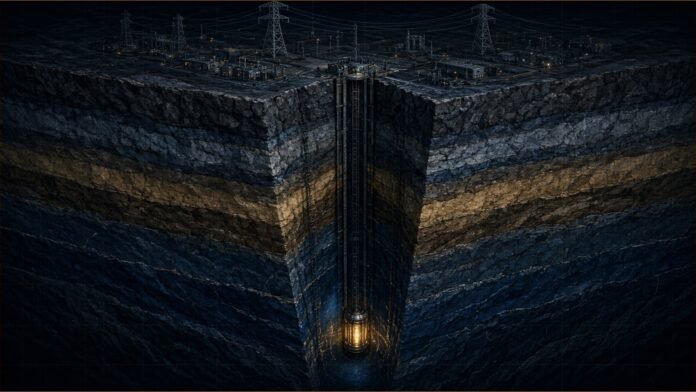
Deep Fission calls its design the Gravity Nuclear Reactor. According to the company, it is “a pressurized water reactor that runs on standard low-enriched uranium fuel”. A pressurised water reactor is the most common type of nuclear reactor in use today.
The difference is where it goes. Deep Fission says it places the reactor in a borehole “approximately one mile underground”. The company says this is designed so that the water and rock around it provide “pressure control, cooling and shielding”, which could reduce the need for much of the surface infrastructure a conventional plant needs.
These are design claims. The reactor has not yet produced commercial power.
What did the two sides say?
“This agreement turns a shared vision into a binding commitment,” said Liz Muller, Deep Fission’s chief executive and co-founder. “Our approach is to bring firm power directly to where it’s needed.”
Brad Reams, park director at GPDA, said: “Dependable, affordable power is what draws employers to Southeast Kansas, and it’s what the companies we’re talking to are asking for.”
The park covers more than 14,000 acres in Labette County, on the site of a former US Army ammunition plant, according to the release.
Why does this matter for data centres?
Deep Fission says it is focused on supplying “reliable, low-carbon baseload power” to utilities, industrial customers and data centres. Baseload power is electricity that runs around the clock, which is what large data centres need.
TSN has also covered Amazon, X-energy and AEP’s plans for Xe-100 reactors in Indiana and Japan’s plan to invest in US nuclear reactors to power AI data centres.
Our read
This is TSN’s analysis. A binding contract is a step up from a letter of intent, but this one carries little commercial risk for the buyer: GPDA pays only for power it takes, and there is no minimum. The real tests are still ahead, starting with NRC licensing for a reactor design that has not yet run. The September 2028 target leaves under two years, and the release itself warns that the project could be delayed or scaled back.
Sources
- Deep Fission: “Deep Fission Signs Binding 25-Year Master Energy Purchase Agreement for Planned Commercial Project” (20 October 2026)
Related stories
- Amazon, X-energy and AEP Will Explore 12 Xe-100 SMRs in Indiana
- Japan to Invest 40 Billion in U.S. Nuclear Reactors to Power AI Data Centers
Follow @tsnmediahub on X for breaking AI news as it happens.
Follow on X