Eka Robotics has closed a $150m Series A round that values the robotics start-up at $1.45bn post-money, TechCrunch reported on 20 October. The round was led by the venture funds a16z and F-Prime, according to the report.
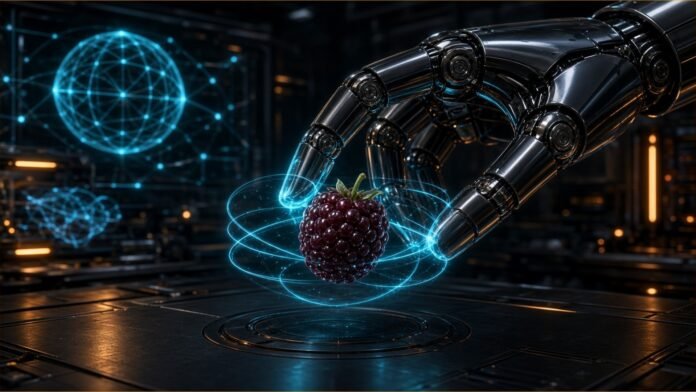
Eka is betting that the hard part of robotics is not seeing objects but feeling them. Its system pairs a force-sensitive gripper with what TechCrunch describes as a “vision-force-action model”, an alternative to the vision-language-action models that much of the field has adopted. For manufacturers and warehouse operators, the promise is robots that can pick up awkward objects quickly and reliably, though that promise has yet to be tested at scale on real production lines.
In brief
- TechCrunch reports that Eka Robotics raised a $150m Series A at a $1.45bn post-money valuation, led by a16z and F-Prime.
- The start-up uses force sensing and simulation-trained reinforcement learning to help robots grasp objects; its performance figures are company and demo claims.
- Eka’s industrial pilots are unnamed, and outside experts say the real test is running on assembly lines for a full year.
Founders from MIT and DeepMind, and a bet on force
The company was founded by MIT professor Pulkit Agrawal and former Google DeepMind researcher Tuomas Haarnoja, TechCrunch said. The two met in graduate school at the University of California, Berkeley, and work in reinforcement learning for robot control, according to the report.
Their argument is that touch matters more than sight at the moment of grasping. “Vision is not the primary way in which you close this last millimeter problem,” Agrawal told TechCrunch. “Vision tells you roughly where the object is, what the pose is, but the actual grabbing, the actual searching is happening through forces.” To support that, Eka designed its own robotic hand with more force sensors than traditional grippers, TechCrunch reported.
Training is the other half of the approach. Rather than relying on videos of human demonstrations, Eka uses a physics simulator to model the forces a robot meets as it grasps something and runs reinforcement learning on that at scale, according to the report. The founders say they can generate thousands of hours of robot experience in minutes.
Performance claims from the company and its demo
The headline numbers come from the company and from the demo TechCrunch described. According to the report, the robot “can pick up about 1,500 objects that weigh up to 1 kg in an hour, compared to about 600 for a human”, and “Eka says it reliably picks up objects more than 95% of the time.” These are not independent test results.
| Claim | Figure |
|---|---|
| Objects picked per hour (up to 1 kg) | About 1,500 |
| Human comparison, per hour | About 600 |
| Reliable picks (Eka’s figure) | More than 95% |
| Gripper cost | Less than $1,000 |
| Rated duty cycles | 5 million |
Investors and outside experts are enthusiastic. “They are already exceeding superhuman performance for certain tasks,” said Raghu Raguram, the a16z general partner who co-led the round, adding that “over the next few months there will be superhuman performance in many dexterous manipulation tasks”. Kris Hauser, a professor at the University of Illinois Urbana-Champaign, said the robot had a “wow factor” and “was able to adapt to a large number of different objects without retraining”.
The lab-to-line test still lies ahead
Eka still has to prove itself in the field. It is running secretive pilots with a number of industrial customers in pick-and-place and wire handling, TechCrunch reported, without naming them. “What’s going to be a big challenge is when they work with integrators on real assembly lines, and it needs to run without breaking for an entire year,” Hauser said.
Durability is part of that. Agrawal told TechCrunch the gripper, which costs less than $1,000, is rated for 5 million duty cycles, while the goal is the 20 million cycles of standard industrial arms. The approach fits a wider push towards so-called physical AI models; TSN has covered Dream Labs’ $90m seed and public robot-model API and NEURA Robotics’ Neuron AI model, which combines sight and touch.
Our read
This is TSN’s analysis, not investment advice. A $1.45bn valuation at Series A prices in a lot of future success for a company whose customers are still unnamed. The force-first approach is a credible answer to a known weakness in robot grasping, but the numbers so far come from Eka and a demo. The milestone to watch is a named customer running Eka’s system on a real line for months, not minutes.
Sources
Related stories
- Dream Labs Exits Stealth With $90M Seed and a Public API for Its Robot Model
- NEURA Robotics Unveils Neuron AI, a Model That Lets Robots Combine Sight, Touch, Sound and Memory
- Schaeffler Opens ‘Humanoids Making Humanoids’ Factory in Taicang, China
- Robotics Roundup: How Robot World Models Scale, a Beijing Funding Round and a Shop-Floor Humanoid
Follow @tsnmediahub on X for breaking AI news as it happens.
Follow on X