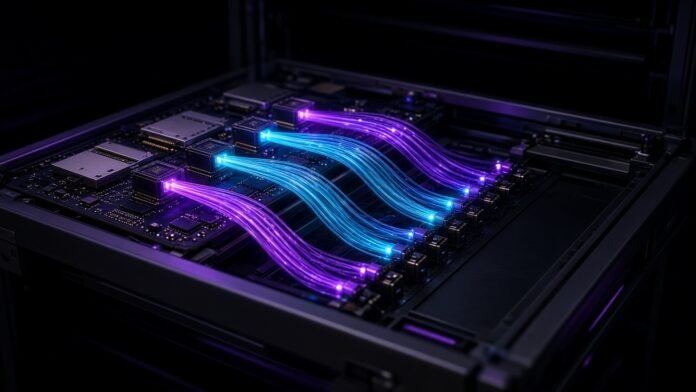
The US photonics company Lightmatter has shown two new rack systems that use light instead of copper to move data, at the Open Compute Project (OCP) Global Summit [1]. One is a network switch tray built with the manufacturer Flex. The other is a compute tray holding four AI accelerators.
Both are showcase and test systems, not products on sale. Lightmatter did not give a price, name any customers or say when they would ship [1].
What is co-packaged optics?
Inside an AI data centre, chips constantly send data to each other. Today that usually travels as electrical signals over copper, then gets turned into light by separate plug-in modules at the front of the equipment. Co-packaged optics (CPO) puts the parts that turn electrical signals into light right next to the chip, in the same package. Less distance means less power wasted and more data in less space.
The switch tray, built with Flex
The first system is a 204.8 terabits-per-second (Tbps) switch tray that fits in one rack unit (1RU), the smallest standard slot height in a rack [1]. Lightmatter said it was developed with Flex as a “production validation system”, meaning a test of whether it can be made at scale. It uses eight of Lightmatter’s Passage CPO engines, powered by its Guide DR laser modules, in a liquid-cooled box.
Lightmatter claims systems like this are “2-4x more efficient in rack faceplate density” than designs using conventional external lasers and fibre harnesses [1]. Chief executive Nick Harris said it “packs the optical bandwidth of a two-to-four rack unit design into one.” These are Lightmatter’s claims.
Colin Chapman, a senior vice president at Flex, said the aim was “to validate a manufacturing path for integrating co-packaged optics into production systems at scale” [1].
The compute tray
The second system is a 102.4 Tbps compute tray holding four accelerator chips and two CPUs, linked by four Passage engines [1]. Lightmatter said the optical links connect as the tray slides into the rack, “eliminating the need for copper connections”. The chassis comes from what Lightmatter called “a major ODM partner”, a contract hardware maker it did not name. Optical connectors come from Corning and fibre from SENKO.
Lightmatter calls this the industry’s first compute tray to carry four accelerators with 102.4 Tbps of optical bandwidth in one rack unit [1]. That is Lightmatter’s claim.
Both designs follow OCP’s open rack standards. Lightmatter said an industry group it backs for open silicon photonics now has more than 20 companies [1].
The market
Brendan Burke, a research director at the analyst firm Futurum, said: “Optics can win a significant share of the nearly $350 billion we forecast for AI networking spend in 2030” [1]. That is Futurum’s forecast. Burke said building these trays to open standards with established manufacturers “creates a path to volume production within two years”. That is his view.
What this means
- Light is moving closer to the chip. Big AI systems need ever more bandwidth, and copper is hitting its limits.
- These are demonstrations. No prices, buyers or shipping dates were given.
- The big claims are Lightmatter’s. The “first” and efficiency figures have not been independently tested.
Sources
- PR Newswire (Lightmatter release), “Lightmatter Delivers Open Rack CPO Switch and XPU Scale-Up Server Through Independent Collaborations with Flex and Other Industry Partners”, 12 October 2026. https://www.prnewswire.com/news-releases/lightmatter-delivers-open-rack-cpo-switch-and-xpu-scale-up-server-through-independent-collaborations-with-flex-and-other-industry-partners-302906361.html